Do I Need a Barre at Home? What You Actually Need to Start Barre
Chrissy Sundt · Mindful Movement ·
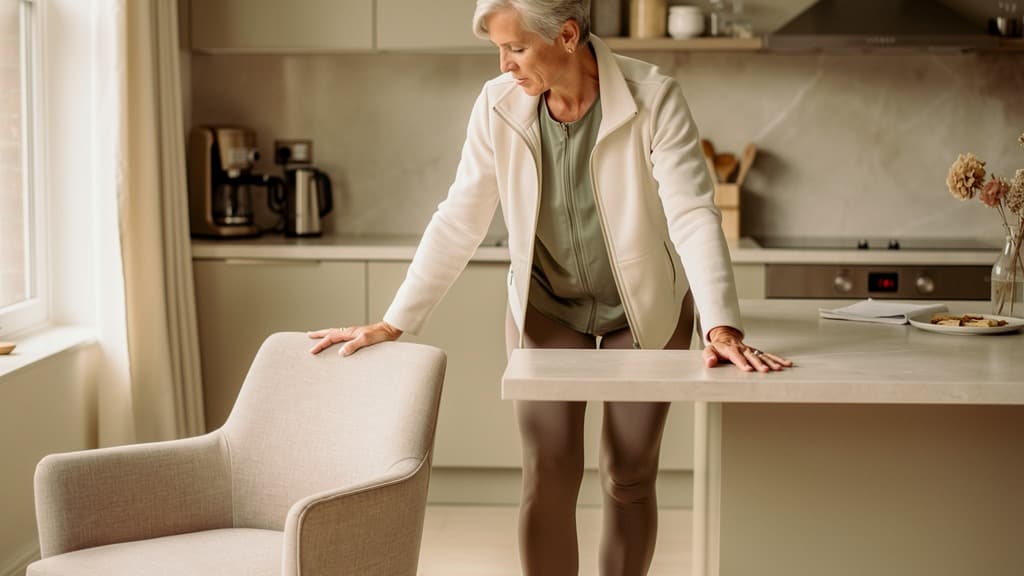
No. Barre at home doesn't require a proper ballet barre. A sturdy kitchen counter, a solid chair back, or even a wall gives you the same balance aid a studio barre does. What actually matters is the quality of the movement, small and controlled, using the support only for stability, never as a piece of kit to buy before you begin.
Do you actually need a barre to do barre workouts at home?
Here's the honest answer: no. The barre itself is not the exercise. It's a prop, there to give you one point of contact so you can balance while the real work happens somewhere else in the body. In a studio, that prop happens to be a fixed wooden rail. At home, it can be almost any sturdy, waist-to-hip height surface that isn't going anywhere.
This is worth sitting with, because it's the thing that stops a lot of women before they even start. If the word barre conjures a proper studio, mirrors, a sprung floor, it's easy to assume you need to recreate that whole setup before you're allowed to try. You don't. You need somewhere stable to rest a hand, and about the same amount of floor space you'd need for a yoga mat.
What the barre gives you is confidence, not difficulty. Holding on lightly means you can go deeper into a hip hinge, hold a longer balance, or work through a full range at the ankle and knee without worrying about tipping over. Take the barre away entirely and most people simply grip harder, stand more stiffly, and get less out of the same movement. The support isn't a crutch. It's what lets the actual work happen.
So the real question isn't do I need a barre. It's do I have something at home that can do a barre's job. For almost everyone, the answer is already sitting in their kitchen or hallway.
What can you use instead of a proper ballet barre?
Anything that is sturdy, stable, and roughly hip height will do the job. The test is simple: could you lean your body weight into it without it sliding, tipping, or rolling? If yes, it works as a barre.
A kitchen counter is usually the easiest option, because it's already the right height for most adults and it isn't moving. The back of a solid dining chair works well too, ideally one with some weight to it rather than a flimsy folding chair that will slide across the floor the moment you shift your weight. A stair rail, a heavy console table, or even a wall you can press a palm flat against for balance, all of these will get you through a session.
What doesn't work as well: anything with wheels, anything on a soft rug that can skid, or furniture that wobbles when you touch it. It's less about finding the perfect object and more about ruling out anything that could move unexpectedly mid-balance. Test it before you start, push down on it the way you would mid-exercise, and if it holds firm, you're set.
It's also worth knowing you don't need the same support for the whole session. Some women use the counter for the standing series and then move to the floor or a mat for core and stretching work, where no support is needed at all. The barre substitute is only relevant for a portion of what you'll actually be doing.
Is barre actually ballet? Do I need any dance experience?
No, and this is one of the biggest misconceptions holding women back from trying it. Barre as a fitness discipline is inspired by ballet, it borrows the idea of a supported standing position and small, precise ranges of movement, but it is not a ballet class. There's no choreography to learn, no positions with French names you're expected to already know, and nobody is watching your turnout.
What barre actually asks of you is much simpler: small, controlled movements, held or pulsed within a limited range, working muscles through positions they don't usually get challenged in. A tiny lift of the heel. A short pulse in a bent-knee stance. A slow lower and lift of the leg while holding the counter. None of it requires flexibility, grace, or a background in dance. It requires patience and a willingness to move in a smaller, more deliberate way than you might be used to.
This matters especially in midlife, when a lot of us are looking for training that doesn't demand we throw ourselves at intensity to feel like it's working. Barre's small ranges and steady tempo mean the effort comes from control and repetition, not from flinging the body around. You don't need dance experience for that. You need a chair, twenty minutes, and a willingness to feel a new kind of effort.
If the word barre has been putting you off because it sounds like a class you'd feel out of place in, that's the part to let go of first. The equipment question and the ballet question are really the same worry wearing two different outfits, and neither one should keep you from starting.
What else, beyond a chair, actually helps at home?
Once you've sorted your support, the rest of the list is short. You don't need a home gym. You need a bit of clear floor, something to stand on, and clothes you can move in.
A mat helps for the floor-based portion of a session, anything with a bit of grip and cushioning is fine, you don't need a specific brand or thickness. Bare feet or grip socks are usually better than trainers for barre work, because so much of it involves feeling the floor through small shifts in the arch and ankle, something a cushioned trainer sole tends to mute.
Space-wise, think arm's reach in every direction rather than a whole room. You need enough room to extend a leg to the side and swing an arm without hitting furniture, which in most homes is a clear patch roughly two metres square, in a hallway, beside a bed, or in front of the sofa once it's pushed back a little.
The one thing worth actually buying, if you decide you enjoy it, is a proper yoga mat if you don't already own one, since the wrong surface can make floor work uncomfortable on wrists and knees. Beyond that, resist the urge to shop before you've tried a session. A counter, a mat, and twenty minutes cost nothing and tell you far more about whether this suits you than anything you could buy.
What does a 20-minute Awaken Barre session actually ask of your space and gear?
Inside Awaken Barre, sessions are built around roughly twenty minutes, deliberately kept short and precise. That window is designed to fit into an ordinary home without any special setup, which is part of why the barre question comes up so often. Women want to know what they're actually walking into before they press play.
In practice, that means a kitchen counter or sturdy chair for the standing series, a mat or a rug for the floor-based core and mobility work, and enough space to step a foot out to the side. No studio, no mirror, no proper barre bolted to a wall. The sessions are built around what a real home actually has, not around equipment most people would need to go out and buy first.
This matters because the barrier to starting barre was never really about kit. It's usually about not knowing whether you'll feel foolish, whether your knees will keep up, or whether twenty minutes can genuinely do anything. Removing the equipment question is meant to remove one more reason to keep postponing.
If you've been putting off trying barre because you pictured a studio setup you don't have at home, that's worth reconsidering. A chair and a bit of floor space is the whole ask. What Awaken Barre adds on top of that is the structure, the sequencing, and twenty minutes that fit around a life that's already full.
Common questions
Do I need to buy a proper ballet barre before starting?
No. A sturdy kitchen counter, a solid chair back, or a wall you can press a hand against will do the same job as a studio barre. Buy one later if you decide you love it, not before.
What if my chair or counter feels wobbly?
Test it first by pressing down firmly the way you would during a balance move. If it slides, tips, or wobbles, choose something heavier or use a wall instead. Anything on wheels or a soft rug is worth avoiding.
Do I need special shoes for barre at home?
No. Bare feet or grip socks are generally better than trainers, since barre relies on feeling small shifts through the arch and ankle that a cushioned sole tends to dull.
Is barre the same as ballet, and do I need dance experience?
No to both. Barre is inspired by ballet's supported standing positions but involves no choreography and no dance background. It's small, controlled movement, not a dance class.
How much space do I actually need?
Roughly a two metre square clear patch, enough to extend a leg to the side and swing an arm without hitting furniture. Most hallways, bedrooms or living rooms already have this.