Do You Need Dance Experience for Barre? The Honest Answer for Midlife Beginners
Chrissy Sundt · Mindful Movement ·
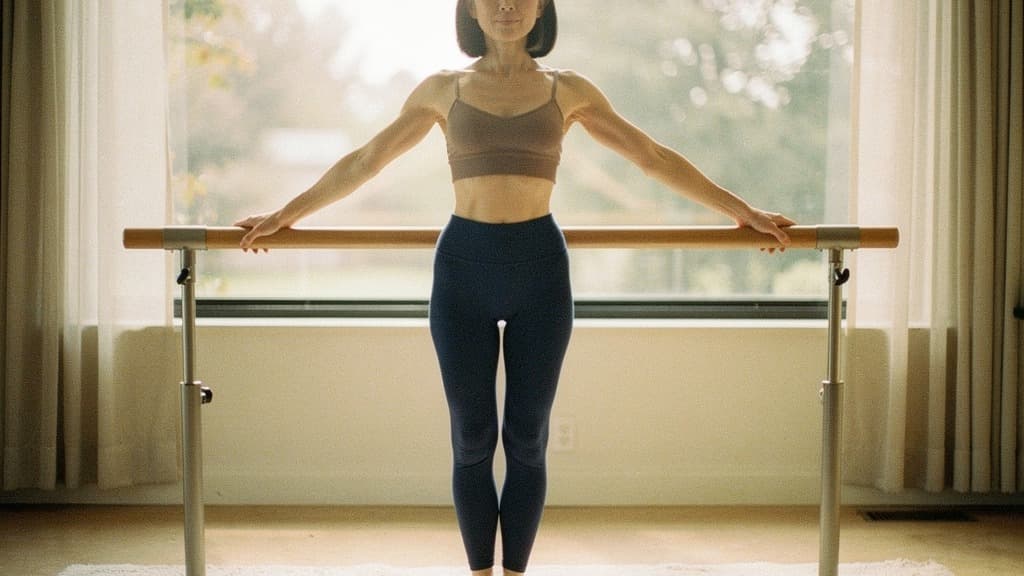
No. Barre is a fitness discipline inspired by ballet, not a dance class, and the barre itself is simply a balance aid, much like the back of a sturdy chair. You need no dance background, flexibility or prior fitness level. In midlife, willingness to move slowly matters more. Beginners often start with [online barre classes for women over 50](/blog/online-barre-classes-for-women-over-50-uk).
Isn't Barre Just Ballet For Grown-Ups?
It's the question sitting underneath the actual question, and it's a completely fair one to ask. Barre borrows its name from the ballet barre, and some of its shapes echo positions you might remember from watching a dance class through a studio window years ago. So the assumption makes sense: surely you need some kind of dance background just to keep up?
You don't, and this matters enough to say plainly. Barre is a fitness discipline inspired by ballet, not a replica of a dance class. There's no choreography to memorise, no routine performed for an audience, and nobody checking whether your toes are pointed correctly. What barre borrows from ballet is the posture and the precision, the idea of small, controlled movement done with intention, not the dancing itself.
In an actual class, the language reflects that. Instead of French ballet terminology, cues tend to describe what to feel: a lift through the seat, a squeeze through the inner thigh, a lengthening through the spine. You won't be corrected for turnout or asked to point a toe with balletic precision. If anything looks like a ballet position, it's being used as a shape to load a muscle safely, not as a performance skill to master.
What The Barre Is Actually For
The bar itself is a far more ordinary object than the name suggests. Picture the back of a sturdy kitchen chair. That's essentially its job: something at hand height to hold onto while you work through a small, controlled movement, nothing more theatrical than that.
You're not using it to strike a pose or hold an elegant line. You're using it because having a support under your hand frees you to focus entirely on the muscle you're actually working, rather than spending your concentration on staying upright. Take that support away too early and most beginners, dancers or not, wobble. That's exactly why it's there.
In practice, the bar tends to come and go through a session rather than being used the whole way through. You might spend part of a class standing side-on to it, one hand resting lightly at around hip height, working through small movements in the leg furthest from the bar. Later sections often move to a mat on the floor, where the bar isn't involved at all and the work shifts to the core and upper body instead. Nobody expects you to hold a particular grip or angle; the hand is there to steady you, not to demonstrate technique.
What You Actually Need Before Your First Class
None of it is dance related. Here's the real list.
Notice what isn't on that list. No mention of coordination, no mention of having 'a dancer's body', no mention of already knowing how to point a toe. None of it is required, because none of it is what barre is actually testing.
A few practical details make the first session smoother, though none of them are barriers if you don't have them yet. Arriving five or ten minutes early gives you time to find a spot near the bar and get your bearings before the class starts. Grip socks help on a smooth studio floor if bare feet feel unstable, though bare feet work perfectly well too. If there's a joint or area you'd rather move carefully around that day, mentioning it to the instructor beforehand means they can point you toward a comfortable variation of any move where that matters. None of this is about passing a test before you arrive; it's simply what makes settling in easier.
- No dance background of any kind, past or present
- No particular flexibility; that develops over time, it isn't a prerequisite
- No existing fitness level; barre meets you where your body is now
- Comfortable clothes, bare feet or grip socks, and a little floor space
- A willingness to move slowly and actually pay attention to what you're doing
Why This Matters More In Midlife, Not Less
If your body has changed over the last few years, and for most women in perimenopause it has, you've probably already noticed that pushing harder doesn't get you the results it used to. What tends to help more is patience rather than force, and consistency rather than intensity. A method built around control rather than momentum tends to fit that reality far better than one built around going faster or harder.
That's also why sessions built around 20 minutes aren't a compromise, they're the point. Not less ambition, more intelligence. Twenty minutes is enough time to work properly through the deep, stabilising muscles that barre targets, without tipping into the kind of prolonged intensity that's hard to fit into an already full day.
In practice, this means a typical set might involve holding a position for several breaths before adding a small pulse, rather than rushing through a count of repetitions. The pace gives you time to notice whether your weight is even through both feet, whether your shoulders have crept up toward your ears, whether you're gripping muscles that don't need to be working yet. That kind of attention is hard to access at speed. It's available at 20 minutes of controlled movement in a way it simply isn't in a class built around constant motion.
What If You've Fallen Out Of Exercise Completely?
This is probably the bigger barrier, and it has nothing to do with dance at all. If it's been months, or years, since you did anything structured, walking into any class, barre or otherwise, can feel exposing. The fear usually isn't 'will I know the steps', it's 'will I look like I don't belong here'.
You will belong there. Awaken Barre was built as a beginner-friendly starting point for exactly this situation: women in midlife whose bodies have changed and who want to rebuild strength, energy and confidence again, without needing to already be fit, flexible or coordinated before they start. You don't need to recognise your old fitness routine, your old stamina or your old flexibility to begin. You just need to show up and start where you actually are.
None of that means pretending the nerves aren't real. It's fine to tell the instructor beforehand that it's your first class, if that helps you settle. You won't be asked to demonstrate anything, explain your fitness background, or catch up to a pace that's already underway; every class starts from the same beginning point, whoever is in the room. The only expectation is that you turn up and follow along at whatever pace your body wants to move at that day.
You may also find is barre good for menopause and restorative movement for midlife women useful alongside this.
Common questions
Do I need to be flexible to start barre?
No. Flexibility tends to improve as a result of practising barre regularly; it isn't a prerequisite for walking in the door. Most beginners start with tight hips, stiff shoulders or a hamstring that hasn't touched their toes in years, and that's entirely normal at the start, not a sign you're in the wrong place.
I've never taken a fitness class before, will I be able to follow along?
Yes. Barre movements are small, controlled and repeated within a session, which makes them far easier to follow than fast-paced cardio or memorised choreography. Cues focus on where you should feel the movement in your body, rather than on remembering a complicated sequence of steps.
Is barre the same as a ballet fitness class at my gym?
Not necessarily; barre classes vary considerably between studios and gyms. MMM Barre, the discipline behind Awaken Barre, is built specifically around strength and mobility for midlife bodies, using ballet-inspired positions as tools for stability and control rather than as the main focus of the class.
How long is a typical session?
Around 20 minutes. That length is deliberate: precise work for the deep core and stabilisers, easy to keep midweek. For weekly rhythm, read [how often should I do barre](/blog/how-often-should-i-do-barre).
What should I wear or bring to a barre session?
Comfortable, fitted clothing you can move in, bare feet or grip socks, and a small patch of floor space near something sturdy to hold onto. No dance shoes, no specialist kit and no prior barre experience required.