Barre for Beginners Over 50: How to Actually Start
Chrissy Sundt · Mindful Movement ·
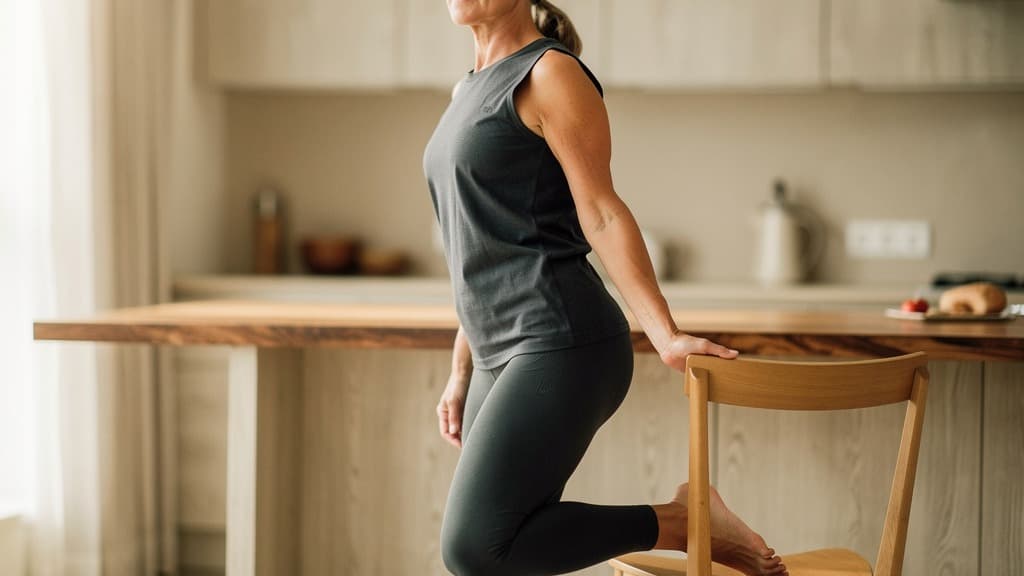
Barre for beginners over 50 is a low-impact strength and mobility practice inspired by ballet, using a chair or wall for balance rather than any dance skill. Sessions run around twenty minutes and build core strength, stability and confidence through small, controlled movements. No dance background, no jumping, and no need to get up and down off the floor.
Do I need any dance experience to start barre?
Barre gets its name from the wooden rail dancers use, and that is where the connection to ballet ends for our purposes. You will not be asked to point your toes, remember a sequence, or move with any particular grace. Barre for beginners uses the discipline's small, controlled movements, the pulses, the holds, the slow lifts, because they build strength and stability without asking your joints to do anything sudden or jarring.
The barre itself is not a skill you need to master. Think of it the way you'd think of the back of a sturdy dining chair: something to rest a hand on while you find your balance, nothing more. In a home practice that is often exactly what it is, a kitchen chair instead of a studio rail. It holds you steady while your legs and core do the actual work.
If your last experience of structured movement was a gym class that left you self-conscious, or you have simply never done anything that felt like dance, that history has no bearing here. Beginners arrive with stiff hips, a weak grip, a wobbly single-leg balance, all of it. The starting point is wherever your body is now, not wherever a class assumes it should be.
Is it too late to start barre in your 40s or 50s?
It is not too late, and the question itself is worth examining. Midlife is often framed as a body running out of road, something to manage rather than train. That framing is wrong. Your body isn't broken, it's evolving, and the workouts that felt effective at twenty five were built for a nervous system and a hormonal landscape you no longer have. Starting barre now isn't catching up, it's choosing the right map for the terrain you are actually standing on.
Training that leaves you flattened for the rest of the day isn't a badge of honour, it's just poor training. Barre's small, controlled ranges of movement build genuine strength, deep core engagement and better balance, without demanding that you empty the tank to get there. It looks gentle and works hard in exactly the right places.
Starting later also means you bring things a twenty five year old body doesn't have: patience, self awareness, the sense to notice what a movement is actually doing rather than racing through it. Those are advantages, not compensations. Nothing about beginning barre at this stage of life needs justifying to anyone, least of all yourself.
What does a beginner barre session actually involve?
A typical beginner barre session runs around twenty minutes, and that length is deliberate rather than a compromise. It usually opens with standing work at the chair, small pulses and lifts through the legs and glutes, then moves through core focused sequences, and often finishes with some floor or mat based work for the deep abdominals and a stretch.
Every movement is repeated in small pulses rather than big showy ranges, which is where the actual work happens. You will feel a particular kind of shake in the muscle being targeted, that's normal and not a sign you are doing it wrong. Instructors typically offer modifications throughout, a wider stance, a lower range, holding the chair with both hands instead of one, so the same sequence works whether it is your first week or your fiftieth.
None of it requires getting up and down off the floor repeatedly, which matters if that is currently uncomfortable for your knees. Most of the standing work stays standing, and where floor work does appear there are usually options to do it seated or against a wall instead.
- Standing leg lifts and small pulses at the chair, working the outer hip and glutes
- Small range plie style bends through the knees, working the inner thighs with no jumping
- Heel raises for calf and ankle stability, useful for everyday balance
- Core sequences, often seated or lying, for the deeper abdominal muscles rather than just the surface ones
- A short stretch or release to finish
What can barre actually do for a changing midlife body?
Barre won't fix or reverse anything, and it isn't designed to. What consistent practice can build is capability: a stronger deep core, steadier balance, more comfortable movement through your hips and spine, and the kind of everyday strength that makes carrying shopping, getting up from the floor or standing for a long stretch feel less effortful.
Barre's small, controlled movements work more than just the surface abdominal muscles you can see, they also engage the deeper muscles that support your spine and pelvis. Building that kind of strength is less about force and more about patience, precision and repetition, which is part of why barre suits this stage of life so well.
There is also what it does for how you experience your own body, separate from any physical measure. Rebuilding a movement habit after time away, noticing you can hold a balance a little longer or lift a leg with a little more control, tends to change how capable and steady you feel generally, not just during the twenty minutes of the session itself.
How do you start barre at home without a studio or equipment?
You need less than you'd think: a sturdy chair or a section of kitchen counter, enough floor space to stand with your arms out to the side, and around twenty minutes. No leotard, no dance shoes, no studio membership. Bare feet or grippy socks and comfortable clothes you can move in, that's the full kit list.
Missed sessions don't erase progress, this isn't a streak you're protecting. Returning after a week off matters more than never having stopped. Two or three short sessions a week, done consistently over a few weeks, will tell you more about how barre suits your body than one intense session ever could.
That's the structure Awaken Barre is built around, beginner friendly barre sessions of around twenty minutes, designed for a body in midlife rather than adapted from a class meant for someone twenty years younger. Each session builds on the last, so you are never guessing what to do or wondering if you're ready to start.
Common questions
Do I need any ballet or dance background to try barre?
No. Barre borrows small, controlled movements from ballet training, but the barre itself is simply something to hold for balance. Beginners with no dance history at all can start straight away; the barre is a balance aid, not a skill test.
What equipment do I need to start?
A sturdy chair or a wall, comfortable clothing, and about twenty minutes is all you need to begin. No mat, weights or studio kit required at the start.
How often should a beginner do barre?
Two to three sessions a week is a solid starting point, done consistently rather than intensely. Missing a session here and there doesn't undo progress, coming back to it does the work.
Is barre high impact or hard on the joints?
Barre is low impact by design, there's no running or jumping involved. Movements are small and controlled, with modifications available if kneeling or floor work isn't comfortable yet.
Will barre help with balance and stability?
Regular practice builds standing balance and core stability through repeated small holds and shifts of weight. It's a gradual capability that improves the more consistently you practise.