Barre Classes in Belfast for Midlife and Perimenopause: What Actually Helps
Northern Ireland, United Kingdom
Yes, barre classes exist across Belfast, and some are taught well for a midlife body. The difference is pace, modification and a teacher who understands why energy and joints behave differently now. If your search hasn't turned up the right fit yet, an on-demand programme built specifically for this stage is a genuine alternative worth trying.
Is there barre in Belfast for a midlife body? Here's what to check
Belfast has no shortage of barre classes, in studios, gyms and community centres across the city. If you've searched for one because you're navigating perimenopause, that instinct is a good one. A well-taught barre class, done at a sensible pace, can genuinely suit a changing body. What matters is whether the specific class you find has actually been built with your stage of life in mind, and that takes a bit of digging beyond a timetable listing.
Start with pace. A class that moves through positions quickly, with barely a pause between sets, can be a poor match for a body that needs longer to recover between hard efforts. Ask how much of the class is spent recovering versus working, and whether the teacher builds pauses into the format as standard, for everyone, every week.
Modification matters just as much, and how it's offered matters more than whether it exists at all. A throwaway line from the front of the room, telling the class to ease off if needed, is very different to a teacher who checks in directly, adjusts a stance, or quietly offers an easier version of a move. Ask, before you book, how the instructor handles a day when your knees or your energy aren't cooperating.
None of this requires a teacher with a medical background. It requires curiosity about how a midlife body actually shows up to class, and a willingness to slow the whole room down when it's needed, so no one person is treated as the exception.
- Ask how much of the class is spent recovering versus working
- Check whether modifications are a genuine, built-in part of the format
- Ask the teacher directly how they'd adjust for a low-energy or sore-joint day
- Look for a class time that doesn't force a trade-off with sleep
Why a class that used to work doesn't always work now
Plenty of women reach their late forties or fifties and find that a class they've done for years no longer sits the same way. The same effort can land differently on a body that has changed: a workout that used to leave you buzzing might now leave you flattened for the rest of the day, and a hard session on Tuesday can still be felt on Friday.
Energy also gets less predictable. A pace that felt manageable every Monday for years can suddenly feel like too much on a week when sleep has been patchy, often with no obvious reason for the difference from one week to the next. That kind of unpredictability has a practical consequence: a class built around one fixed intensity, week after week, stops working as well as it once did.
The practical response is to choose a class, or a way of moving, that flexes with how you actually feel that day: one where going gently on a low week doesn't mean falling behind, and where a slower session still counts as a session. Recovery becomes as much a part of what you're choosing a class for as the workout itself.
This comes down to practice. Nobody needs to explain what's happening in your body to justify choosing a gentler pace on a given day. Noticing how you feel during a class, and the day after it, is reason enough to choose differently.
- A workout leaves you flattened for the rest of the day
- Soreness lingers for two or three days
- The same weekly pace suddenly feels too hard, with no obvious reason why
- You start dreading a class you used to look forward to
When Belfast doesn't have the right fit, and what to do instead
Sometimes, even in a city the size of Belfast, the class that fits this stage of life simply doesn't exist yet locally. The timetable might clash with work or the school run, and the teacher might never have adapted anything for a body going through perimenopause. That's a genuine gap, and plenty of women searching for the same thing will recognise it.
This is where an on-demand programme built specifically for this stage earns its place. It doesn't ask you to be at a particular studio at a particular hour. A session done at half six before the rest of the house is awake works just as well as one done at ten at night after a late shift, and both count.
That matters for shift patterns, for anyone working across time zones, and for weeks when childcare or caring for a parent makes a fixed class time hard to commit to. The format doesn't change depending on where you are or when you can get to your mat. It's available whenever twenty minutes exist in your day.
None of this makes a good local class less valuable if you find one. It simply means the search doesn't have to end in frustration if Belfast hasn't produced the right fit yet. There's a genuine, well-built option that works from home, on your own schedule, whenever you need it.
- Works before the house wakes up or after a late shift ends
- No commute or fixed class time to build a week around
- A low-energy day still gets a session, even a gentle one
- Fits shift patterns and different time zones without adjustment
What Awaken Barre actually is
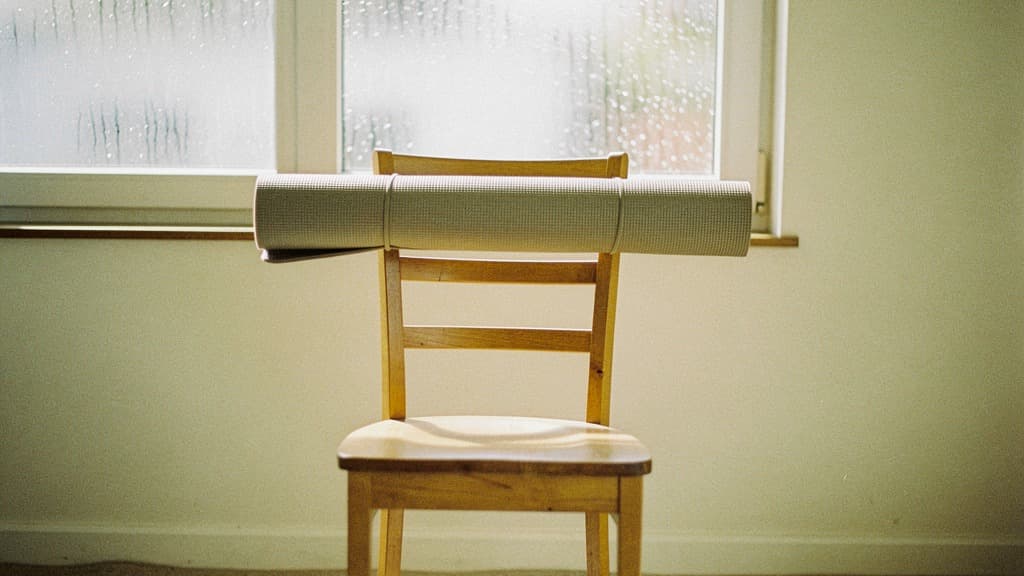
Awaken Barre is a barre-based strength and mobility programme, part of The Midlife Movement Method, done at home with a mat and a sturdy chair. Barre, in this context, is a fitness discipline that borrows positions and shapes from ballet training, not a dance class, and no dance background is needed to follow a session. Sessions run around twenty minutes.
It's taught by Chrissy Sundt, who has spent more than twenty-five years working in movement as a barre and Pilates trainer, and who is navigating perimenopause herself right now. That matters practically: the pace and format have been tested against her own changing energy and recovery, week to week, as she builds each session.
The sessions favour precision and control over doing lots of repetitions, with a focus on strength, balance and mobility that a chair-assisted format makes accessible without needing to get down onto the floor for every move. Twenty minutes is treated as a deliberate length, not a compromise: short enough to fit into a full day, long enough to be worth doing.
None of this is presented as treatment for perimenopause or a fix for anything specific. It's a movement practice built around what women navigating this stage have said they actually need from a workout: something that fits the time available, doesn't demand recovery time you don't have, and can be done in whatever space has room for a mat and a chair.
- Around 20 minutes per session
- Needs just a mat and a sturdy chair
- Barre positions adapted for strength and mobility, no dance experience needed
- Taught by a Barre and Pilates trainer with 25+ years in movement
Common questions
Do I need any dance experience for barre?
No. Barre borrows positions and shapes from ballet training as a way of building strength, balance and control, but it's taught as a fitness format. If you've never done a plié in your life, you can still follow a full session.
Is there a barre studio in Belfast that specialises in perimenopause?
There are barre classes across Belfast, but we can't point you to one built specifically around perimenopause as we don't have that local knowledge. Use the checklist above, pace, modification, a teacher who asks questions, when you're weighing up options near you.
Where is Awaken Barre taught from?
It's entirely online. There's no studio, no in-person class and no teacher based in Belfast or anywhere else physically. Sessions are recorded and followed at home, on your own schedule.
What equipment do I need?
A mat and a sturdy chair for balance support. Nothing else is required to get started.