Why Do Women Lose Strength, Not Tone, in Midlife?
Chrissy Sundt · Mindful Movement ·
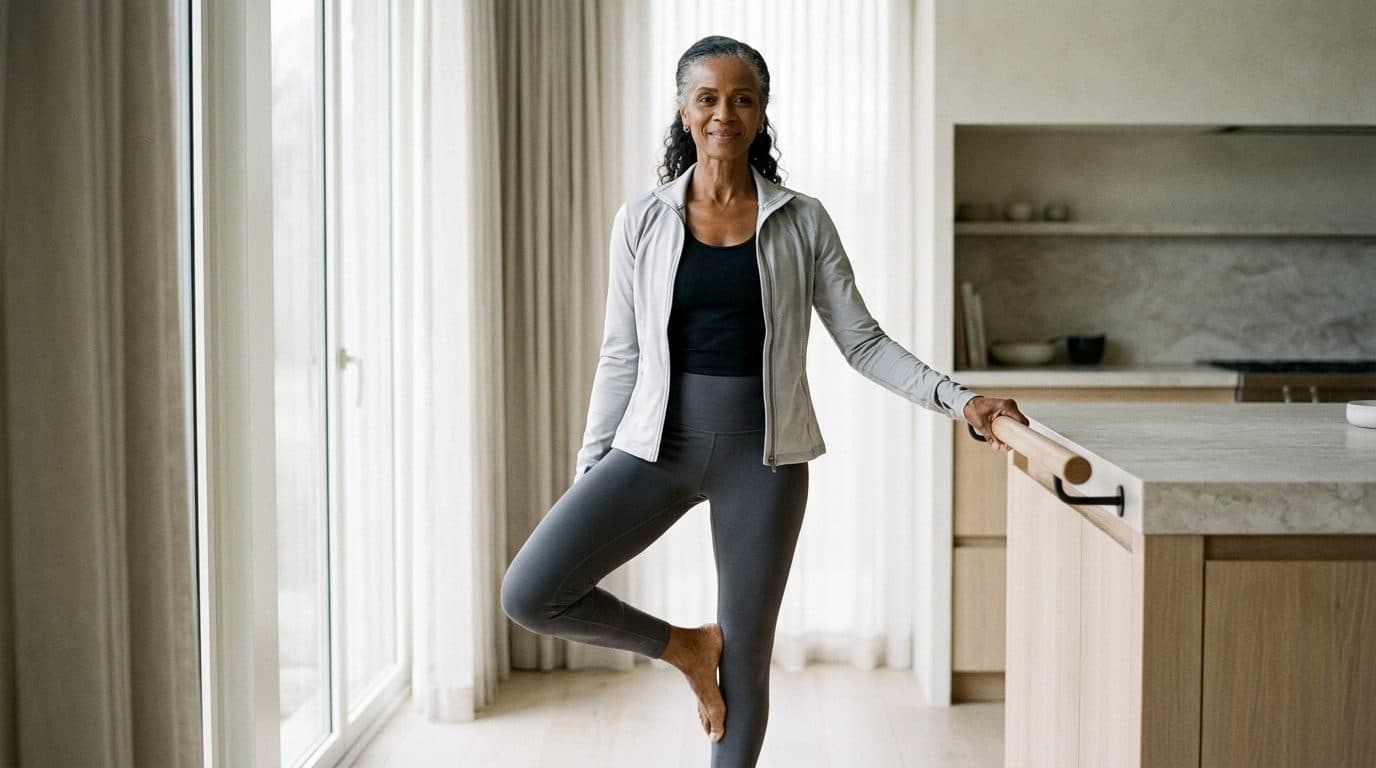
Tone isn't a measurable property of muscle, so what you're sensing as 'losing tone' is really a drop in strength: less force your muscles can produce, slower recruitment, and a nervous system that no longer fires the way it did at thirty. The fix isn't firmer muscles, it's rebuilding the strength and control underneath them.
Is It Really 'Tone' You're Losing, or Is It Strength?
Muscle tone, in the strict physiological sense, is the small amount of tension a muscle holds even at rest. It is not a meaningful measure of fitness and it was never something you could train directly. When women in midlife say they feel they have lost tone, what they are usually describing is something else entirely: a real drop in strength, the amount of force a muscle can produce when you ask it to.
That mislabelling matters because it points you towards the wrong fix. Tone implies firmness, so the instinct is to reach for exercises that make muscle feel tighter in the moment: small isolated movements, lighter resistance, more repetitions. Strength is a different thing to build. It is how much weight you can lift, how fast you can stand up from a low chair, how steady you are on one leg at the bus stop. Those are capacities you can measure in daily life, and they respond to a different kind of training.
This is also why the change can feel sudden even though it has been building for years. You do not notice a slow decline in force production the way you notice a dress that no longer buttons. You notice it on the day you cannot get the suitcase into the overhead locker without help. Mindful movement for midlife women is built around training that develops real capacity first, letting how firm a muscle feels come second.
Why Does Strength Slip Even When Your Routine Hasn't Changed?
Plenty of women doing exactly what they did in their thirties, the same classes, the same step count, the same weights, still watch their strength decline. The effort was never the problem. The training had stopped matching the body it was written for.
Exercise physiologist Stacy Sims has spent her career arguing that women are not small men, and that the same point applies again in perimenopause: training built for a twenty-five-year-old body, or even your own body a decade ago, is the wrong map for the terrain you are standing on now. Recovery takes longer. Connective tissue responds better to patient, controlled loading than to repeated high-intensity effort. The nervous system that once fired muscle fibres quickly and reliably needs more consistent, more precise input to do the same job.
This is a mismatch, not a malfunction: the inputs that used to produce strength now produce fatigue instead, because the stimulus and the recovery either side of it have not been adjusted. Doing more of the same training, more classes, more cardio, usually makes this worse rather than better, because it adds load without addressing what has actually changed in how that load is used. The practical shift is in strength training for women over 50: fewer, more deliberate sessions rather than more volume.
What Does Training Need to Do Differently Now?
If strength, not firmness, is the real target, the practical shift is in what training asks the body to do: produce force through a controlled range, under load, slowly enough that you can feel exactly which part of the body is doing the work. The missing piece is usually precision, not more exercise.
This is where deep core training earns its place, rather than the familiar sit-up or crunch. Real core strength involves the deep stabilising muscles around the spine and pelvis as much as the visible abdominal muscles, and those deep muscles respond best to controlled positions held under tension. Core exercises for women after 40 covers this in more depth, but the principle carries into every part of a session: slow enough to control, loaded enough to matter.
Balance and single-leg stability belong on this list too, as strength training in their own right. Standing on one leg while holding a position at a barre, or stepping through a controlled lunge, asks muscles to stabilise a joint under load in a way a seated machine never will. None of this needs to look dramatic to be effective. The usual marker of good midlife training is that it looks unremarkable from across the room and feels entirely different from the inside.
- Controlled, loaded movement through a full range rather than fast, bouncy reps
- Deep core work that holds and stabilises, not just repeated crunches
- Single-leg balance and stability drills, treated as strength training in their own right
Does Fixing This Mean More Exercise, or Different Exercise?
A common worry at this point is that fixing this must mean finding more hours in a week that already has none to spare, when in fact strength in midlife responds to precision far more than it responds to volume. That is part of why sessions built around twenty minutes can do real work when they are structured with intent rather than treated as a shorter version of a longer workout.
This also answers the question that usually comes next: if an hour of cardio stopped delivering results, doing more of it will not be the fix either. More time spent on training that already does not match your physiology just produces more fatigue for the same return. The better question is what the twenty minutes contains, not how many of them you can fit in.
Missing a week, or several, does not erase what came before. Strength training in midlife is closer to a long-term practice than a streak you cannot afford to break. Returning to it matters far more than never missing a session, and a method built around that reality asks less of your discipline and more of your consistency over time. Low impact strength training for exhausted, busy midlife women was written for exactly this version of the problem, where the limiting factor is energy and time, not willingness.
Where Does Barre Fit Into Rebuilding Real Strength?
Barre fits this picture because of what it asks the body to do. It is a fitness discipline inspired by ballet, and the barre itself is used the way you would use the back of a sturdy chair, as something to steady a hand while the legs and core do the real work. No dance background is needed, and nobody is checking your turnout.
What barre does well for midlife strength is hold a muscle in a controlled position under load for long enough that it has to recruit properly, without momentum carrying the movement. Small range, high control movements at the barre train exactly the kind of force production and stability that tends to slip first: the inner thigh and glute muscles that stabilise the hip, the deep core that holds the spine steady, the calf and ankle muscles that keep you balanced on uneven ground. Can barre replace weights looks at where barre and traditional strength work overlap and where they do not, because the honest answer is that each does a job worth keeping, and together they cover more ground than either on its own.
For a woman who has noticed strength slipping and wants to address that directly, a session built around this kind of controlled, loaded movement is where to start. Consistency over time is what makes it work.
If you want this as movement rather than another article, Awaken Barre is the twenty-minute programme I built for a body that has already changed.
Common questions
Is muscle tone a real, measurable thing?
In the strict sense, tone is just the small amount of tension a resting muscle holds, and it isn't something you train directly or improve with exercise. What people usually mean by 'losing tone' is a change in strength and how a muscle feels and performs under load.
Can strength lost in midlife be rebuilt?
Strength responds to training throughout life, including in midlife, when the training matches what the body needs now rather than repeating what worked at twenty-five. Controlled, loaded movement done consistently is how that capacity is built back up.
Do I need heavy weights to address this, or will barre do it?
Barre and traditional weights both load muscle, just differently: barre uses small range, controlled positions and body weight or light resistance, while free weights add external load directly. Many women use both, since the two approaches complement each other rather than compete.
Why does cardio alone not fix this?
Cardio trains the heart and lungs, not the force production and recruitment that strength depends on. Adding more of it when strength is the issue usually adds fatigue without addressing what has actually changed.