Core Exercises for Women After 40: What Actually Works Now
Chrissy Sundt · Mindful Movement ·
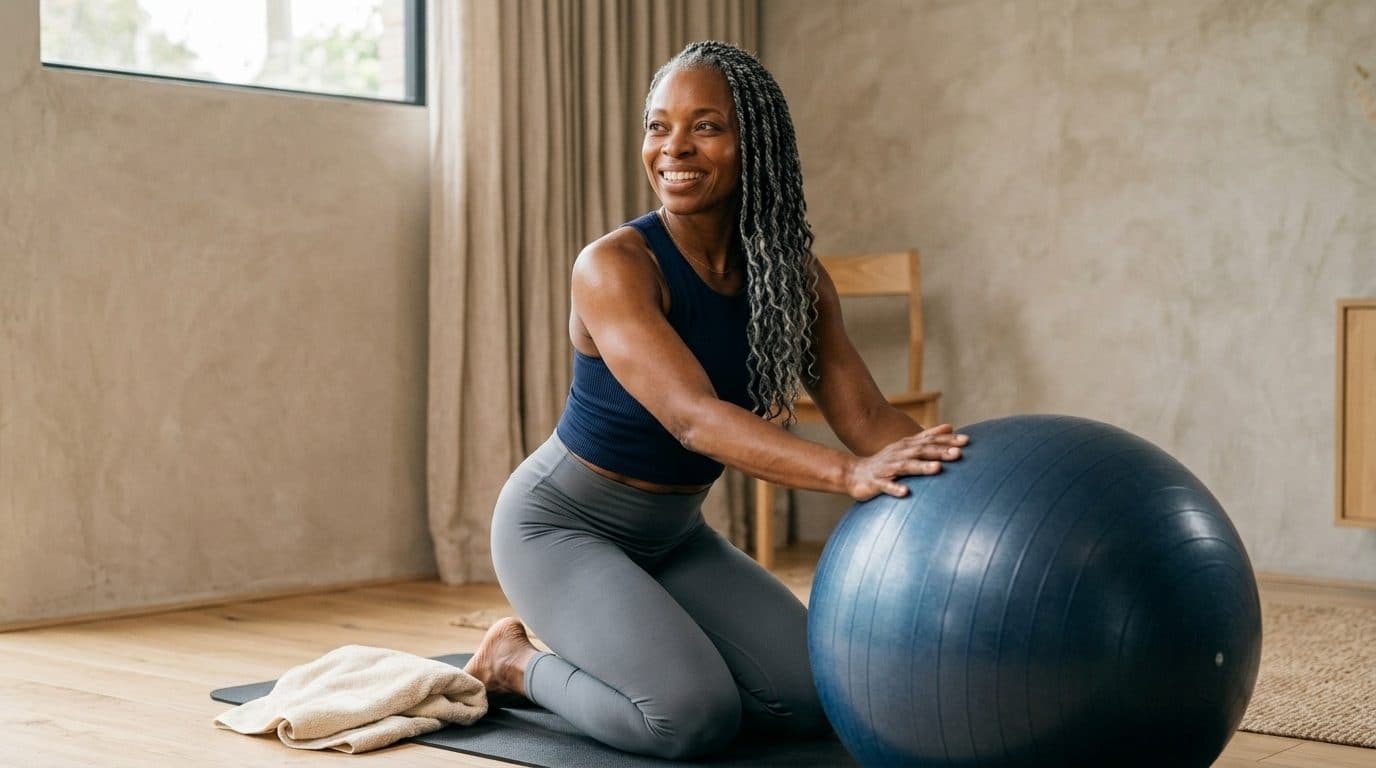
Core exercises for women after 40 work best when they train the deep core as a system, not just visible abs: breath-led bracing, pelvic floor coordination, anti-rotation holds like a plank or dead bug, and controlled rotation. The goal is 360 degree stability held with precision, in short consistent sessions, rather than endless crunches chasing a flat stomach.
What counts as a core exercise once you're past forty?
Ask a trainer what a core exercise is and you'll usually get a demonstration of a plank or a crunch. After forty, that answer is incomplete. Your core is not just the visible band of abdominal muscle at the front. It includes the diaphragm at the top, the pelvic floor at the base, the deep transverse abdominis wrapping around like a corset, and the small stabilising muscles running along your spine.
Chrissy Sundt, who has spent over twenty five years teaching movement and is navigating perimenopause herself, describes this as 360 degree core activation: the deep structures that actually create strength and stability, alongside the superficial abs most people picture. A real core exercise recruits all of it together, through breath, engaging more than just the muscle you can see in a mirror. That's a different job to the one crunches were built for.
In your twenties a flat stomach might have been the whole goal, so isolated crunches did the job you were asking of them. In your forties the job has changed. You need a core that holds you steady when you twist to grab something off a high shelf, that keeps your spine supported when you carry shopping in one hand, that lets you get up off the floor without thinking about it. That's a different exercise entirely.
Why do the core exercises that used to work stop working?
This isn't about losing discipline or letting standards slip. Training in perimenopause works with a different physiology than it did at thirty. Oestrogen supports collagen production, joint stability and how your nervous system recruits muscle. As it fluctuates through perimenopause, the same forty crunches can feel different, or simply stop delivering anything.
Your fascia, the connective tissue wrapped around every muscle, responds to patience rather than force at this stage of life. Your nervous system trusts consistency over sudden intensity. Your deep core, in particular, activates from listening, tuning into a slow, controlled contraction, rather than from pushing through as many reps as you can manage. Rushing a movement you used to do without thinking is often exactly why it now feels harder to find the muscle at all.
Cortisol, the stress hormone, is often already elevated in perimenopause, so training that piles more intensity on top can work against you rather than for you. That doesn't mean going gentle for the sake of it. It means choosing exercises precise enough to genuinely load the deep core without tipping your whole system into another kind of stress it doesn't need.
What does a deep core routine actually look like?
Forget the image of pounding through hundreds of sit-ups. A deep core session built for your forties and beyond starts with breath. You brace by exhaling and drawing the deep abdominal wall in and up, coordinating with the pelvic floor, before you add any load or movement at all. That coordination is the exercise, long before it looks like exercise on the outside.
From there the work tends to fall into a few practical categories, and a session usually threads several of these together rather than doing one in isolation.
None of this needs equipment. A mat and, for balance work, something sturdy to rest a hand on, like the back of a chair, is enough. What matters more than the exercise list is the quality of each rep: can you keep breathing, can you keep the brace as you move your limbs, can you stop the moment your form starts to slip rather than grinding out extra reps. That precision is the actual training effect.
- Breath-led bracing: finding and holding a gentle deep core contraction before you move
- Anti-rotation and anti-extension holds: a plank, a dead bug, a bird dog, where the goal is stillness under challenge, not speed
- Controlled rotation: slow, loaded twisting work once the basics are solid, rather than avoiding rotation altogether
- Integration: carrying that same bracing into a squat, a lunge or a step, so it becomes automatic rather than a separate exercise you do and then forget
How often and how long should you train your core?
Around twenty minutes is a deliberate length, not a compromise you settle for because you're busy. Deep core work is precise rather than high volume, so once you're actually coordinating breath, brace and movement, twenty focused minutes asks more of you than forty minutes of distracted crunches ever did. Three sessions a week is a reasonable place to start, alongside whatever other strength or barre work you're already doing, because the deep core also switches on in the background of most other training.
Consistency matters more than any single session being perfect. If you miss a week because life happened, that doesn't erase what you built before it. What counts is coming back to it. Perimenopause is not a stable, predictable backdrop, and a routine that only works when everything else in your life is calm is not a routine you can actually keep.
Notice too that this isn't about training harder as the weeks go on. Progress here often shows up as being able to hold the brace for longer without losing it, or finding it automatically when you sneeze or lift something awkwardly, rather than as heavier weights or more reps. That's the more useful measure of progress here.
Is it normal for your core to feel weaker in your forties?
It's a common experience, and it makes sense given everything shifting underneath it, from hormones to how much sleep you're getting to old injuries that never quite got rehabilitated properly. Feeling less connected to your midsection than you did at thirty is not a sign that something has gone wrong with you specifically. It's a sign your body is asking for a different kind of attention than it needed before.
This isn't medical advice, and if you're dealing with a specific concern, whether that's ongoing pain, an old injury or anything you're unsure about, a physiotherapist or your GP is the right first conversation to have. What movement can offer alongside that is somewhere to consistently practise coordination, breath and control, in a way that respects wherever you're starting from.
What we teach is education about movement. It isn't a treatment for anything specific. The aim is capability: being able to move through your day, and the decades after it, with a core that supports you rather than one you have to think about constantly. That's a long game, built in twenty minute sessions.
Common questions
Do I need to do crunches for a strong core after 40?
No. Crunches mainly work the surface abdominal muscle. A stronger, more useful core after 40 comes from breath-led bracing, anti-rotation holds and controlled rotation work that trains the deep core as a whole system.
Can I do core exercises without any equipment?
Yes. A mat is enough for most of the work, and something sturdy like the back of a chair helps with balance-based moves. None of it requires a gym.
How long before I notice a difference?
Because sessions are short and precise, many women notice the bracing becoming more automatic within a few consistent weeks, though how quickly that shows up varies. Consistency matters more than any single week.
Is barre good for core strength?
Barre is a fitness discipline inspired by ballet, not a dance class, and it works the deep core continuously through small controlled movements and postural holds, alongside more targeted core work in a dedicated session.
What if I have back pain or a previous injury?
This is not medical advice. If you have pain or a specific injury, speak to a physiotherapist or your GP before starting, then bring that guidance into how you approach any core routine.