Can Barre Replace Weights? What Actually Builds Strength in Midlife
Chrissy Sundt · Mindful Movement ·
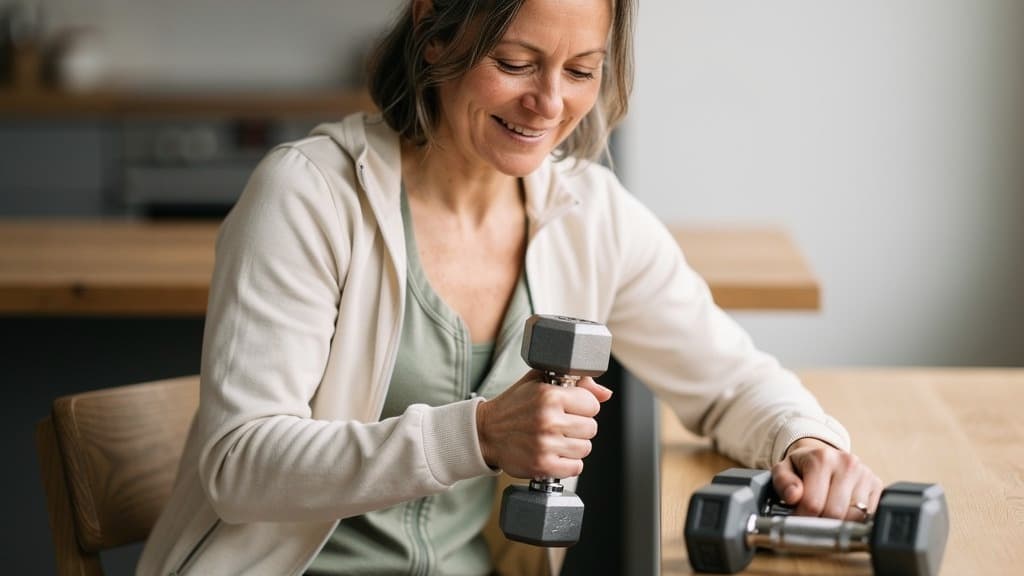
Barre can genuinely replace weights for building strength, because it's resistance training in its own right: body weight, isometric holds and small pulses fatigue muscle without a dumbbell in sight. If your goal is strength, stability and mobility rather than maximal load, barre is a complete practice on its own, not a warm-up for the 'real' workout.
Is barre actually strength training, or just toning?
Barre so often gets filed under 'toning' or 'stretching', and that undersells what's actually happening in a class. When you hold a plié at the base of a pulse, or keep a leg lifted an inch off the floor for thirty seconds, your muscles are working under sustained tension. That is resistance training. The resistance simply comes from your own body weight and gravity, not from a dumbbell rack.
This matters because strength training was never really about the equipment. It's about asking a muscle to work hard enough, for long enough, that it adapts. Barre does this through small range pulses, isometric holds and slow, controlled tempo, which fatigue muscle fibres in a way a quick set of bicep curls often doesn't. It also asks for 360° core activation throughout, not just the superficial abs you'd target in a typical ab routine, but the deeper structures that hold your spine and pelvis steady.
So no, barre isn't lesser strength training dressed up in ballet language. It's strength training built around control, position and time under tension, which happens to be one of the most effective ways to build real, usable strength in a changing body.
What does barre do differently to lifting weights?
With free weights, you build strength mostly through progressive overload: you add plates, the muscle adapts, you add more. It's a simple, effective equation, and there's nothing wrong with it. Barre asks a different question. Instead of adding load, it changes the demand, smaller ranges of movement, longer holds, faster pulses, or a change in tempo, so the muscle is challenged through precision rather than weight on the bar.
This suits where a lot of women find themselves in perimenopause, when energy and recovery can feel less predictable, and a change of pace that favours consistency and control can feel more sustainable than piling on extra intensity. A 20 minute barre session that asks your deep core and stabilising muscles to work with precision can do more for how you feel than an hour spent chasing heavier plates.
That's not a knock on weights. It's a reminder that your body isn't broken or asking less of you, it's asking for a different kind of intelligence. Not less ambition. More precision.
Do I still need dumbbells at home?
If you already own a set of dumbbells and enjoy using them, keep them. Barre isn't asking you to clear them out of the cupboard. But if the question is whether you need to buy weights, build up to heavier ones, or feel like barre alone is 'not quite proper training', the answer is no. Barre on its own, done consistently, is a complete resistance practice.
The barre itself isn't equipment in the way a dumbbell is. It's a balance aid, much like the back of a sturdy kitchen chair, there to steady you through a position so you can focus entirely on the muscle doing the work, rather than on staying upright. That's part of what makes it accessible if you've fallen out of the habit of exercise: there's no equipment to source, no weight to guess at, nothing to work out before you begin.
What builds the strength is the position, the pulse, the hold and the breath, all of which you carry with you into a hotel room, a living room floor, or a class with no kit at all. That portability is a feature, not a compromise.
- No dumbbells or resistance bands required to start
- The barre works purely as a balance aid, not as equipment for load
- Movements travel with you: no kit needed for a hotel room or living room floor
Can barre build real strength in perimenopause?
Perimenopause changes how your body responds to exercise, and pretending otherwise doesn't serve you. Energy fluctuates, recovery can take longer, and a training style that worked in your twenties can leave you flat rather than strong. That's not you doing it wrong, it's your body asking for a different approach for the stage you're actually in.
Barre works with that reality rather than against it. Short, focused, 20 minute sessions are intentional, not a compromise version of a 'proper' workout. The isometric holds and controlled pulses build strength and stability without demanding maximum effort every time you show up. Over time, that shows up as steadier balance, a stronger deep core, and more ease moving through ordinary things, getting off the floor, carrying shopping, standing on one leg to put on socks.
To be clear, barre is movement and strength education, not a medical treatment, and it isn't designed to treat or prevent any specific condition. What it offers is a way to keep building capable, confident strength through a stage of life where your body is recalibrating, not declining.
How will I know it's working if there's no weight going up?
With free weights, progress is easy to see: the number on the plate goes up. Barre asks you to track progress differently, and that can feel unfamiliar at first if you're used to a spreadsheet of personal bests.
Look instead at what you can hold and control. Can you keep a leg lifted through a full set of pulses without your hips dropping? Can you hold a plank thirty seconds longer than you could a month ago? Is standing on one leg to put on trousers less of a wobble than it used to be? Are you getting up off the floor without needing your hands as a springboard? Some women notice it in daily life before they notice it in class: stairs feel less effortful, bags feel lighter, posture holds for longer without thinking about it.
Missed a week? That doesn't erase what you've built. Returning matters more than an unbroken streak, this isn't about perfect attendance, it's about what your body can do the next time you ask it to.
If you want to find out what your body can do with the barre as the only equipment, Awaken Barre is a beginner-friendly place to start.
- Holding a leg lift through a full set of pulses without your hips dropping
- A plank held for longer than a month ago
- Less wobble standing on one leg to dress
- Getting up off the floor without pushing off with your hands
Common questions
Will barre make my muscles bulky?
Barre tends to build long, controlled strength rather than significant muscle bulk, because the resistance comes from body weight, pulses and holds rather than heavy external load. The aim is visible tone and stability rather than size.
Do I need any equipment to start barre at home?
No. The barre itself is a balance aid, similar to the back of a sturdy chair, so you can start with nothing more than a small clear space and bare feet.
Do I need ballet experience to do barre?
None at all. Barre is inspired by ballet positions, but it isn't a dance class and no previous training is expected. Moves are taught from scratch, with the barre there purely to help with balance.
How often would I need to do barre to feel stronger?
Consistency matters more than frequency. A handful of 20 minute sessions a week tends to build strength more reliably than occasional long ones, especially in a body that responds to precision rather than volume.