Mindful Movement for Midlife Women: How to Train With Your Changing Body, Not Against It
Chrissy Sundt · Mindful Movement ·
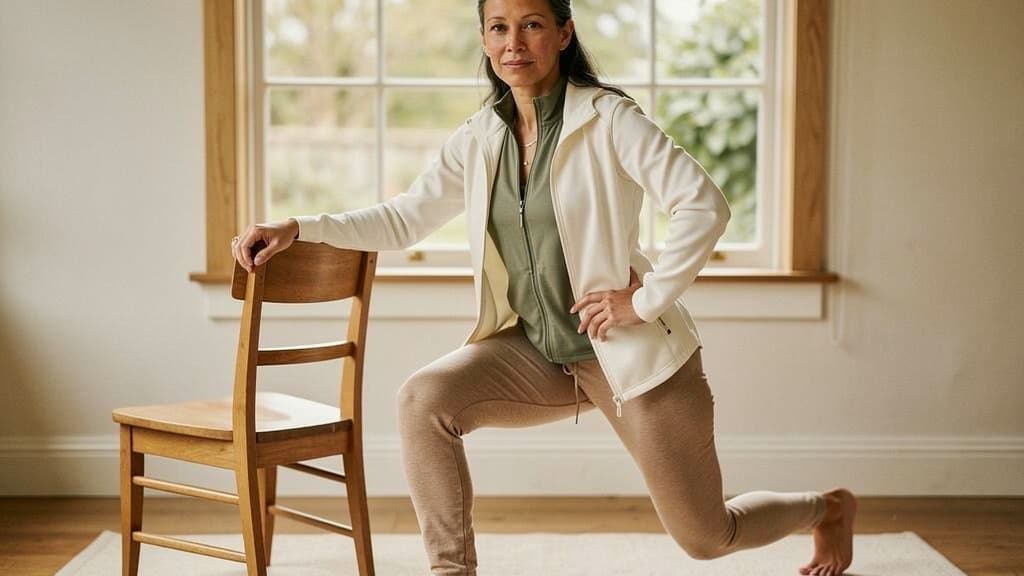
Mindful movement for midlife women means training with attention rather than force: shorter, precise sessions that fit the way your energy and body are changing, rather than pushing through on autopilot. In practice, that is around 20 minutes of focused strength and mobility work, like barre, done consistently rather than intensely.
What does 'mindful movement' actually mean in midlife?
Mindful movement is not about moving slowly for the sake of it. It is about paying attention to what your body is asking for in a given session, rather than running the same routine you did in your twenties and wondering why it leaves you flatter, not stronger. For most of your life, exercise meant volume: more reps, more classes, more sweat. That approach was built for a nervous system and hormonal landscape that does not work quite the same way any more. You are using the wrong map for the terrain you are now on, and pushing harder does not redraw it.
In practice, mindful movement means training with precision instead of force. Your body does not respond to being forced the way it once did, it responds to patience. Your nervous system trusts consistency over adrenaline, especially when it is already carrying more day to day. And your deep core, the structures that actually hold you steady rather than just the ones you can see in a mirror, tends to switch on more readily when you slow a movement down and feel it than when you rush through it.
This is why Mindful Movement sits as one of five pillars in the Method, alongside sleep, nourishment, rest and illumination, and connection. None of them work in isolation, and none of them are about doing more. A short session done with real attention does more for your body than a long one done on autopilot, because presence is part of the training effect, not something separate from it.
Why does the exercise that used to work stop working in perimenopause?
It is common to feel like you have done everything right by the old rules and still find your training has stopped delivering the way it used to. That is not you doing it wrong. It is your body being different to how it was, and the approach that used to work simply has not caught up. Perimenopause changes how your body handles stress, recovery and effort, so a workout style built around pushing hard and resting later can end up working against you rather than for you.
This is where the approach matters. Stacking intensity on top of intensity in this stage of life can leave you feeling more depleted, not less, even when the effort itself has not changed. The more useful move is to keep intensity intelligent and contained: enough challenge to build real strength, without leaving you feeling wrung out for days afterwards. Your body now seems to respond to precision, not to volume. That is worth taking seriously as a shift in what works for you, not a verdict on your effort or your discipline.
It helps to think of this less as decline and more as recalibration. The training that worked on the old terrain simply needs updating for the terrain you are on now. Midlife is the same kind of update, not a downgrade. The training has to change because the terrain has changed, and once it does, movement can start to feel like it is working with you again instead of something you are gritting your teeth through.
Do I need to be flexible or have dance experience to try barre?
No, and this is one of the most common misconceptions worth clearing up early. Barre is a fitness discipline inspired by ballet, not a ballet class. You do not need any dance background, any particular flexibility, or a leotard. The barre itself is simply a balance aid, used the way you might use the back of a sturdy kitchen chair: something to steady a hand on while your legs and core do the actual work.
A session is built around small, controlled movements and held positions rather than big, showy choreography. Think tiny pulses in a squat, a slow controlled lift of the leg, a held plank variation, rather than anything resembling a routine you would need to memorise or perform. The skill being built is control and stability, not steps. That is precisely why it suits a body that wants strength and mobility without needing to learn a new physical language to get it.
Because nothing about it depends on prior dance training, it tends to meet you wherever you are starting from, including if it has been a long time since you last exercised regularly. The barre gives you something to hold onto, literally, while you rebuild strength and confidence in how your body moves. This is not about how gracefully you move at the barre. It is about what your body can do once you step away from it, in ordinary moments like carrying shopping, getting up off the floor, or keeping pace on a walk.
How much movement do I actually need each day?
Sessions in the Method run to around 20 minutes, and that number is intentional, not a compromise. The instinct in midlife is often to assume that if a little movement helped before, more must help now, especially when energy or time feels tight. But a body that is more sensitive to stress does not necessarily get more benefit from a longer session, it gets more benefit from a well-built one.
Twenty minutes is enough time for a proper warm up, focused strength and mobility work targeting the muscles that actually support your posture and joints, and a deliberate finish, without tipping into the kind of prolonged effort that leaves your nervous system with a bill to pay later. The aim is a genuine training effect: real fatigue in the right places, done in a window your day can actually hold. Not less ambition. More intelligence about where that ambition goes.
This also solves a very practical problem. Midlife life is frequently fuller, not emptier, between work, family, ageing parents, or simply a to-do list that never quite ends. A movement practice that depends on finding a spare hour is a practice that quietly gets skipped. One that fits into 20 minutes before the day properly starts, or in a gap between calls, is one you can actually keep. Consistency beats duration almost every time, and consistency is only possible when the time commitment is realistic.
How do I stay consistent when my energy is unpredictable?
Energy in this stage of life is genuinely unpredictable, and building a movement habit around the assumption that you will feel the same every day sets you up to feel like you are failing when you do not. The more useful assumption is the opposite one: some days will be strong, some will be flat, and both are normal inputs, not evidence that something has gone wrong.
Missed sessions do not erase progress. This is not a streak-based habit where one gap sends you back to zero, it is closer to a practice you return to, again and again, for as long as it stays useful to you. What matters far more than perfect attendance is whether you come back after the days you miss. That single habit, of returning without guilt, does more for long-term consistency than any amount of willpower on your best days.
A few practical anchors help. Attach the session to something that already happens daily, like right after you make coffee, so it does not depend on remembering. Keep a genuinely low-effort version in your back pocket for the flattest days, mobility and breath rather than full effort, so the habit survives even when your energy will not stretch to a full session. And treat rest as part of the training, not a failure of it. This is where Mindful Movement leans on the Method's rest and illumination pillar, the one about recovery and the clarity that follows it: some days the most useful thing you can do is less, done properly, rather than more, done resentfully.
Common questions
Is mindful movement the same as yoga or stretching?
No. Mindful movement describes how you approach training, with attention and precision, rather than a specific style. In the Method it takes the form of barre-based strength and mobility work, not a yoga or stretching class.
What is the difference between MMM Barre and Awaken Barre?
MMM Barre is the name of the movement discipline itself, the barre-based approach at the heart of the Method. Awaken Barre is the actual programme you can join to learn it, built around 20-minute sessions.
Do I need any equipment to start?
No special kit is required. The barre itself is simply something sturdy to hold for balance, like the back of a dining chair, so most sessions can be done at home.
I have some joint discomfort, is barre suitable for me?
Barre uses small, controlled movements and a support to steady you rather than high-impact or ballistic moves. It is not a treatment for any joint condition, so speak with your doctor first if you have specific concerns.
What if I miss a few days or weeks?
That is completely normal, especially as energy fluctuates in midlife. Missed sessions do not erase progress, what matters is returning to the practice rather than starting over from scratch.