Why I Created the Midlife Movement Matrix
Chrissy Sundt · Mindful Movement ·
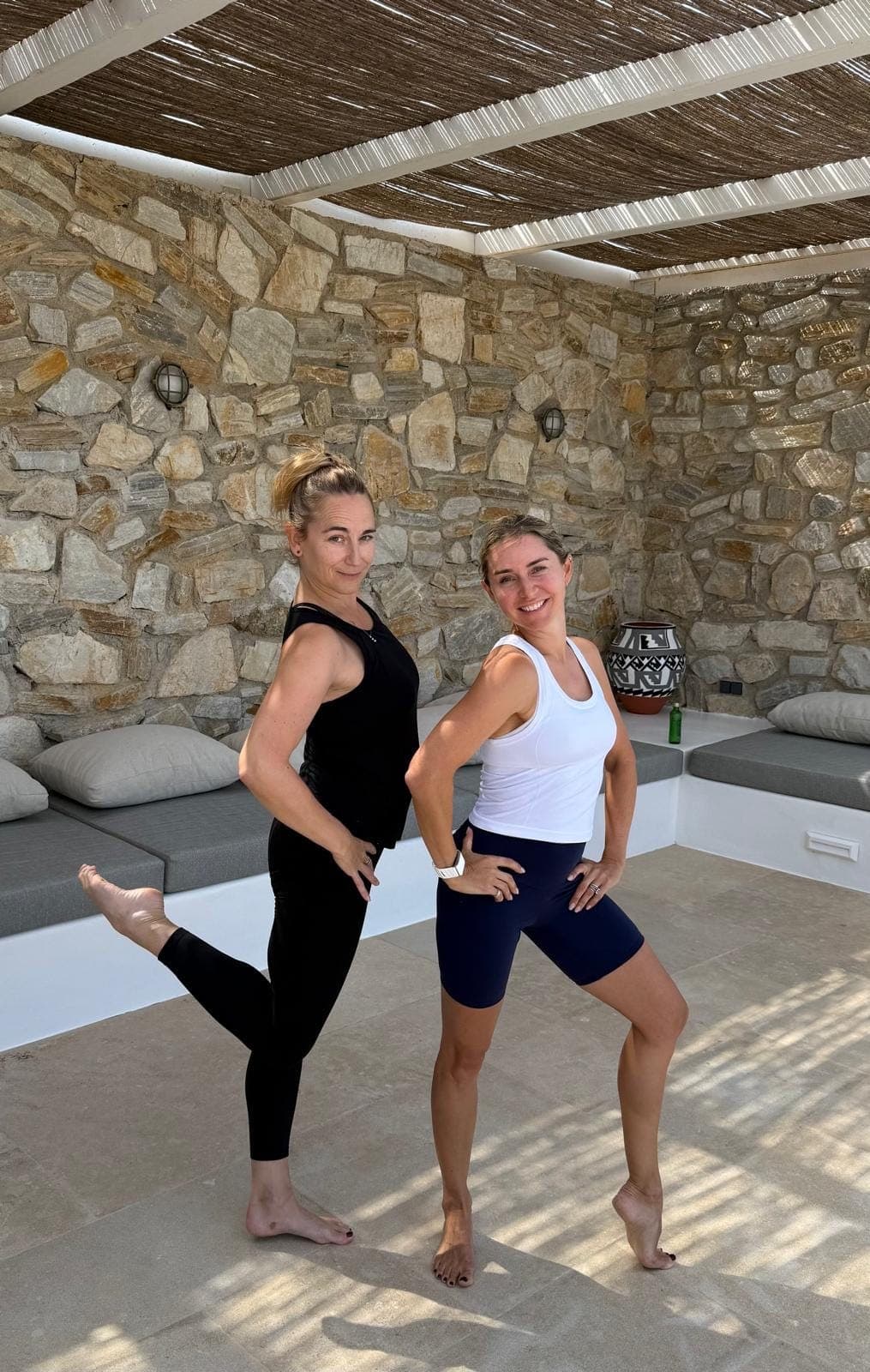
Over the years, I have taken the elements that work, left behind the ones that do not, and experimented with how different forms of movement can complement one another.
I have never believed there is one perfect way to exercise.
Throughout my career, I have trained in a myriad of movement disciplines. Ballet, Barre, Pilates, strength training, yoga, conditioning, mobility and more. Partly because I love movement, but also because I have always been fascinated by what each discipline gives us.
First for my own body. Then for the thousands of bodies I have had the privilege of teaching.
That philosophy eventually became what I now call The Midlife Movement Matrix.
And this week in Greece has been a rather lovely example of it in practice.
We have been enjoying precious family time, beautiful food, sunshine and, yes, a little Greek rosé. I haven’t followed a rigid training schedule. I haven’t tried to compensate for dinners out. And I certainly haven’t exercised myself into exhaustion.
But I have moved every day because movement makes me feel good.
Monday was Barre followed by a cycle ride into town. I have apparently acquired the family nickname “the pastry elf” because of my early morning bike rides to the little island bakery.
Tuesday was Barre with my stepdaughters, which was enormous fun.
Wednesday was walking and resting.
Thursday I did the full advanced Pilates mat sequence. It takes me around 30 minutes and I still love playing with the variations after all these years.
Friday was Barre with my new MMM playlist, which I cannot wait to share with you.
Saturday was Pilates mat again.
Sunday Barre with my bestie from Ballet School!
And throughout the week, I have walked. A lot.
I have felt the sun on my skin, eaten delicious Greek food, slept, rested, laughed and spent time with people I love.
It doesn’t look particularly extreme.
Midlife changed the question for me
When I was younger, fitness could easily become about how hard I could push myself.
How much could I do? How sweaty could I get? How many calories could I burn?
Perimenopause has made me much more interested in a different question:
What does my body need in order to remain strong, mobile, capable and resilient for the decades ahead?
That changes everything.
We absolutely need to challenge our muscles as we move through midlife. Maintaining and building muscle becomes increasingly important as we age, and resistance training gives the body a reason to preserve that precious lean tissue.
But strength is only part of the picture, we also need balance, coordination, mobility, power, cardiovascular fitness and the ability to move confidently through different planes and ranges of motion.
And I think we sometimes forget the brain in this conversation.
Learning choreography, coordinating arms and legs, balancing, changing direction, remembering sequences and responding to different tempos all require the brain and body to communicate.
This is one reason I love Barre and Pilates so much. You’re not simply repeating a mechanical movement. You’re concentrating. Coordinating. Adjusting. Remembering. Stabilising.
It is physical training with a cognitive component built in.
Why variety matters
This is where the Matrix really comes to life.
For years, fitness culture encouraged us to find our thing and do more of it.
Run every day.
Spin every day.
HIIT every day.
Go to the same high-intensity class four or five times a week.
There is nothing inherently wrong with any of those forms of exercise. Cardiovascular training is enormously valuable. But a single repeated training stimulus cannot necessarily give a midlife body everything it needs.
And now there is some fascinating research supporting the value of variety.
A major study published in BMJ Medicine in 2026 looked at more than 111,000 people, including over 70,000 women, using data collected across more than 30 years.
Those who consistently engaged in the greatest variety of physical activities had a 19% lower risk of death from all causes compared with those doing the least variety.
And here’s the really interesting part.
The association remained even after researchers accounted for the total amount of physical activity people were doing.
This was an observational study, so it doesn’t prove that exercise variety itself caused people to live longer. But it does suggest something rather compelling.
It may not simply be about how much you move. How many ways you move may matter too.
And that makes intuitive sense to me.
Different forms of movement ask different things of the body.
Strength training challenges our muscles and bones.
Walking and cardiovascular work challenge our heart and lungs.
Barre and Pilates bring in balance, control, coordination, mobility and complex movement patterns.
Mobility work helps us maintain the freedom and range of motion that we want to carry with us into later life.
And rest allows the body to adapt to all of it.
No single discipline needs to do everything.
Perimenopause makes this even more important
Perimenopause can expose the limitations of a repetitive approach to fitness rather quickly.
Our recovery can change. Sleep can become less predictable. Hormonal fluctuations can affect how energetic or resilient we feel from one day to the next. Meanwhile, maintaining muscle, bone, mobility and metabolic health becomes increasingly important.
The answer isn’t to stop challenging ourselves.
It is to become more intelligent about how we challenge ourselves.
Strength one day.
Barre another.
Pilates.
Walking.
Mobility.
Cardiovascular work.
And sometimes, as I did on Wednesday, rest.
Each gives the body something slightly different.
The Midlife Movement Matrix isn’t about doing everything, every day.
It’s about giving your body the right variety of stimulus across the week, while allowing enough recovery to actually benefit from it.
Movement should support your life
Perhaps my favourite thing about this week is that movement hasn’t competed with my holiday, it has enhanced it.
I haven’t disappeared into a gym for hours while everyone else is enjoying themselves. I’ve cycled to buy pastries. I’ve done Barre with my stepdaughters. I’ve rolled out a mat for half an hour. I’ve walked everywhere.
Movement has simply woven itself into the rhythm of our days.
And that is ultimately what I want the Midlife Movement Matrix to teach women. Exercise doesn’t have to be punishment for what you ate. It doesn’t have to leave you depleted to be effective.
And it doesn’t have to be one rigid prescription that you repeat forever.
Your movement practice can be varied, challenging, restorative, social, joyful and intelligent.
Because we’re not simply training for this summer.
We’re training for the woman we want to be at 60, 70, 80 and beyond.
Strong. Mobile. Curious. Capable.
And still very much moving.
If you want this as movement rather than another article, Awaken Barre is the twenty-minute programme I built for a body that has already changed.
First published in The Midlife Movement, Chrissy’s newsletter.
Common questions
What is the Midlife Movement Matrix?
It is Chrissy Sundt's approach to movement, built from years of training across ballet, Barre, Pilates, strength work, yoga, conditioning and mobility. Rather than following one method, it blends elements from different disciplines so the body gets varied stimulus across the week, with room for rest and recovery.
Why mix disciplines instead of sticking to one form of exercise?
Each discipline offers something different: strength training supports muscles and bones, walking and cardio work support the heart and lungs, and Barre and Pilates bring balance, coordination and control. Relying on one repeated activity may leave some of these needs unmet, so variety helps cover more ground.
Does research support varying your workouts?
A large observational study in BMJ Medicine, following more than 111,000 people over 30 years, found that those with the greatest variety in their physical activity had a lower risk of death from all causes than those with the least, even after accounting for total activity levels. It does not prove variety alone caused this, but the pattern stood out.
What role does the brain play in Barre and Pilates?
Learning choreography, coordinating arms and legs, balancing, changing direction and remembering sequences all require the brain and body to communicate. Chrissy describes this as physical training with a cognitive component built in, involving concentration, adjustment and stabilising rather than repeating a purely mechanical movement.
What did a typical week of movement look like on holiday?
Over one week in Greece, movement happened daily without a rigid schedule: Barre sessions, a full Pilates mat sequence, cycling to a local bakery, and days of walking and rest. The mix let movement fit around family time and holiday life rather than compete with it.