Don’t Train the Calendar. Train the Woman.
Chrissy Sundt · Mindful Movement ·
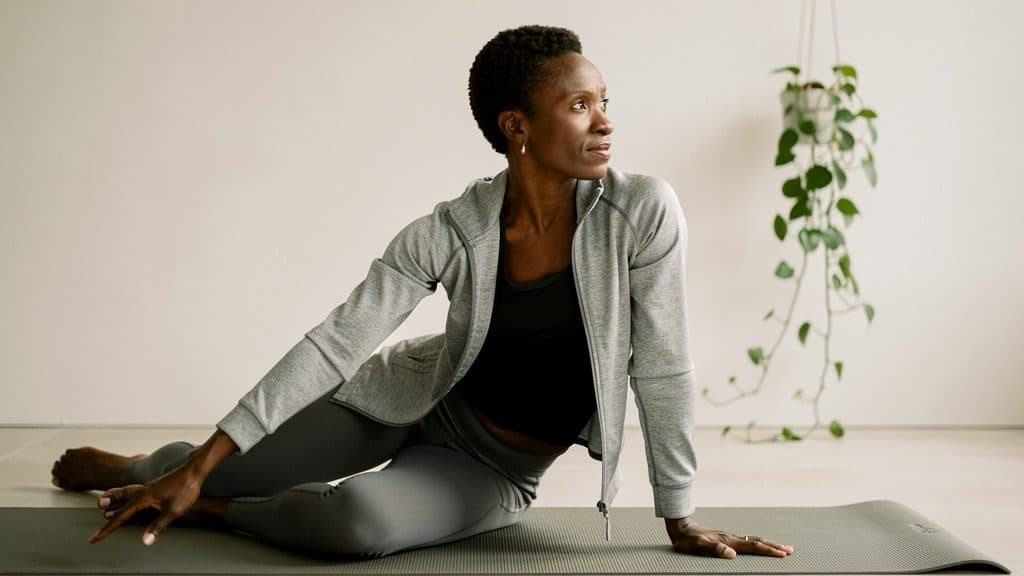
Cycle syncing assumes a predictable calendar. Perimenopause rarely offers one. Training the woman means checking in with energy, sleep and how your body feels today, then choosing movement that matches, instead of forcing a plan written for a cycle that no longer runs on schedule. Consistency still matters; rigidity does not.
I don’t mind sharing that my cycle is pretty disrupted these days. It has been for the last year or so.
Initially, I wondered whether it might be my training load. When I was dancing professionally and training hard in my twenties and thirties, my cycle could be disrupted too. After the initial panic, I almost got used to it. I knew that when I was dancing intensely, rehearsing for hours and putting my body under considerable physical demand, my periods might not behave entirely predictably. But this feels different.
Now, a period might be late for no obvious reason. Sometimes very late. And occasionally I reach that point where I feel like a balloon that is about to burst. Bloated, heavy, uncomfortable and decidedly not at my best. Which, naturally, always seems particularly helpful when I have a filming day coming up.
But beyond the physical discomfort and the knock it can give my confidence, it got me thinking about something much bigger.
How exactly are we supposed to “cycle sync” our exercise when our cycle has become wildly unpredictable? Because cycle syncing is everywhere: train harder here. Pull back there. Lift during this phase. Recover during that one.
There are some interesting physiological ideas behind it. Hormonal fluctuations can influence how we feel, perform and recover. But when I started digging into the research, I found the science was considerably more nuanced than Instagram might have us believe. And, perhaps most importantly, much of the neat cycle-syncing advice doesn’t translate particularly well to perimenopause when the cycle stops following the calendar
One of the hallmarks of perimenopause is that ovarian hormone production becomes increasingly erratic. Cycles can become shorter or longer, heavier or lighter or disappear for extended periods.
So, the beautifully colour-coded 28-day training calendar suddenly becomes rather difficult to follow.
Am I on day 17?
Day 37?
Is my period coming tomorrow? Or in three weeks?
And this is where I think we need to change the conversation.
Rather than becoming obsessed with identifying precisely where we are hormonally before deciding whether we’re “allowed” to train hard, perhaps midlife is the moment we learn something far more useful: how to read our own bodies. Tuning in so that we can train ‘smarter’ for our changing bodies.
The science isn’t telling every woman to train the same way
This is important because I don’t want MMM to replace one rigid fitness rulebook with another. The evidence around menstrual-cycle phase and exercise is fascinating, but it isn’t nearly strong enough to justify universal prescriptions (and I suspect it never will be as we really are all unique).
A major systematic review and meta-analysis found that exercise performance may be reduced during the early follicular phase, but individual variation was considerable and the quality of the evidence relatively low. The researchers concluded that a personalised approach was preferable to general rules based purely on menstrual-cycle phase.
That’s an important distinction because women are not simply smaller men. But neither are women all the same woman and that becomes even more relevant during perimenopause.
Your recovery today might be influenced by hormones but it might also be influenced by the terrible night’s sleep you had because you woke at 3am.
The stressful week you’ve had at work.
The fact that you haven’t eaten enough.
The strength workout you did yesterday.
The glass or two of wine you had last night.
The hot flushes that kept waking you.
Or simply the fact that your body is asking for a little less today.
The intelligent response isn’t always to push through, sometimes it is to adapt and occasionally it is to stop. Which is why I’m changing the Midlife Movement Matrix
From now on, I want every Midlife Movement Matrix week to contain something very deliberately:
A protected the ‘Rest & Illumination Day’ (Mine will often be Sunday, yours doesn’t have to be!) Choose the day that works with your body, your family, your work and your life. But protect it. And by rest, I actually mean rest.
Of course you can potter. Walk the dog. Stretch if it feels wonderful. Go outside. Read. Have lunch with friends. Lie on the sofa. But there is no workout that needs ticking off.
I don’t want us to think of this as a day lost from our training programme. It’s part of the programme.
Recovery isn’t the absence of training. Recovery is part of training.
But one rest day doesn’t solve everything because there is another change I want to make to the Matrix. I want us to stop blindly following the workout calendar when our bodies are clearly telling us something different.
Before you train, I want you to check in. Not with your cycle-tracking / wellness app.
But with yourself:
• How did I sleep?
• How is my energy?
• How does my body feel?
• How stressed or emotionally depleted am I?
• How recovered do I feel from my last training session?
And then make an intelligent decision.
🟢 GREEN — GO
You slept reasonably well. Your energy feels good. Your body feels strong and recovered.
Follow the Matrix. Train as planned.
🟠 AMBER — ADAPT
Sleep wasn’t great. You’re unusually sore, tired, stressed or simply not feeling quite yourself.
Keep moving, but change the dose.
Use lighter weights. Reduce the intensity. Shorten the workout. Swap HIIT for Barre, Pilates, mobility or a walk.
Movement can still make you feel enormously better without asking your body to dig an even deeper hole.
🔴 RED — REST
You’re exhausted. Your sleep has been dreadful. Your body feels unusually heavy or depleted. You’re ill, in pain, or everything in you is saying not today.
Listen.
Take the rest day.
Without guilt.
Without trying to “make it up” tomorrow.
And without worrying that you’re losing progress.
Because sometimes the decision not to train is as intelligent as the decision to train.
This isn’t about doing less in midlife
And this point is incredibly important to me.
I do not want the message to women in their forties, fifties and beyond to become:
Your hormones are changing. Be careful. Slow down.
Quite the opposite.
We need muscle.
We need strength.
We need cardiovascular fitness.
We need mobility, balance, coordination and bone-loading movement.
We need to keep challenging our bodies if we want them to remain capable for the second half of our lives.
But challenge and punishment are not the same thing.
The goal isn’t to discover how much exercise your body can tolerate.
It’s to discover the right combination of stimulus, recovery and nourishment that allows your body to thrive.
That is Intelligent Movement™.
And increasingly, I think that is what the Midlife Movement Matrix needs to teach us. Not simply what to do, but when to push. When to adapt and when to rest. Because ultimately, I don’t want you strong just for next summer.
I want you strong now. Strong for what comes next.
If you want this as movement rather than another article, Awaken Barre is the twenty-minute programme I built for a body that has already changed.
First published in The Midlife Movement, Chrissy’s newsletter.
Common questions
What does train the woman not the calendar mean?
It means basing exercise choices on how the body actually feels each day rather than following a fixed training calendar or app, since hormonal patterns in midlife can become unpredictable and stop following a neat monthly rhythm.
Can you still cycle sync exercise during perimenopause?
Cycle syncing depends on a predictable cycle, but during perimenopause ovarian hormone production becomes erratic and cycles can shorten, lengthen, or disappear for extended periods, making it hard to know which phase you're actually in on a given day.
What is the Rest and Illumination Day in the Midlife Movement Matrix?
It's a protected day each week, chosen to fit the person's own life, set aside for genuine rest rather than a workout. Gentle things like walking, stretching, or reading are fine, but there is no exercise session to tick off that day.
How do you decide whether to train or rest each day?
Before training, check in on sleep, energy, how the body feels, stress levels, and recovery from the last session. A green, amber or red response then follows: train as planned, adapt the workout by lowering intensity, or take a full rest day.
Does taking a rest day mean losing fitness progress?
No. Recovery is treated as part of training rather than time lost from it, so resting without guilt, and without trying to make up the missed session the next day, is considered just as intelligent a choice as training.