How to Stop Scrolling at Night and Sleep Better in Midlife
Chrissy Sundt · Sleep ·
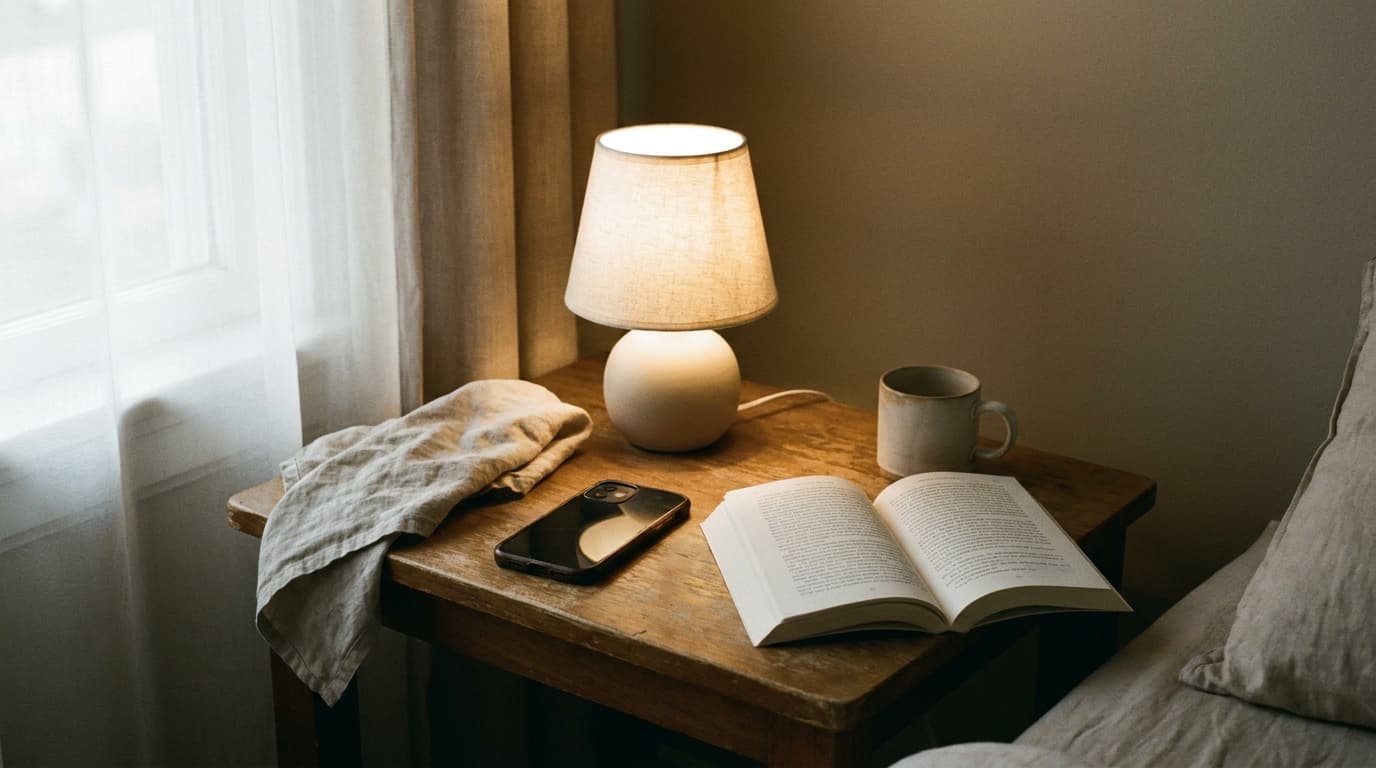
To stop scrolling at night, get your phone charging outside arm's reach before you get into bed, dim the lights in the hour beforehand, and replace the scroll with something low-stimulation like reading or stretching. The screen's brightness delays your body clock. Removing the option works better than relying on willpower in the moment.
Why does scrolling in bed actually stop you sleeping?
Lying in the dark with a bright screen inches from your face, thumb moving without much thought, is one of the most common habits women bring into midlife sleep, and it's rarely about willpower. Something in the mechanism itself is working against you, and the cost shows up well beyond next day's tiredness.
Light is the strongest signal your brain uses to work out what time it is. Morning daylight tells your clock it's time to be alert. Dim evening light tells it the opposite: wind down, start producing melatonin, get ready for sleep. A phone screen at eleven at night sends the first message when your body needs the second.
The light-sensing cells in the eye that feed into the body clock respond strongly to bright, blue-rich light, exactly the kind screens produce, which is why a small screen can matter more than the room's main light. Your eyes don't need a lit room to register 'daytime' when a phone is that close.
Then there's the scrolling itself, not just the light. An endless feed is built to keep your attention moving, which keeps your mind alert exactly when it should be settling. In perimenopause, when sleep is already lighter and more easily broken, stacking a stimulant like this on top makes the whole night more fragile, not just the falling asleep part.
What should I do instead of scrolling before bed?
Swapping the phone out means giving your evening a shape that doesn't involve a screen, so there's something to reach for instead of a habit to resist.
The behavioural side matters just as much as the light: a proper wind-down before bed does more than switching the lights off. That might mean a stretch of the evening where the phone is genuinely out of the room. Leaving it face-down beside you isn't enough, because it's still within reach the moment you're restless.
One practical detail worth using: your body cools down as it settles into sleep, and a warm bath or shower about an hour before bed helps with that, because you cool off afterwards as you get out. A cooler bedroom works the same way. That's a better use of the hour than a feed that never ends.
None of this has to be elaborate. A few pages of a book, a short stretch on the floor, laying out tomorrow's clothes, even sitting with something warm to drink and no screen in your hand. What matters is that your evening has an off-ramp before you get into bed, so the scroll isn't the only thing standing between you and lights out.
- A book or magazine, not an app
- A warm bath or shower around an hour before bed
- A few minutes of stretching or gentle mobility
- Laying out clothes or tomorrow's plan on paper
How do I actually stop reaching for my phone?
Most people already know screens before bed aren't ideal. The gap is between knowing that and not doing it at quarter to eleven when you're tired and the phone is right there. This is where a simple behavioural principle called stimulus control is useful: change the environment so the habit has nowhere to land, instead of trying to talk yourself out of it in the moment.
The single most effective change is where your phone charges. If it charges on the other side of the room, or better still in another room, you remove the easy reach that most scrolling depends on. Buy an actual alarm clock. It sounds small, but 'I need my phone for my alarm' is the reason most women give for keeping it on the nightstand, and it's the easiest one to solve.
Bed itself matters too. If bed is where you scroll, bed becomes associated with being awake and alert, not sleep. Keeping the phone, and scrolling of any kind, out of the bed itself, even before you're asleep, helps your brain treat bed as the cue for sleep rather than the cue for a feed.
This won't feel comfortable for the first week or so. That's a normal part of changing a genuinely well-practised habit. Those habits take a little time to loosen, more than one good intention on its own.
What if I wake at 3am and reach for my phone anyway?
Brief awakenings are a normal part of a night's sleep, and on their own they're nothing to worry about. The trouble usually starts with what happens next.
Reaching for the phone at 3am does two unhelpful things at once. It puts bright light directly in front of your eyes when your body clock is trying to hold you in sleep, and it gives your mind something to engage with, whether that's the time, a headline or an email, right when it should be drifting back down.
There's a second layer worth knowing too: catastrophising the waking, lying there thinking you'll be exhausted tomorrow, is itself arousing. It's a second problem stacked on the first, and it's often the one that actually keeps you up. If you wake and can't settle after a while, getting up, sitting somewhere dim, and coming back when you're properly sleepy tends to work better than lying there scrolling or willing yourself back to sleep.
In perimenopause, night waking is common enough that it deserves a plan rather than dread. A glass of water by the bed instead of a phone, a book with a dim reading light, or simply lying still without reaching for anything at all, all give your body a chance to drift back down on its own terms.
Does it matter what time I do all this, every single night?
Yes, more than most people expect. A consistent time for winding down, and a consistent time for getting up, weekends included, trains your body clock far more reliably than an occasional early night after a run of late ones.
The same principle runs through movement and nutrition in midlife: showing up regularly beats occasional perfection. One disciplined phone-free evening followed by five scrolling ones won't shift much. A slightly imperfect version, kept up most nights, tends to work better than one perfect night surrounded by lapses.
Caffeine plays into this too. It lingers in your system for longer than it feels like it does, so a mid-afternoon coffee can still be affecting you at bedtime even if you fall asleep without any trouble. It isn't the same mechanism as scrolling, but it stacks with it, so a late coffee and a late scroll together ask more of your sleep than either alone.
None of this needs to be rigid. Life happens, and one late night with the phone doesn't undo a week of better habits. The aim is a pattern your body can predict, followed most nights rather than perfectly.
If you want this as movement rather than another article, Awaken Barre is the twenty-minute programme I built for a body that has already changed.
Common questions
Do blue light glasses actually help?
They may take the edge off, but overall brightness matters as much as blue wavelengths as a signal to your body clock. Dimming the screen and reducing time on it matters more than the glasses alone.
Is it the phone or perimenopause waking me at night?
Often both. Hormonal changes can make sleep lighter and waking more frequent in perimenopause, and a phone in reach turns a normal brief waking into a longer one. Removing the phone won't stop the waking, but it removes one thing making it worse.
How long before bed should I actually put the phone away?
There's no single number that suits everyone. What matters more is a genuine phone-free stretch, even a short one, that becomes a normal part of your evening rather than an exception to it.
What do I do about using my phone as an alarm?
Replace it with an actual alarm clock. It's a small purchase that removes the main reason most people keep a phone within reach of the bed overnight.
Will this fix my sleep completely?
It's one part of a bigger picture that includes light, temperature, caffeine timing and routine. Putting the phone down removes one significant obstacle from a much longer list of things that affect sleep.