Nervous System Regulation for Midlife Women: A Practical Guide
Chrissy Sundt · Rest & Illumination ·
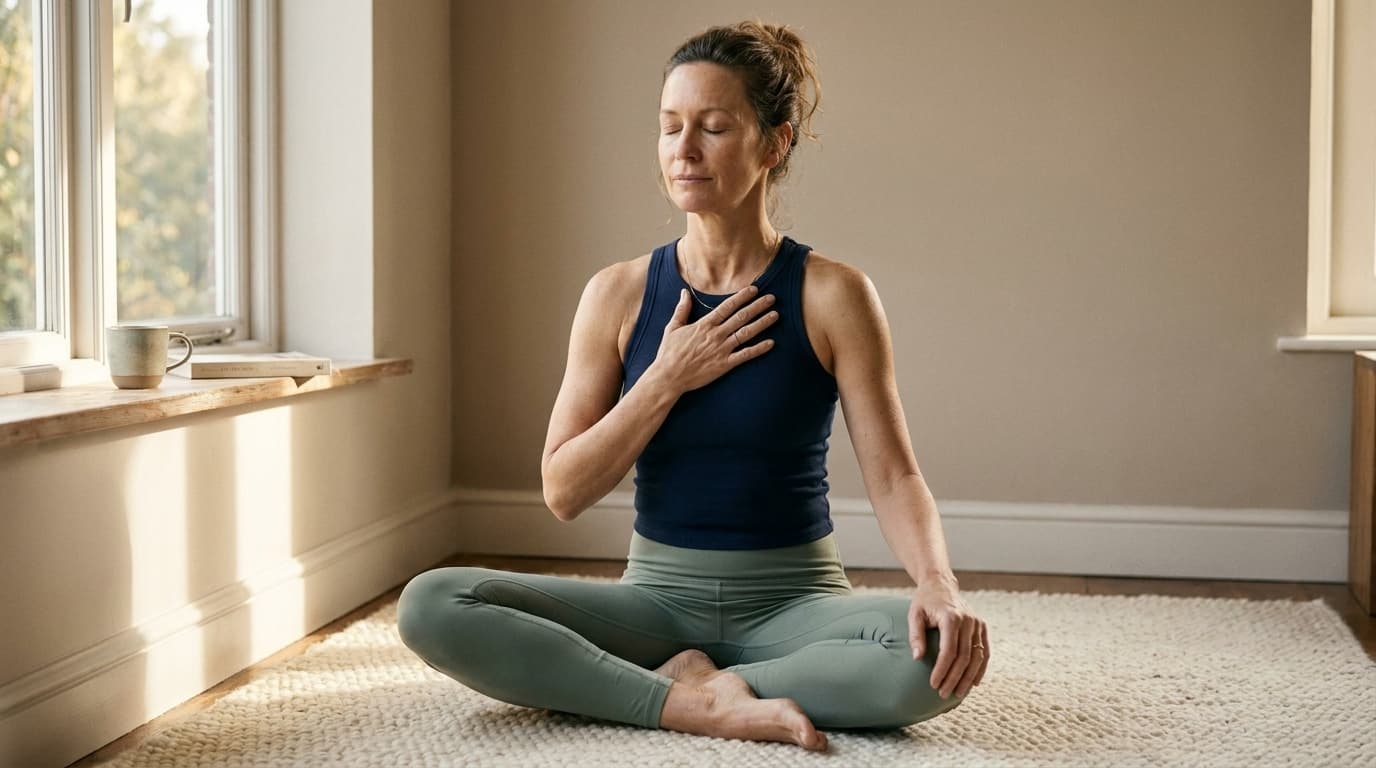
Nervous system regulation in midlife means training your body to move between alert and calm states with less friction. For women in perimenopause, that means short, consistent practices, slow breathing, gentle strength work, and predictable rest, that build steadier capacity to recover.
What does nervous system regulation actually mean in midlife?
Your nervous system runs on two settings: sympathetic, the alert, get-things-done state, and parasympathetic, the rest, digest and repair state. Regulation isn't about living permanently in the calm setting. It's about how easily you move between the two when the day demands it, and how quickly you come back down afterwards. In your twenties and thirties that switch was probably automatic. You didn't think about it, it just happened in the background.
In midlife, a lot of women notice the switch has gotten stickier. You feel wired but exhausted at the same time, slower to settle after a day that ran hot than you'd expect. None of that means something has gone wrong with you. It means your nervous system is doing its job under different hormonal conditions, and the recovery side of the switch is worth practising deliberately, the way any skill improves with practice.
This is where the rest & illumination pillar sits inside the wider picture of sleep, movement, nourishment and connection. You can lift with good form and eat well and still feel frayed if the nervous system side is ignored. Regulation is the piece that lets the rest of it land properly: more capacity for the things you actually want your energy for, instead of running on empty by the time evening comes.
Why does perimenopause make regulation harder?
Hormones and the nervous system are tightly linked. As oestrogen fluctuates through perimenopause rather than declining in a straight line, those signals get noisier. For some women, that wired feeling is slower to settle than it used to be, still there at bedtime instead of easing off hours earlier.
This is also why more of the same intensity can often feel worse, not better. On a day when you're already running hot, a punishing workout or a whirlwind schedule can feel like piling more on top rather than letting off steam. Your body isn't asking for less effort. It's asking for a different kind of effort, one dosed carefully rather than thrown at the problem. Think of it as running new hardware on old software: push harder, sweat more still runs, but it isn't reading the terrain correctly anymore.
None of this is a decline. It's a recalibration, and recalibration needs information your body can actually use: consistent signals, predictable rhythms, breath and movement that say you're safe rather than brace for impact. That's a mindset shift as much as a practical one, and it's usually the piece that gets skipped when a woman is trying to fix how she feels by working harder at the things that used to work.
What are practical ways to regulate your nervous system day to day?
You don't need an hour of meditation to shift state, and you don't need to get it right every time. Most regulation tools work because they're short, repeatable and physical: they talk to your body directly rather than asking your thinking brain to calm down first, which rarely works when you're already wired.
The fastest wins tend to come from your breath and your senses, because both have a direct line to the vagus nerve without needing you to think your way there. Everything below works whether you have ninety seconds in the car park or twenty minutes at home, and none of it requires special kit.
None of these need to be perfect or daily to help. The aim isn't to add another task to a day that's already full, it's to have two or three tools you actually reach for the moment you notice the wired feeling building, rather than powering through until it passes on its own, or doesn't, and you're left short-tempered by six o'clock.
- Extend your exhale. Four counts in, six to eight counts out, for ten breaths. It's one of the quickest ways to feel the shoulders drop and the breathing settle.
- Get outside within an hour of waking. It's a simple, consistent way to start the day, and it can give the rest of the day a steadier rhythm to work with.
- Hold something cold against your wrists or the back of your neck when you feel keyed up. It's a blunt, physical reset.
- Name what you're doing, out loud if you can. 'I am making tea' sounds trivial, but it's a small, physical way of anchoring your attention to the here and now.
- Protect the last thirty minutes before bed: no inbox, no news, dim light. Your nervous system reads that window as a cue, not an afterthought.
How does movement fit into nervous system regulation?
Movement is one of the most direct lines you have into your nervous system, but the type and pace matter more in midlife than they used to. High-intensity, breathless exercise can be a stress signal in itself if your system is already running hot: useful sometimes, but not the default tool for calming down.
Slower, controlled strength work does something different. Barre-style training, moving through small ranges with a steady tempo and a hand on the barre for balance, asks you to breathe and pay attention at the same time. That combination, breath plus attention plus control, is what teaches the nervous system that effort and safety can coexist.
This is also where the core comes in, and not in the sense of doing more crunches. The deep core and the nervous system are closely connected: it activates properly through breath and steadiness, not through force. Learning to engage it gently, and to actually feel it working, gives you a physical anchor you can return to away from a mat too, in a queue, in traffic, anywhere your shoulders have crept up around your ears.
How do you build a regulation practice that actually sticks?
The honest answer is: badly, at first, and that's fine. A regulation practice doesn't fail because you missed three days. It fails when a missed day turns into a story about how you're bad at this, and you quietly stop altogether. Returning matters more than an unbroken streak. This isn't an app tracking your consecutive logins, it's your actual nervous system, and it responds to what you do most of the time, not what you did perfectly once.
Attach your practice to something that already happens. Breathing exercises while the kettle boils. A short barre-based session before the house wakes up. Screens off when you clean your teeth at night. You're not trying to find an extra hour, you're trying to slot a small, specific action into a moment that already exists in your day.
Rest & Illumination is one of five pillars for a reason, it doesn't work in isolation from sleep, movement, nourishment and connection, and you don't need to master all five at once. If you want the fuller picture of how they fit together, and where to start given what's actually going on for you right now, the free guide walks through it without asking you to overhaul your entire life in one go.
Common questions
Is nervous system regulation the same as relaxation?
Not quite. Relaxation is one state, while regulation is the capacity to move between alert and calm as needed and recover afterwards. You can be excellent at relaxing on holiday and still carry a nervous system that struggles to downshift on an ordinary Tuesday.
Can exercise make nervous system regulation worse?
It can, if the intensity doesn't match what your body has capacity for that day. On days that already feel like a lot, a punishing workout can add to that feeling rather than ease it, so gentler, controlled strength work tends to sit more comfortably as an everyday choice.
How long does it take to notice a difference?
This varies from person to person and isn't something we can put a number on. Consistency, short practices most days, tends to matter more than any single technique, and returning after a missed day counts for more than never missing one.
Do I need any equipment to start?
No. A chair or wall to steady yourself on, a few quiet minutes, and a breath pattern you can repeat are enough to begin. The free guide has a simple starting point if you want more structure.
Is this a substitute for medical support?
No. This is movement and lifestyle education, focused on comfort, capability and how you feel day to day. It sits alongside whatever other support you have in your life, not in place of it.