Breathwork for Perimenopause: A Practical Way to Steady Your Nervous System
Chrissy Sundt · Rest & Illumination ·
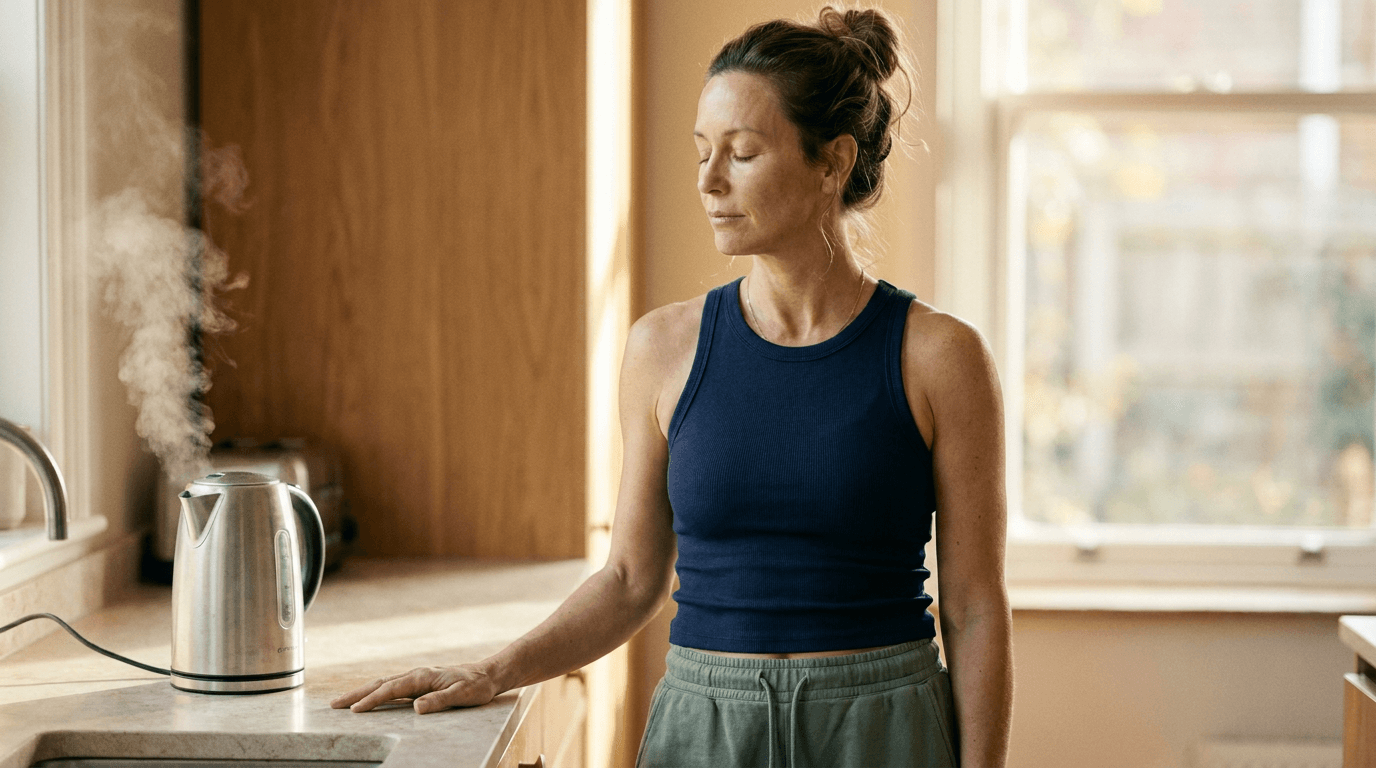
Breathwork for perimenopause means using slow, structured breathing, usually a longer exhale than inhale, for a few minutes at a time, to give your nervous system a clear signal to settle. It won't change your hormones, but practised regularly it can ease tension and give you something steadying to reach for in the moments that feel hardest to get through.
Why does breathwork feel different once you're in perimenopause?
"Just take a deep breath" is advice you've heard your whole life, and it used to be enough. In perimenopause it can fall flat, and that isn't you doing it wrong. It's an old map for new terrain: your hormones are shifting on an unpredictable schedule, and the nervous system deciding whether you feel calm or on edge is reading different signals than it used to.
Oestrogen and progesterone influence how fast your body tips from settled into alert, and how long it takes to come back down. When they're in flux, that swing can feel sharper: a small frustration lands like a big one, a quiet room suddenly feels too loud. That's your nervous system working exactly as designed, just with less predictable input.
This is where breathwork earns its place: not a fix for the hormones themselves, but one of the few tools that talks directly to the nervous system in real time. Lengthening your breath gives your body evidence that it's safe to stand down right now, whatever your hormones are doing in the background.
This sits inside rest & illumination, one of the five pillars of the Midlife Movement Method. It's separate from sleep and movement: it's the baseline your body runs on in between the two, and breathwork is one of the simplest, most portable ways to shift it. No equipment, no class required.
What can you do with your breath when a hot flush hits?
Breathwork will not stop a hot flush arriving, and it is not being offered here as something that will. What it can change is the thirty seconds after you notice one starting, often the part that feels worst: the bracing, the flash of panic on top of the flash of heat, the urge to fight it or apologise for it.
The pattern that helps most is a longer exhale than inhale, something like four counts in and six or eight counts out, shoulders kept soft rather than hunched. Bracing against a hot flush, gripping your jaw, holding your breath, tensing your shoulders, adds a second layer of discomfort on top of the physical one. Slowing the exhale tells your body it doesn't need to fight what's already happening.
This is a small, practical shift, not a promise. It won't shorten the flush or make it happen less often. What it can do is give you something to do with your attention while it passes, so you come out steadier rather than rattled, whether it's happening mid-meeting or at three in the morning with the duvet half off.
If hot flushes are frequent enough to disrupt your day or night regularly, that's worth raising with your GP. Breathwork sits alongside that conversation, something to reach for in the moment, not instead of it.
What's the actual technique for when you feel overwhelmed?
You don't need a complicated ritual, and overcomplicating it is usually what makes people give up within a week. The one pattern worth learning properly is the extended exhale: breathe in through your nose for a count of four, hold for one or two, then breathe out for a count of six to eight. Repeat for one to three minutes.
The exhale is doing the work, not the inhale. A longer, slower out-breath is one of the clearest signals you can give your body that the moment has passed. You don't need textbook belly-breathing precision for it to count. You need the exhale longer than the inhale, consistently, for more than a few rounds.
The goal isn't to feel blissed out. It's to feel a notch calmer than you did ninety seconds ago, and to do that standing in a supermarket queue or sitting in the car at school pickup, not only cross-legged at home. Precision beats volume here: two focused minutes will do more than twenty distracted ones.
This isn't the only pattern that works, but it's the one to start with because it's easy to remember under stress, when your brain has less bandwidth for anything complicated. Once it's familiar, you can reach for it before a hard conversation, before you walk into a room, or the second you feel your chest tighten.
- Breathe in through your nose for a count of four
- Hold for one or two counts
- Breathe out for a count of six to eight
- Repeat for one to three minutes, or until your shoulders drop
How do you fit this into a day that's already full?
Breathwork earns its place in a full day precisely because it doesn't ask for extra time, it asks you to attach it to time that already exists. Before you reach for your phone in the morning. Sitting in the car before work or the school run. Standing in the queue at the school gates. Before you open the laptop for a meeting you're dreading.
Stack it onto something you already do rather than trying to build a new habit from nothing. Two or three rounds of the extended exhale while the kettle boils, while a page loads, while you're stopped at a red light, is enough to count. You're not aiming for a ten-minute sit-down practice, you're aiming for a reflex you can reach for anywhere.
Movement and breathwork aren't separate tasks, one supports the other, so if you're already moving regularly, this fits alongside it rather than competing with it. The same principle applies here.
This is not less ambition, it's more intelligence: a smaller, more precise tool used consistently, rather than a bigger one used never. You don't need to find a spare twenty minutes for breathwork specifically. You need to notice the minutes you already have and use thirty seconds of them differently.
- Before you check your phone in the morning
- Sitting in the car before work or the school run
- Standing in the queue at the school gates
- Before opening the laptop for a meeting you're dreading
What can breathwork do around bedtime and if you wake in the night?
Breathwork won't solve interrupted sleep on its own, and nothing here claims it does. Here's where it can fit: winding down before bed, and what you reach for if you wake at three in the morning with your mind already running.
Before bed, a few minutes of the extended exhale, lying down, lights low, phone out of reach, signals to your body that the day is closing rather than continuing. It won't override racing thoughts by itself, but it gives them something to sit alongside instead of spiralling unchecked.
If you wake in the small hours, reaching for the extended exhale before you reach for your phone changes what happens next. Checking a screen at three in the morning tends to wake you up further. A few minutes of slow, longer exhales gives your body the option of settling back down, without guaranteeing it, every night is different.
Treat this as one part of a wider wind-down, alongside things you already know help: less caffeine later in the day, a consistent bedtime, a room that's properly dark and cool. Breathwork isn't a replacement for any of that. It's a small, free tool that sits well alongside it, and one of the few things you can do lying in bed at three in the morning without getting up.
If you want this as movement rather than another article, Awaken Barre is the twenty-minute programme I built for a body that has already changed.
Common questions
Is breathwork the same as meditation?
No. Meditation is broader and often about attention or awareness; breathwork is a specific technique using the pace and length of your breath to shift your nervous system state. You can do it in ninety seconds with your eyes open in a supermarket queue, which is rather the point.
How long before breathwork actually makes a difference?
In the moment, a longer exhale can take the edge off within a minute or two. As a tool for steadier days generally, give it a couple of weeks of consistent use before deciding whether it's working for you, the same as you would with any new habit.
Do I need an app or to sit cross-legged for this?
No. You can do the extended exhale sitting, standing or lying down, eyes open or closed. A timer or app can help while you're learning the counts, but it isn't required once the pattern feels familiar.
Can I do breathwork alongside Awaken Barre?
Yes, they work well together. Movement and breath support each other, and the extended exhale is something you can use on its own too, any time your day needs it, not only around a session.
What if I feel light-headed when I try this?
Slow down and breathe more gently rather than pushing the counts. If light-headedness continues, stop, breathe normally, and mention it to your GP before carrying on, as you would with any new breathing practice.