Restorative Movement for Midlife Women: Why Slowing Down Is Part of the Work
Chrissy Sundt · Rest & Illumination ·
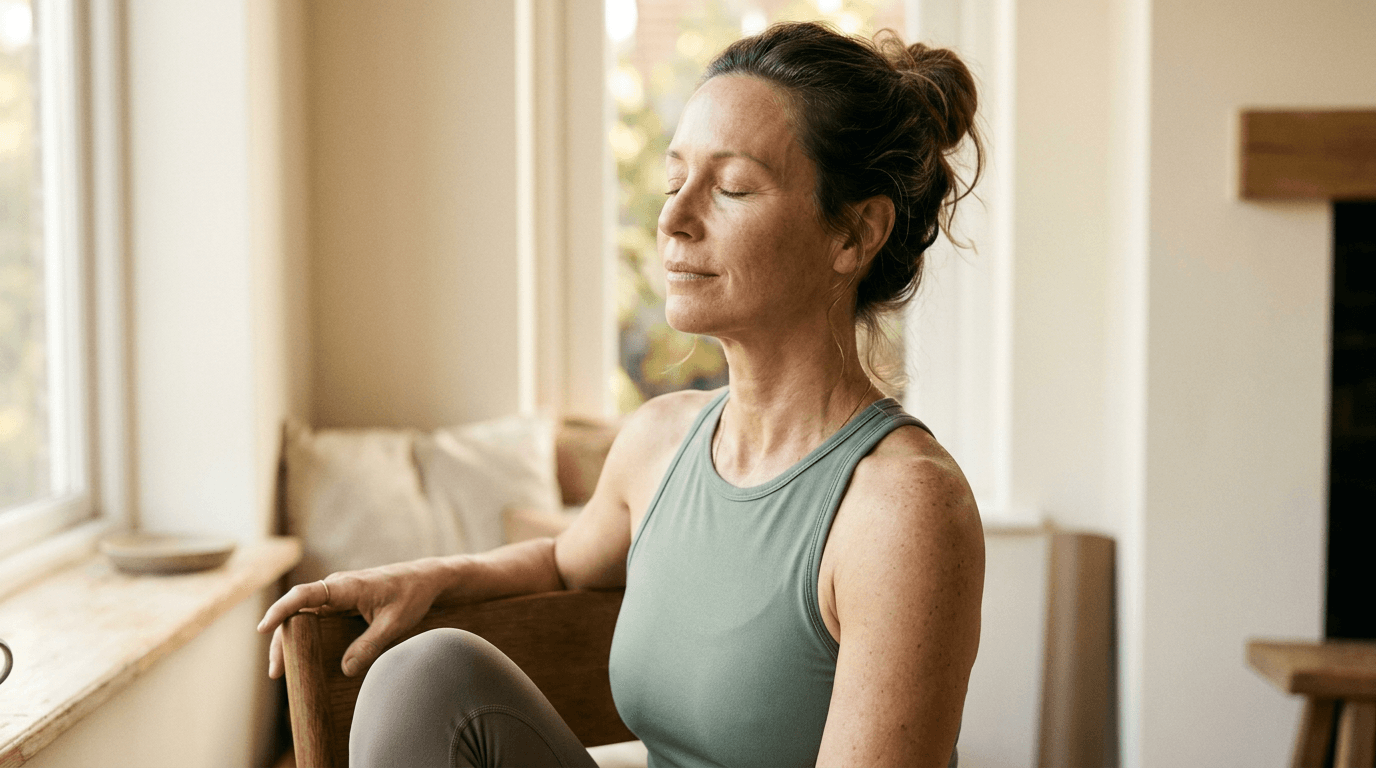
Restorative movement for midlife women means slow, deliberate mobility, breath-led stretching or short barre-inspired sequences that help the nervous system settle rather than brace. More intensity is not automatically more progress. Aim for sessions your body trusts, often around twenty minutes, alongside strength work like [Awaken Barre](/awaken-barre).
What counts as restorative movement, exactly?
Restorative movement is not the same as doing nothing, and it isn't the same as pushing through a hard set either. It sits between the two: slow, deliberate movement done with full attention, the kind that gives your nervous system somewhere to land rather than something to brace against.
In practice it can be genuinely simple. A few examples:
None of these need to look impressive from the outside. That's rather the point, and it's why this pillar gets skipped so often: it doesn't look like progress in the way a heavier weight or a faster mile does.
Which one you reach for matters less than picking one at all. The barre-inspired sequence suits a day when you have the full twenty minutes and want structure to follow. Breath-paced mobility work suits five spare minutes when one part of you, hips, shoulders, spine, feels tight. A held stretch fits an evening when sleep has been patchy. The slow walk is for days you need to be outside more than you need a routine. Swapping between them from one day to the next is normal, not a sign you can't settle on one.
- A short, barre-inspired sequence of holds and slow transitions, no jumping, no rushing
- Breath-paced mobility work, moving through one joint or one direction at a time
- A held stretch you stay in long enough to feel your breathing change
- A slow walk with no target pace or distance to hit
Why does your body need this differently in midlife?
The training advice most of us grew up with was built for a different body. In your twenties and thirties, more intensity usually meant more progress, and rest was just the gap between the hard sessions. That's the wrong map for the terrain you're on now.
The intensity that worked at twenty doesn't always sit the same way now. Stack a punishing workout on top of a poor night's sleep and a demanding week, and you're not necessarily building resilience, you may just be asking more of a body that's already carrying plenty. Restorative movement is a different kind of input, one that meets you at the pace the day allows rather than adding to it.
This isn't a sign anything has gone wrong. Midlife isn't a decline, it's a recalibration, and rest & illumination is one of five pillars of the Method for exactly that reason, alongside sleep, mindful movement, nourishment and connection. None of them do much good in isolation, and the strength work tends to land better once this one is in place.
In practice, that might mean noticing you've had three broken nights in a row and swapping the strength session you had planned for a restorative one instead, or choosing the slow walk over a faster one on a week that's already asking a lot of you elsewhere. It isn't about doing less overall. It's about matching the input to what the system can actually take on that day, the same way you'd eat differently after a poor night's sleep than after a good one.
Isn't this just stretching, or having a lazy day?
Not quite, and both of those are fine in their own right. A lazy day on the sofa is valid and sometimes exactly what's needed, but it's a different thing. Restorative movement has a shape to it: you're upright, or moving with intention, using your deep core and stabilising muscles even while the pace is slow.
Think of it as gentle done with intelligence and precision, rather than gentle meaning absent. You're still working. Just not against yourself.
The difference shows up in how your body's actually organised while you do it. On the sofa, your muscles largely switch off, which is exactly what a lazy day is for, and there's nothing wrong with that. In a restorative session you're still finding your footing: ribs stacked over hips rather than slumping into a stretch, a light hold through your midsection as you move slowly from one position to the next. It's a quieter kind of effort than a strength session, but it's effort all the same, which is part of why a session tends to leave you loosened rather than simply tired.
What does a session actually look like?
Most restorative sessions run around twenty minutes, the same length as the rest of the Method, because twenty minutes done with intention does more than an hour done on autopilot.
You might stand beside a chair or a wall for balance, the same kind of support you'd use at a barre, and move through a sequence of slow holds and transitions, breathing through each one rather than rushing to the next. No dance background required, no ballet steps to learn. No equipment beyond something sturdy to steady yourself on.
A typical twenty minutes might open with a minute or two of standing tall, feet hip-width apart, hands resting on the back of a chair, simply noticing your breath before you move at all. From there it moves through a handful of slow holds, a supported hip stretch, a gentle twist, a slow roll through the shoulders, each held long enough that your breathing visibly changes before you move to the next. The transitions matter as much as the holds: rather than dropping from one position into another, you move through the middle of it slowly, which is where much of the mobility work actually happens.
Morning or evening both work, and which suits you has more to do with your day than any rule about restorative movement itself, some use it first thing before the day speeds up, others in the evening as a way of signalling the day's asking is done. Loose clothing you can move in is all you need, bare feet or socks so you can feel the floor. If a hold doesn't suit you on a given day, shorten it or swap it for one of the other options rather than pushing through a sequence as written.
How will you know if it's actually working?
There's rarely one dramatic sign. More often it's smaller things: a bit more ease in how you move through the day, a hold that used to feel effortful settling into something more familiar, feeling steadier heading into a harder strength session the next day.
It's also fine if some days it seems to do very little. Consistency counts for more than any single session, and the point isn't to chase a feeling, it's to give your body a genuine option other than pushing through.
There's no need to track it formally. A quick mental check-in, does today feel steadier than a day without it usually does, is plenty. For a lot of women the clearest evidence turns up sideways: you only really notice the effect when a busy week knocks the sessions out entirely and things feel a touch more effortful again until you pick them back up.
How does this fit alongside strength work like Awaken Barre?
Restorative movement isn't a replacement for strength and mobility training, it's what makes that training sustainable. A body that never gets a genuine down-shift tends to stop responding to the up-shifts too, whatever intensity you're working at.
Missed a restorative session, or a whole week of them? That doesn't erase anything. Returning matters more than streaks. This isn't about perfect adherence, it's about building a rhythm you can actually keep, one that has room for both the effort and the recovery from it.
In practice that might mean a short restorative session the evening before an Awaken Barre class, or straight after one, using it to help the body settle rather than staying keyed up for the rest of the day. Some weeks that looks like two or three short sessions alongside two or three strength sessions. Other weeks it's whatever actually fits. There's no fixed ratio to hit, and the balance is meant to move with your week rather than the other way round.
You may also find barre for perimenopause, is barre good for menopause, do you need dance experience for barre, and online barre classes for women over 50 useful alongside this.
Common questions
Is restorative movement just stretching?
Not quite. Stretching lengthens muscle. Restorative movement adds deliberate, held positions and slow, breath-paced transitions that give your nervous system time to downshift too, not just your muscles.
How often should I do restorative movement?
No fixed quota. Many women use a short restorative session on a rest day or after harder strength work so the week stays sustainable. If barre is your main strength practice, pair it with the rhythm in [how often should I do barre](/blog/how-often-should-i-do-barre).
Do I need any equipment?
No. A sturdy chair or a wall for balance is enough, the same kind of support you'd use at a barre, and there's no need to seek out anything more specialist than that.
Will this replace my strength training?
No. Rest & Illumination is one of five pillars alongside strength and mobility, sleep, nourishment and connection. They work together rather than swapping one out for another, and skipping it tends to make the others harder to sustain.
I only have a few minutes some days, is that really enough?
Yes. In midlife your body tends to respond to precision rather than volume, so twenty minutes done properly counts as real work, not a consolation prize for a longer session you didn't have time for.