Barre for Balance Over 50: Why the Barre Works Better Than the Gym Floor
Chrissy Sundt · Mindful Movement ·
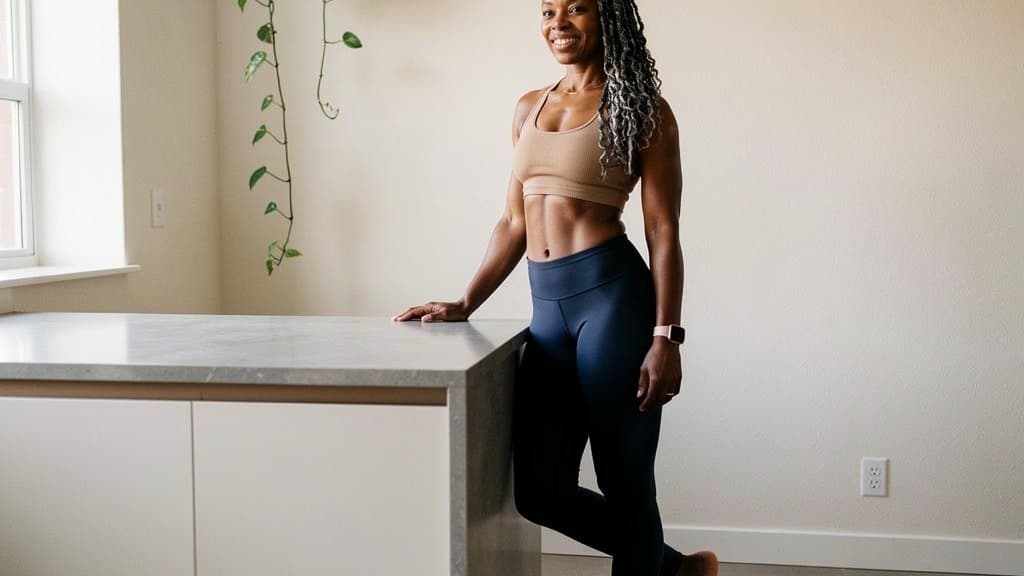
Barre improves balance over 50 by training the small stabilising muscles around your ankles, hips and deep core in slow, controlled positions, with the barre acting as a support rail rather than a piece of equipment. Short, regular sessions rebuild the coordination between your eyes, inner ear and muscles that everyday life stops asking of.
Why does balance feel less reliable in your 40s and 50s?
Balance isn't one thing. It's a constant, quiet negotiation between your eyes, your inner ear and the small stabilising muscles around your ankles, knees and hips, all reporting back to your nervous system many times a second. In your twenties and thirties, life kept that system busy without you noticing: stairs taken two at a time, sport, standing on one leg to put on trousers without thinking about it. In midlife, a lot of that incidental practice quietly disappears from daily routines, and the system that supports balance gets less rehearsal, not because anything is wrong with you.
Many women also find their body responds better to patient, controlled movement in midlife than it once did to force. That's a different instruction to your body than the one most exercise gives, which is usually more push, more reps, more speed.
None of this means balance is declining in some fixed, one-way sense. It means the terrain has changed and the map most of us are using, built for a younger body that didn't need to think about this, is out of date. You're not doing anything wrong. Your body is simply asking for a different kind of input, one that trains coordination and control rather than just strength or cardio.
How does barre actually train balance, rather than just movement?
Barre works because it isolates the exact muscles that balance depends on and asks them to hold, control and slowly release, rather than swing through a big range at speed. A tiny pulse in a turned-out position, a slow lift of the heel, a controlled shift of weight from two feet to one: these are small movements, but they are precisely the movements your stabilising muscles have stopped being asked to do.
The barre itself is doing quiet, important work here too. It isn't there for support because you're not capable. It's there so your nervous system can experiment with less certainty in a position that still feels safe, which is exactly how balance is rebuilt. You place one hand on the barre, take weight through one leg, and your body learns, again, what it feels like to hold that position and trust it.
This is also why the pace matters. Barre in this context isn't performed fast. It's deliberately slow and controlled, because a nervous system in midlife responds to consistency far more than it responds to intensity. Rushing the movement teaches nothing. Slowing it down gives your ankles, hips and deep core the repeated, specific information they need to recalibrate.
Over repeated short sessions, this builds a kind of body awareness, often called proprioception, that shows up off the barre too: in how steady you feel stepping off a kerb, reaching into a high cupboard, or standing to put on a shoe.
Do I need dance experience or existing flexibility to start?
No, and this is worth saying plainly because it puts a lot of women off before they begin. Barre is a fitness discipline inspired by ballet, not a ballet class. Nobody is teaching you choreography, checking your turnout, or expecting you to have done this before. The barre itself is simply a stable support, doing the same job as the back of a sturdy kitchen chair.
If you've never taken a barre class, or any class, in years, you are exactly who this is designed for. The positions are taught from the ground up, and modifications are always available, because the point isn't to look a particular way in the movement. The point is what the movement is doing for your stability, quietly, underneath the surface.
Flexibility isn't a prerequisite either. Balance work and flexibility are related but separate things, and you build the first through controlled, repeated practice, not through being able to touch your toes first. Plenty of the people who need barre-style balance work most are the ones who feel furthest from anything resembling a dance background, and that distance closes fast once you're actually in a session rather than imagining one.
What matters far more than prior experience is simply showing up consistently. Balance is rebuilt through repetition, not through arriving with any particular background.
What does a barre session built around balance actually involve?
A typical session moves between standing work at the barre and floor-based core work, because balance isn't only about the legs. Your deep core, the muscles that wrap around your midsection rather than just the visible abdominals, is what keeps your torso stable while your legs do the finer balancing work. That's the 360-degree activation that barre is built around: not just the muscles you can see, but the deeper structure that actually holds you steady.
At the barre, expect small, controlled movements: a slow plié with a shift of weight, a single-leg hold, a gentle heel raise held and released with control. These aren't dramatic movements, and that's deliberate. The value is in the precision and the repetition, not the size of the movement.
Sessions are also intentionally short, around 20 minutes, and that's a considered choice rather than a compromise. Balance training doesn't need exhaustion to work; it needs focus. Twenty minutes of precise, controlled work asks your nervous system for consistency without asking for exhaustion, which is exactly the input balance training responds to.
You finish a session having worked through standing balance, controlled core work and a bit of gentle mobility, without ever needing to have broken a sweat or performed a single dance step.
How often do I need to practise before I notice a difference?
Balance responds to consistency far more than to volume, which is genuinely good news if you're working around a full life. A short, regular practice, even a few sessions a week, keeps asking your stabilising muscles the question they need to stay sharp. One long, occasional session doesn't do the same job, because the adaptation comes from repetition, not from how hard any single session feels.
It's worth saying clearly: missed sessions don't erase progress. This isn't a streak to protect. If a week gets away from you, returning is what matters, not whether you kept an unbroken run going. Balance training is cumulative in a forgiving way, as long as you keep coming back to it.
Most women notice small, practical shifts before anything dramatic: feeling steadier getting up from the floor, less hesitant on uneven ground, more confident standing on one leg to get dressed. These are the everyday moments balance actually shows up in, and they tend to shift gradually rather than overnight.
Give it real weeks rather than days. Balance is a skill built through repetition, and like any skill, it responds to showing up more than it responds to any single, harder effort.
If you want that balance work held for you rather than reconstructed from a page, Awaken Barre is where these sessions live, twenty minutes, with the barre as support the whole way through.
Common questions
Is barre safe for balance work if I'm a complete beginner?
Yes. The barre is there specifically to give you a stable support while you work, so you can build confidence gradually rather than being asked to balance unsupported from day one. Sessions are taught from the ground up with no assumed experience.
Do I need any equipment at home to practise balance-focused barre?
You need something sturdy to hold, such as the back of a solid chair or a kitchen counter, and enough floor space to stand comfortably. No dedicated barre or ballet equipment is required.
Will barre help if I already feel quite unsteady?
Barre is a movement and coordination practice, not a medical treatment, so it isn't a diagnosis or cure for any underlying condition. If you already feel quite unsteady, check with a doctor before starting any new movement practice, so any underlying cause can be looked at first.
How is barre for balance different from Pilates or yoga?
There's overlap in the control and precision involved, but barre specifically uses the barre itself as a support so you can isolate single-leg and standing balance work in a way that's harder to replicate on a mat alone.
Can I do barre for balance if I have creaky or stiff joints?
Barre is built around slow, controlled movement rather than force or speed. It isn't a treatment for joint stiffness and it isn't designed to manage any joint condition, but the pace is simply different from high-impact styles. If you have ongoing joint concerns, check with a doctor before starting any new movement practice.