Does Barre Build Muscle After 40? Here's What's Actually Happening
Chrissy Sundt · Mindful Movement ·
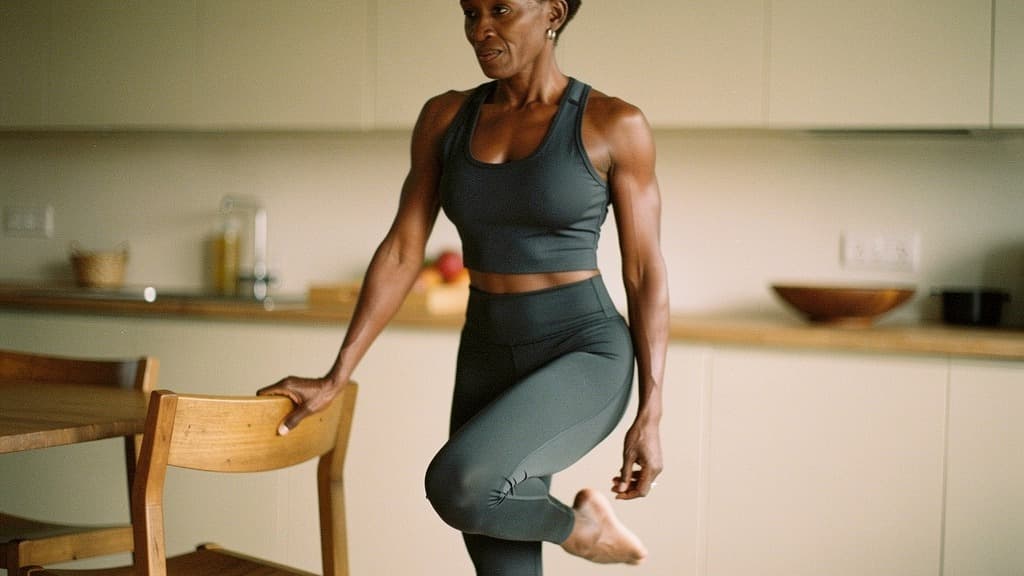
Yes, barre builds muscle after 40, though differently to how it did in your twenties. Small pulsing ranges and isometric holds create genuine muscular fatigue, particularly through glutes, deep core and the stabilising muscles around hips and shoulders. Combined with mindful, consistent practice, this builds real strength and functional capacity, not bulk, without needing heavy external load.
Does barre actually build muscle after 40?
Yes, it does, and this is one of the most common doubts I hear. Barre looks gentle from the outside: small movements, slow tempo, no dumbbells being thrown around. That appearance is misleading. The muscle work is happening in tiny, controlled ranges and long holds, which is a genuinely effective way to fatigue a muscle, just a different one to the version you might remember from your twenties.
The confusion usually comes from comparing barre to lifting heavy in a gym. That's the wrong comparison to make. Barre uses your own bodyweight, gravity and precise positioning to load muscles isometrically and through small pulses, which recruits the same muscle fibres as heavier resistance work, just over a longer time under tension rather than a heavier load moved fewer times.
What you build is strength you can actually use: the capacity to stand up from a low chair without using your hands, to carry shopping up stairs without your legs shaking, to hold a plank position without your lower back taking over. That's muscle. It's just not sold to you as muscle because it doesn't come with a personal record on a barbell.
How does barre create muscle fatigue without heavy weights?
Barre relies on three specific techniques rather than external load. Small pulsing ranges keep a muscle working continuously within a narrow range of motion, so it never gets a moment of full rest between reps. Isometric holds ask a muscle to stay contracted in one position for an extended period, building a different kind of endurance strength to a rep you complete and release. Both create genuine fatigue, the kind you feel as trembling or burning, without ever needing a weight rack.
Precision matters as much as the exercise itself. A pulse performed with correct alignment through the pelvis, ribs and shoulders recruits far more muscle fibre than the same movement done sloppily and quickly. This is why barre instruction spends so much time on positioning: it isn't fussiness, it's the actual mechanism that makes the work effective. Your body in your 40s responds to precision, not volume, so a handful of precise pulses will do more than thirty rushed ones.
Tempo is the third lever. Slowing a movement down forces the muscle to control it through the entire range rather than relying on momentum, which is why a slow barre sequence can feel harder than a fast one covering the same joints. None of this needs equipment beyond the barre itself, which is simply there for balance, the way you'd use the back of a sturdy chair.
- Small pulsing ranges: continuous tension, no rest between reps
- Isometric holds: sustained contraction for endurance strength
- Slow tempo: removes momentum, forces the muscle to do the work
- Precise alignment: recruits more muscle fibre than fast, loose repetition
What's different about building strength during perimenopause?
Your muscles haven't changed function, but the environment they're working in has. Hormonal shifts through perimenopause affect connective tissue, energy availability and how quickly you recover between sessions. Your body remains entirely capable of building strength; the approach that worked at 25 simply needs updating for the different terrain you're working with now.
Barre is built around contained, controlled intensity rather than maximal effort, because pushing hard for the sake of it isn't the goal here. You still get a genuine muscular burn, particularly through the deep core and glutes, but without leaving you feeling drained the next day. It's a deep burn without the burnout.
This is recalibration rather than decline. Your fascia and nervous system respond differently now: less to force, more to patience and repetition done well. This approach sharpens strength training rather than shrinking it, and it's exactly why barre, practised consistently over weeks, builds real capability rather than short bursts that leave you sore and then quietly giving up.
Which muscles does barre target most for women over 40?
Barre works the whole body, but a handful of muscle groups get particular attention because they matter most for how you move through daily life after 40. The deep core is one of the biggest focuses, and this doesn't mean crunching the superficial abdominal muscles you can see. It means the deeper structures wrapping around your spine and pelvis, the ones that actually create stability when you twist, lift or simply stand for a long time.
Glutes are the other major focus. They're a large, powerful muscle group that tends to switch off with a lot of sitting, and barre spends real time reactivating them through pulses, holds and controlled leg work at the barre. Strong glutes change how your hips and lower back feel during ordinary movement, from climbing stairs to getting out of a car.
Beyond that, barre trains the upper back and shoulder stabilisers, which counteracts the forward, hunched posture that builds up over years at a desk, plus the smaller stabilising muscles around the ankles and ribs that keep you steady in a single-leg balance. It's a full-body approach, but built around the specific muscles that make everyday strength and steadiness noticeable, not muscles that only look good in isolation.
- Deep core (the layer beneath the visible abdominals)
- Glutes and hips
- Upper back and shoulder stabilisers
- Ankle and lower-leg stabilisers for balance
How often do you need to do barre to notice real strength change?
Consistency matters far more than duration here. A 20-minute session done three or four times a week, week after week, builds more muscle than an occasional hour-long class squeezed in once a fortnight. The short length is intentional, not a compromise: it's long enough to genuinely fatigue the target muscles through pulsing and holding, and short enough that you'll actually do it on a Tuesday when you're tired.
You'll usually notice the change in capability before you notice it in the mirror. Standing up from a low sofa without pushing off with your hands, holding a plank a little longer than last month, feeling steadier on one leg while putting on socks: these are the early signs that the deep core and glutes are genuinely stronger, not just tired. Give it several weeks of regular practice before judging, since adaptation in muscle and connective tissue takes real repetition to show up.
If you miss a week, or several, that doesn't erase what you've built. This isn't a streak-based habit tracker where one gap resets you to zero. What matters is returning to it, again and again, more than never missing a session. That's the whole approach behind Awaken Barre: intelligent, consistent practice, built around a body that's recalibrating.
Common questions
Do I need to use weights for barre to build muscle?
No. Barre uses your own bodyweight, small pulsing ranges and isometric holds to fatigue muscle, particularly through the glutes and deep core. Some sessions may add light hand weights, but they aren't what makes the muscle work effective.
Will barre make me bulky?
No. Barre builds lean, functional strength through high repetition in small ranges rather than the heavy progressive loading needed to significantly increase muscle size. Expect more capability and definition, not bulk.
Is barre enough on its own to build strength after 40?
Barre builds genuine strength and stability on its own, especially through the deep core and glutes. Some women pair it with focused core work, like Love Your Core, for extra depth, but it isn't a requirement.
How is barre different from Pilates when it comes to building muscle?
Both build deep core strength, but barre adds standing, weight-bearing work at the barre that targets glutes, hips and legs more directly through pulses and holds. The two complement each other rather than compete.
Do I need any dance or ballet experience to do barre?
None at all. Barre is inspired by ballet but isn't a dance class, and the barre itself is only there as a balance aid, much like the back of a sturdy chair.