Best Bedding for Night Sweats: What Actually Helps You Sleep Cooler
Chrissy Sundt · Sleep ·
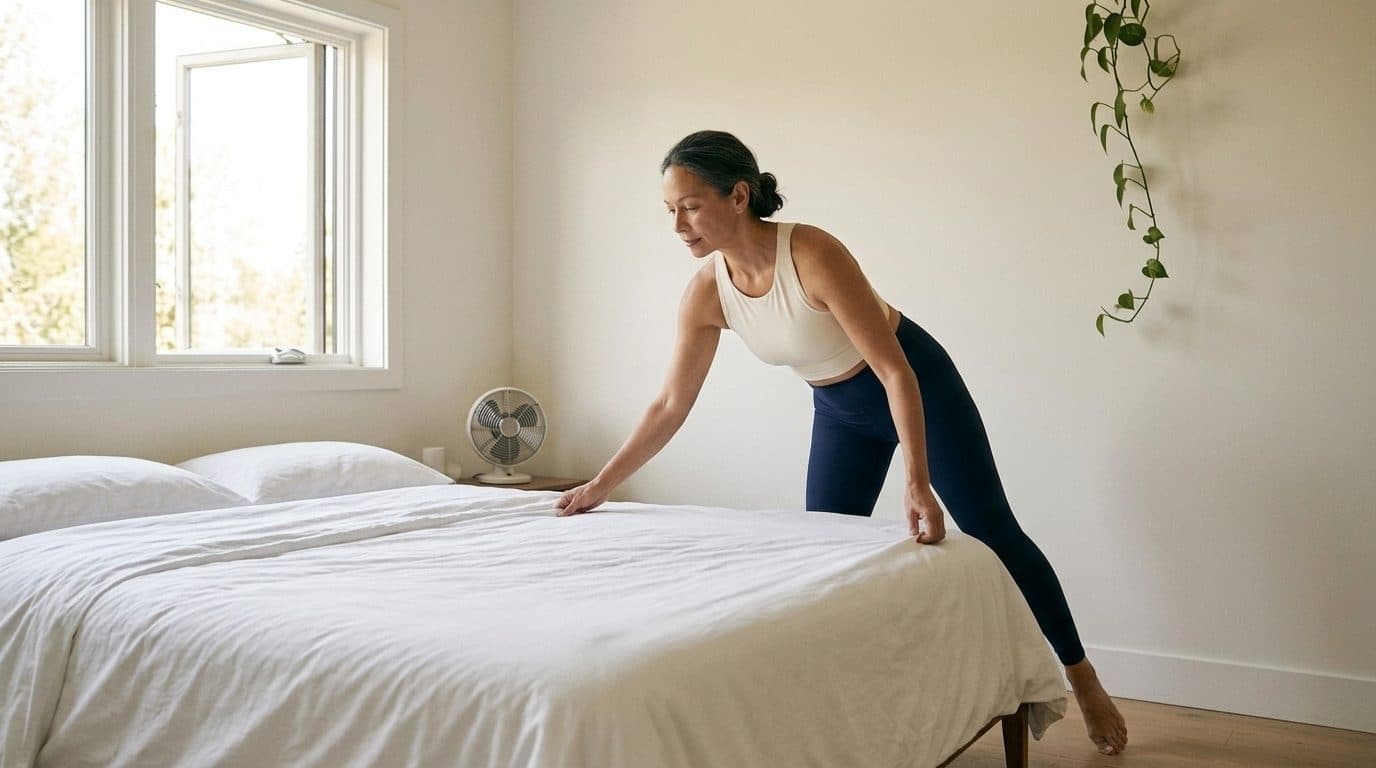
The best bedding for night sweats is natural, breathable fabric, cotton percale, linen or Tencel, paired with a lower-tog duvet, layers you can peel back, and a cool room. Your core temperature needs to drop before you can fall and stay asleep, and cooler bedding supports exactly that.
What fabric actually helps when you're waking up hot?
Fibre matters more than thread count. Cotton percale, linen and Tencel, a lyocell fabric made from wood pulp, all breathe because their fibres are hollow or naturally absorbent, pulling moisture away from your skin instead of holding it against you. Linen is the most forgiving of the three: it gets softer and more absorbent with every wash, and it dries fast enough that a damp patch at 3am doesn't sit there all night.
What to avoid is just as useful to know. Polyester and microfibre blends, even the ones marketed as 'cooling', are plastic fibres that don't absorb moisture, so sweat sits on the surface rather than moving through the fabric. Satin and heavy sateen sheets have a similar problem: the tighter, glossier weave that makes them feel luxurious is exactly what traps heat against your skin.
Weave is worth understanding too. Percale is woven in a simple over-under pattern that gives it a crisp, matte finish and a slightly looser structure, both of which help air move. Sateen uses a different weave that produces more sheen and a heavier drape, which feels rich but sleeps warmer. If a label doesn't mention weave at all, that's usually a sign it's a synthetic blend rather than one of these.
Do you need a new duvet as well as new sheets?
Sheets solve half the problem; the duvet solves the other half. Tog measures a duvet's warmth, and most people sleep under something far heavier than they need for most of the year. A 4.5 tog summer duvet, or even a cotton or linen blanket instead of a duvet, gives you room to regulate without waking fully to strip a layer off.
If you share a bed, a split or 'his and hers' duvet, two thinner single duvets laid side by side instead of one shared one, lets each person choose their own weight without one overheating to keep the other warm. It sounds like a small change but it removes a whole source of night-time negotiation.
Filling matters as much as tog rating. Down and feather duvets insulate well but hold heat close to the body, which is the opposite of what you want on a warm night. Wool-filled duvets and some bamboo-fibre fills regulate temperature more actively, drawing moisture away rather than just trapping warmth, and most are machine washable, which matters when you're changing bedding more often than you used to.
What temperature should the bedroom actually be?
Your core body temperature has to drop to fall and stay asleep, and a hot bedroom works directly against that. A bedroom noticeably cooler than most people keep their homes is a sensible starting point, worth aiming for rather than guessing at.
During the day, keep blackout blinds or curtains closed in a room that gets direct sun, so the space isn't already holding heat by bedtime. A fan positioned to move air across the bed, rather than just around the room, does more than a slightly lower thermostat setting. Cracking a window, even a few centimetres, keeps air moving instead of static, which matters more than most people expect.
There's a counterintuitive tip worth trying: a warm bath or shower about an hour before bed. It sounds like the opposite of what you want, but it brings blood to the surface of your skin, and as you cool down afterwards your core temperature drops faster than it would have done otherwise, which helps you fall asleep rather than lie there overheated.
Is a cooling mattress topper or protector worth it?
A topper changes what's directly under you, which matters because that's the surface you're in contact with for hours. Memory foam alone tends to sleep warm because it moulds close to the body and traps heat in the process. If you want the support without the heat, look for an open-cell or hybrid foam, or a wool topper, which regulates temperature the same way a wool duvet does.
Mattress protectors are easy to overlook but make a real difference. A plastic-backed waterproof protector, the kind designed to guard against spills, will trap heat exactly like a plastic bag would. A breathable, cotton-terry protector does the waterproofing job without sealing the mattress off from air.
None of this needs to be expensive to matter. A thin wool or cotton mattress pad under your usual sheet, swapping one synthetic pillow for a more breathable fill, or simply removing a protector you don't actually need, are small changes that add up faster than buying an entirely new mattress.
What else helps, beyond the bedding itself?
Bedding sets the conditions, but what you do when you wake up hot matters too. A simple principle worth knowing: if you're lying awake, frustrated and watching the clock, get up briefly rather than staying in bed fighting it. Lying there associates the bed with wakefulness, which makes the next night harder, not easier.
Practical logistics help more than people expect. Keeping a spare set of pyjamas, or even just a light change of top, within reach means you're not fully awake and searching drawers at 3am. Moisture-wicking sleepwear, in the same natural fibres as your sheets, does for your body what the bedding does for your bed.
A disrupted night doesn't undo the value of a consistent wake time the next morning. Keeping your usual wake-up time, even after a broken night, helps your body clock stay anchored, which makes the following night more likely to be easier. This is where bedding meets the wider pattern: it's one part of a sleep routine, not a fix on its own, and it works best alongside the rest of that routine, not instead of it.
If you want this as movement rather than another article, Awaken Barre is the twenty-minute programme I built for a body that has already changed.
Common questions
What's the single best fabric for night sweats?
Linen is usually the most forgiving because it absorbs moisture and dries quickly, but cotton percale and Tencel work on the same principle. Avoid polyester, microfibre and heavy sateen, which trap heat rather than moving it away from you.
Should I lower the tog of my duvet?
Yes, most people sleep under a heavier duvet than they need. A 4.5 tog summer duvet, or a cotton blanket instead of a duvet, gives you more room to regulate without fully waking to strip a layer off.
Is memory foam a problem for night sweats?
Memory foam alone tends to sleep warm because it moulds close to the body and holds heat there. An open-cell or hybrid foam, or a wool topper, gives you the support without the same heat build-up.
What temperature should the bedroom be?
A noticeably cool bedroom is a useful starting point, since your core body temperature needs to drop to fall and stay asleep. A fan moving air across the bed helps more than a slightly lower thermostat.