How to Sleep Cooler at Night in Perimenopause
Chrissy Sundt · Sleep ·
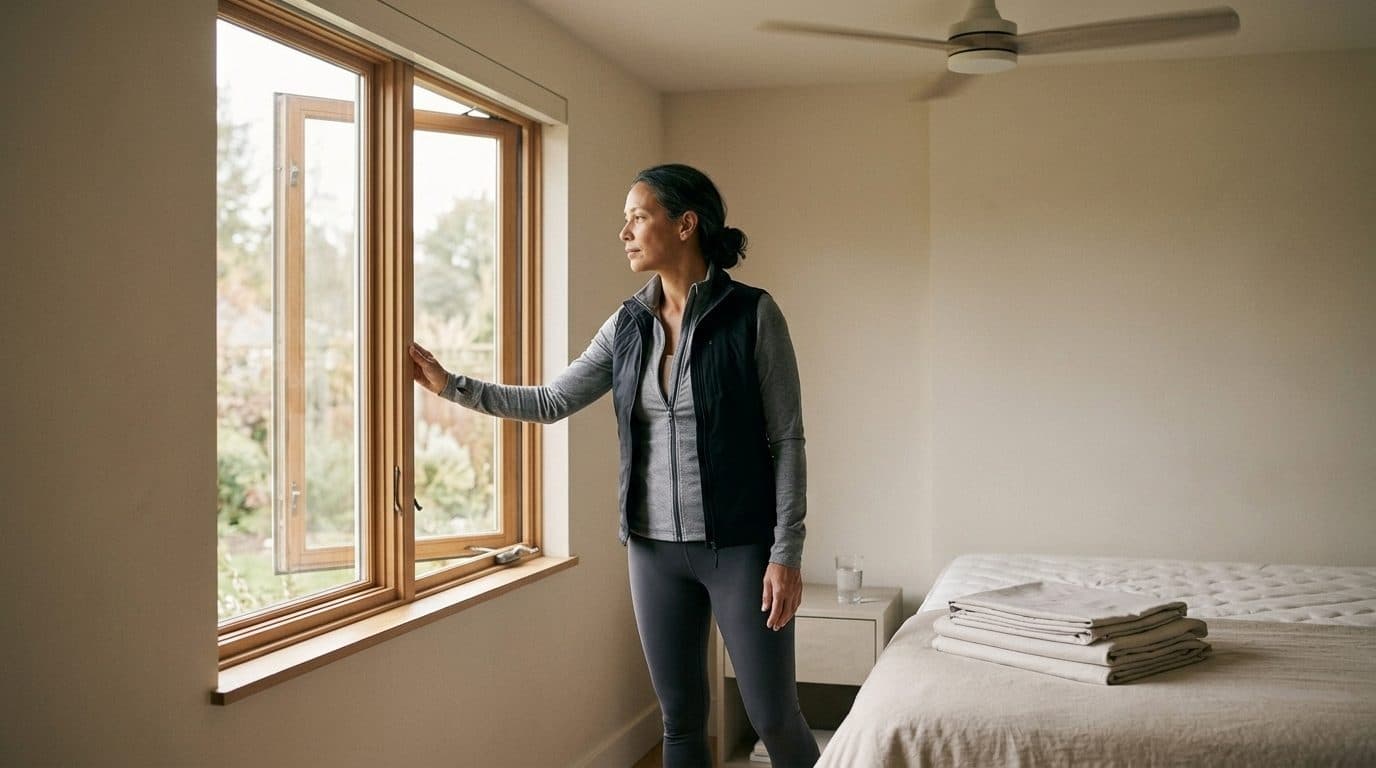
Sleep cooler in perimenopause by keeping your bedroom close to 18°C, taking a warm bath or shower about an hour before bed so your body can shed heat afterwards, choosing breathable natural fibres over synthetics, and moving caffeine and alcohol earlier in the day. A cooling body is part of what helps you fall and stay asleep, so anything that supports that shift works in your favour.
Why does perimenopause make nights feel so much hotter?
Many women in perimenopause describe a heat that seems to switch on from nowhere: you fall asleep fine, then wake an hour or two later flushed, damp, and fully alert, sheets stuck to your skin. It can feel erratic and unfair, arriving on nights when nothing about your evening was different from the one before.
Part of what's happening is that sleep itself changes shape in midlife, independent of any single hot night. Sleep naturally becomes lighter and more easily broken as we age. A rise in temperature that a much younger sleeper would sleep straight through is enough to pull you fully awake and keep you there.
None of this means your sleep is broken or that something has gone wrong with you. It means the conditions that used to protect a full night's sleep, a stable temperature, a predictable rhythm, now need more deliberate support. The rest of this article is about the parts you can actually influence: the room, the routine, and the small daily choices that either work with your body's cooling process or against it.
What temperature should your bedroom actually be?
There's a well-known mechanism worth understanding here: your body needs to cool down to fall asleep and stay asleep. That drop in temperature is part of what tells your brain it's time to sleep. If your bedroom is warm, or your bedding is trapping heat, you're working against that process rather than with it.
A commonly recommended benchmark is a bedroom around 18°C, cooler than most people keep their homes, and cooler than it feels comfortable to walk into before you've settled. Ventilation matters as much as the thermostat: a window cracked open, or a fan moving air rather than just noise, does more than turning the heating down a notch. If you share a bed with someone who runs warmer or cooler than you, a topper or an extra light layer on one side solves more arguments than a single shared duvet setting ever will.
It's worth treating this as an experiment rather than a fixed rule. Some women sleep best noticeably cooler than 18°C, particularly during a run of hot flushes; others need slightly more. The number is a starting point for testing what your own body responds to, not a target to hit exactly every night.
- Aim for around 18°C, then adjust up or down based on how you actually sleep
- Crack a window or run a fan for airflow, not just a lower thermostat number
- Use a topper or extra layer on one side of the bed if you and a partner run different temperatures
Does a hot bath before bed help or make things worse?
It sounds counterintuitive to add heat when you're already too warm at night, but a warm bath or shower around an hour before bed is one of the more reliable tools for falling asleep faster. The heat itself isn't the point, what happens after you get out is.
The explanation is that warming your skin draws blood flow to your hands, feet and extremities. Once you step out of the bath and that blood cools at the surface, your core temperature drops faster than it would have done otherwise, right at the point your body is trying to cool down for sleep. Timing matters: too close to bed and you're still warm all over; leave roughly an hour and the drop lands when you need it.
This is worth trying even on nights when a bath is the last thing you feel like having, particularly if you've been going hot and cold all evening. A shower does the same job in less time if a bath isn't practical. What doesn't help is a hot bath followed by climbing straight into a warm, unventilated room, since you've then removed the one part of the routine, the cooling afterwards, that was doing the work.
What should you wear and sleep on to stay cooler?
Fabric choice does more here than most people expect. Natural fibres, cotton, linen, bamboo, breathe and wick moisture away from your skin, while synthetic sleepwear and sheets trap heat and dampness against you, which is exactly what makes a flush feel worse than it needs to. This applies to nightwear, sheets and pillowcases alike.
Layering beats a single heavy duvet. A lighter tog duvet with a spare blanket folded at the foot of the bed means you can throw off warmth in seconds without fully waking up to do it, rather than lying there overheating because the only alternative is being cold. The same logic applies to nightwear: something you can push off one shoulder or kick free of matters more than any specific cooling fabric claim.
A few small, practical additions help too. A glass of cold water by the bed. A spare pillow kept cool, some women turn it over or even keep one in a pillowcase near an open window for exactly this reason. None of this needs to be expensive or elaborate. The aim is simply to remove the friction between feeling hot and doing something about it at three in the morning, when you're least equipped to problem-solve.
- Choose cotton, linen or bamboo over synthetic fabrics for sheets and nightwear
- Layer a lighter duvet with a spare blanket rather than one heavy single tog
- Keep a glass of cold water and a spare cool pillow within reach
What daily habits are quietly making nights hotter?
What happens hours before bed shapes how hot and disrupted your night feels, often more than anything you do in the bedroom itself. Caffeine is a useful reminder here: it has a half-life of roughly five to six hours, so an afternoon coffee is still substantially active in your system at bedtime even if you feel fine falling asleep. The same goes for alcohol, which acts as a sedative rather than a sleep aid, it can help you drop off faster but fragments the sleep that follows and tends to make night waking, including waking hot, more likely rather than less.
Light exposure earlier in the day matters just as much. Morning daylight is one of the simplest levers for regulating sleep, it helps set the timing of the whole cycle, including the temperature drop that lets you fall and stay asleep. Getting outside, even briefly, earlier in the day is a small habit with a disproportionate effect.
And if you do wake in the night hot and alert, know that the waking itself isn't the failure. Brief awakenings are a normal feature of sleep for everyone; what tends to make them worse is the frustration and clock-watching that follows. Get up if you need to cool down or change something, then go back to bed without turning it into a verdict on the whole night.
If you want this as movement rather than another article, Awaken Barre is the twenty-minute programme I built for a body that has already changed.
Common questions
Are night sweats in perimenopause something I should be worried about?
Waking hot and sweating is a common experience many women describe during this stage, and this article isn't the place for a medical opinion on your individual symptoms. If night sweats are frequent, severe or distressing, it's worth raising with your GP rather than managing it alone.
Do cooling mattress toppers or pillows actually help?
Many women find them useful, mainly because they support airflow rather than trapping heat the way memory foam can. They're not a substitute for a genuinely cool room and breathable bedding, but as one part of the setup they're worth considering.
Should I sleep with a fan on all night?
If moving air helps you personally, that's reason enough to keep doing it. Position it so it's circulating the room rather than blowing directly and constantly on you, which some women find drying or disruptive in its own way.
How late is too late for caffeine if I want cooler, calmer sleep?
Given caffeine's five to six hour half-life, an early afternoon cut-off gives your body a real chance to clear most of it before bed. If you're still struggling, moving that cut-off earlier is worth testing.
Is it normal to wake up at 3am even when the room is cool?
Yes. Brief night waking is a normal part of sleep architecture, not a sign anything has gone wrong. It tends to become more noticeable in perimenopause simply because sleep is lighter overall, so what you do with that waking matters more than trying to eliminate it entirely.