Best Protein Powder for Women Over 40: What Actually Matters
Chrissy Sundt · Nourishment ·
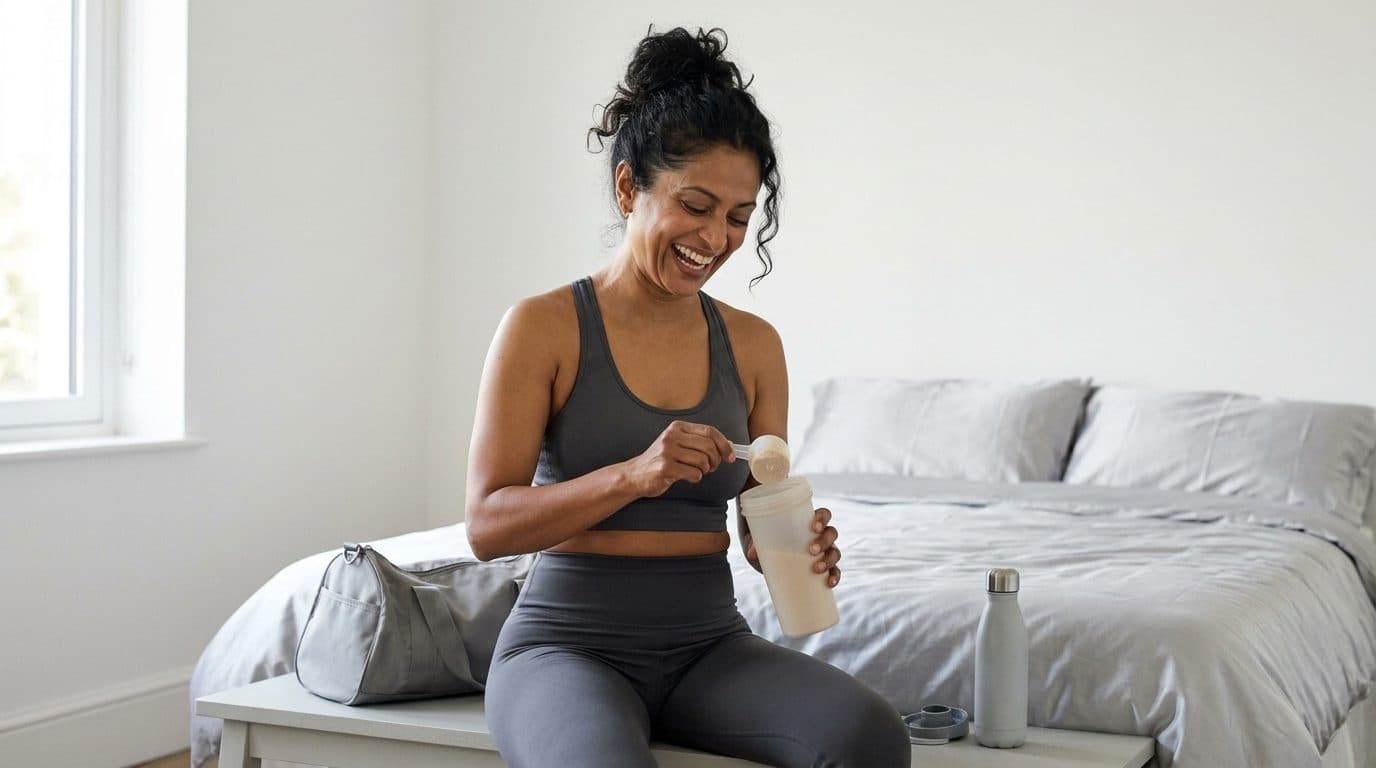
The best protein powder for women over 40 is the one you'll actually finish: a whey isolate or pea-and-rice plant blend with a short ingredients list, little added sugar, and a taste you don't dread. Match the type to your digestion, use it to close everyday gaps, and treat it as one tool alongside real meals.
Do You Actually Need Protein Powder, or Just More Protein?
Most women asking this question don't have a supplement problem, they have a timing problem. Whole food covers most of it: eggs, yoghurt, chicken, lentils, fish, tofu, and if you can build a plate around one of those at most meals, you may not need a powder at all. But by your forties you're often juggling work, a household and a body that's changed its rules, and a powder is simply the fastest way to close the gap between what you eat and what you need.
Exercise physiologist Stacy Sims argues that women are not small men, and the instinct many of us learned in our twenties, to eat less as we get older, works against us in perimenopause. Protein needs don't shrink with age. Training changes, hormones shift, and recovery asks for more attention than it used to, which is exactly why eating less overall is the wrong instinct to carry into this decade.
A protein powder isn't a magic ingredient and it isn't required. Think of it as a convenience tool for the days when cooking another protein-rich meal isn't realistic: stirred into porridge, blended into a smoothie, or shaken with milk after you train. It fills a gap. The plate still does the main work.
How Much Protein Do You Actually Need, and When?
There's no single number that fits every woman, and anyone selling you an exact gram target off the back of a protein powder tub is selling you certainty they don't have. What matters more is pattern: protein spread evenly across the day. Most of us load it almost entirely into dinner without ever noticing.
Breakfast is usually the meal with the biggest gap. Toast and coffee, a piece of fruit grabbed on the way out the door, none of it carries much protein, and by the time dinner arrives you're trying to catch up on a whole day's shortfall in one sitting. A scoop of powder in porridge or a shake alongside breakfast is often the simplest fix, because it's the easiest meal to underbuild.
Nutritionist Tina Lond-Caulk, who wrote MMM's Core Nutrition Reset, works with exactly this kind of pattern, looking at where protein is genuinely missing across a real day instead of handing over a generic target. There's no restrictive rulebook involved, only a smarter way to fit more protein into a day that's already full, and the powder is simply one tool inside that plan.
Whey, Plant-Based or Collagen: Which Type Actually Suits You?
Whey is the most studied option and usually has the most complete amino acid profile, but it's a dairy product, so if lactose sits heavily with you, look for a whey isolate, which strips out most of the lactose. A cheaper whey concentrate keeps more of it.
Plant-based blends, usually pea and rice or pea and hemp together, are a solid option if dairy doesn't agree with you or you simply prefer it, but check that it's a blend, because a mix of sources gives you a fuller amino acid spread than one on its own. Texture is the honest complaint here: plant powders tend to be grittier, and a smoothie with fruit or nut butter hides that far better than a plain shake with water.
Collagen is the one to be clear-eyed about. It's popular, but it isn't a complete protein and it doesn't behave like one. It's a different ingredient with a different job than your whey or plant scoop. If you like it, add it alongside your protein powder.
- Whey isolate: lower lactose, complete amino profile, a common post-session choice
- Whey concentrate: cheaper, more lactose, fine if dairy suits you well
- Plant blend (pea plus rice, or pea plus hemp): dairy-free, choose a blend over a single source
- Collagen: not a complete protein, a useful add-in, not a substitute
What to Check on the Label Before You Buy
Turn the tub around before you look at the marketing on the front. A short ingredients list is a good sign: protein source, a thickener or two, maybe a flavour, done. A long list of things you can't picture in a kitchen is usually filler, and filler is what you're paying for when you buy on brand name alone.
Added sugar is the one that catches people out. Some flavoured powders carry more sugar than a biscuit, so check the actual grams on the panel. Words like 'natural flavour' don't tell you much about sugar content. Artificial sweeteners aren't dangerous in normal amounts, but if you notice they upset your digestion, that's reason enough to choose a powder sweetened differently. Your gut's reaction matters more than any claim on the tub.
Third-party testing, a batch-tested or informed-sport style logo, matters more if you're also taking other supplements or medication, since it's a check on what's actually in the tub against what the label says. And be wary of any powder promising to transform your body or your hormones on its own. No powder does that, whatever the label implies.
- Ingredients list: short and recognisable, not a page of additives
- Added sugar: check the grams, not the marketing words
- Sweeteners: fine in moderation, drop it if your digestion complains
- Testing: a third-party batch-tested logo if you're on medication or other supplements
How to Actually Use It, Not Just Own It
The best protein powder is the one that's actually in your cupboard on a Tuesday. A tub you bought once and abandoned because the taste put you off does you no good at all. Buy the smallest size first, taste it before you commit to a large tub, and don't assume the most expensive option is automatically the best fit for you.
Timing matters less than people think, and more than 'as long as you get it in somehow' would suggest. A shake or smoothie after a strength session is a sensible habit, alongside porridge at breakfast is another, and either one works better as a fixed part of your routine than as something you remember occasionally. Returning to it after a missed day matters more than the miss itself.
If you're already training in short, focused sessions instead of long ones, the same principle applies to nutrition: precision over volume. One well-placed scoop, on the days it's actually needed, does more than a cupboard full of supplements used inconsistently.
This is exactly the kind of detail Tina Lond-Caulk built into the Core Nutrition Reset: real patterns for a real week in perimenopause, built to actually stick.
If the food side of this never quite settles, the Core Nutrition Reset is Tina explaining it in plain language, not another diet.
Common questions
Is plant protein as good as whey for women over 40?
A well-made plant blend, pea and rice or pea and hemp together, can deliver a similarly full amino acid profile to whey. The main differences are taste and texture. Choose based on digestion and preference, since whey isn't automatically the better option.
Does protein powder help with strength as I get older?
Exercise physiologist Stacy Sims argues that adequate protein intake matters for supporting strength as training and hormones shift through midlife. A powder is simply one way to make sure you're getting enough alongside resistance training.
Can you have too much protein powder?
More isn't automatically better. An extra scoop on top of a day that already includes enough protein-rich food just adds calories without much extra benefit. Use it where the gap is real.
Should I have it before or after I train?
Either works. What matters more is consistency, so pick whichever slot, before your session, after it, or alongside breakfast, you'll actually stick to.
Does collagen powder count towards my protein for the day?
Not fully. Collagen isn't a complete protein, so while it has its own uses, it shouldn't be counted as a replacement for your main protein source. Treat it as a top-up alongside your main scoop.