How Much Protein Do Women Need in Midlife? A Practical Guide
Chrissy Sundt · Nourishment ·
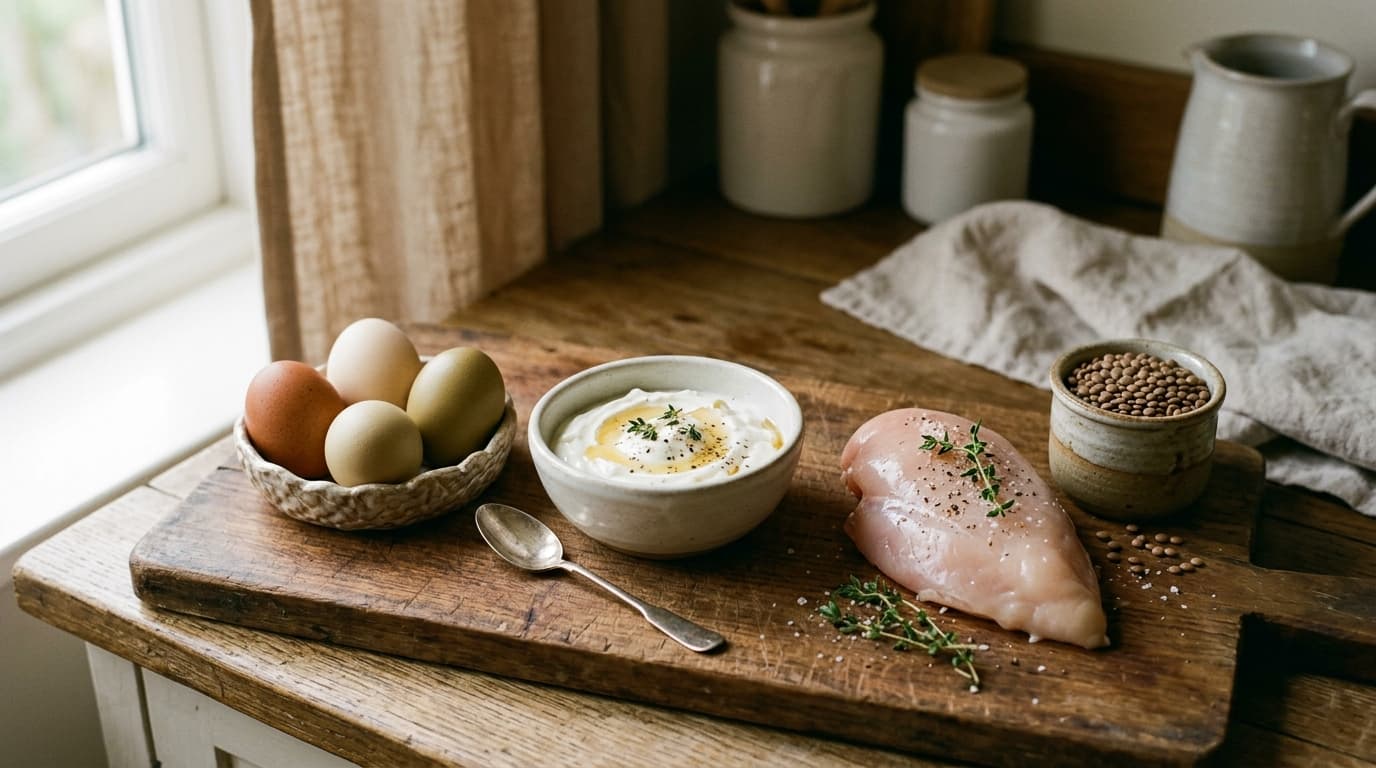
Most women need more protein in midlife than earlier decades taught them to eat. It works best spread across every meal, with breakfast and lunch carrying their share alongside dinner. There's no single gram target that fits everyone. What tends to work in practice is protein at breakfast, lunch, dinner and snacks, alongside regular strength training.
How much protein do women actually need in midlife?
A single gram target does not travel well across every woman's body, activity level and history with food. What matters more is the pattern across a day: more protein than many of us were taught to eat in our twenties, with breakfast and lunch each carrying a proper portion alongside dinner.
There's a simpler explanation for why the old targets fall short: they tend to assume a smaller body simply needs a smaller number, without accounting for what midlife itself asks of it. Midlife is where that assumption breaks down hardest. Cutting calories or protein to compensate for a slower metabolism tends to leave women under-fuelled for the training and daily life they're actually doing.
A practical version of this doesn't start with a spreadsheet of numbers. It starts with what a normal day of eating actually contains, and where protein has quietly gone missing, often at breakfast, often in the gap between lunch and dinner.
For most women that's a workable shift, not an overhaul: eggs or Greek yoghurt at breakfast, a proper portion of chicken, fish, tofu or lentils at lunch, protein again at dinner, and a snack that includes something like nuts or yoghurt alongside the carbohydrate.
Why do protein needs change in perimenopause?
Part of why the old numbers stop working is hormonal. Shifting hormone levels through perimenopause affect how the body handles a meal, and the changes go beyond muscle alone. Protein needs look different at this stage of life as a result.
One practical effect many women notice: a lunch built around protein carries them comfortably into the afternoon, where the same meal without it doesn't. The lunch that used to see them through to mid-afternoon stops doing that, and a plate built around more protein often does the job again.
Protein also plays a straightforward role in feeling satisfied after eating, which matters more when appetite, sleep and energy are already being asked to adjust to a lot at once. On a busy day it's usually the first thing to get skipped.
None of this means more protein is automatically better without limit. The target most of us learned in our twenties deserves a second look, since it was built around a different body and a different life stage.
What does 'enough protein' actually look like across a day?
Counting grams is less useful than thinking in terms of a protein source at each meal. Breakfast is the one most women skip protein on entirely, reaching for cereal, toast or fruit alone, then wondering why elevenses feels urgent.
Lunch and dinner are usually easier to get right if they're built around a clear centre: fish, chicken, eggs, tofu, beans or lentils, with vegetables and wholegrains around it. Protein as an afterthought on the side of the plate is the pattern worth changing.
Snacks are where protein most often disappears. A biscuit or a piece of fruit on its own is carbohydrate without much staying power. Pairing it with nuts, cottage cheese, yoghurt or a boiled egg changes how it holds you through the afternoon.
Spreading protein across the day is generally more useful to the body than one large portion at dinner. Breakfast is worth paying attention to first, since it's usually where the gap is biggest. A simple day might look something like this: adjust it to what you actually enjoy eating, and it doesn't need to be followed to the letter to be useful.
- Breakfast: eggs, or Greek yoghurt with seeds and fruit
- Lunch: chicken, fish, tofu or lentils with vegetables and a wholegrain
- Snack: nuts, cottage cheese or a boiled egg alongside fruit
- Dinner: a palm-sized portion of protein with vegetables and a starchy side
Do I need protein powder or supplements to get there?
For most women eating three meals and a snack most days, whole food gets you there without a tub of powder in the cupboard. Protein powder is a convenience for a rushed morning or after a session when cooking isn't realistic, nothing more than that.
If you do use it, treat it as one ingredient among several, folded into a meal you're already making. Stirred into porridge or blended with fruit and yoghurt, it tops up a meal you'd be eating anyway.
Supplements more broadly are worth approaching with the same question Tina Lond-Caulk brings to food: what is actually missing from a normal day. The Core Nutrition Reset is the programme she authored for MMM; you can see what it covers on the programme page.
Doing it the hard way earns no extra points, and the expensive way earns fewer still. The aim is a pattern you can actually keep going. A cupboard full of tubs you stop using by March doesn't count.
How does protein work alongside strength training in midlife?
Protein and movement do their best work together. Resistance training gives the body a reason to use protein for repair and maintenance, and without that signal, extra protein has less to do. This is part of why a nutrition shift on its own often feels less effective than expected, and why it makes sense to think about the two together, not as separate projects.
Short, focused sessions of strength and mobility work fit into a normal week. Protein spread through the day fits alongside that more easily than one large meal at the end of it.
The relationship works the other way too. Under-fuelled training in midlife, skipping meals, running low on protein, then trying to push through a hard session, wears women down. That's not the aim of any of this.
The two work together: one built through what's on the plate, the other through what you ask your body to do in a session.
Common questions
Is there one protein number every woman in midlife should hit?
No single figure fits every body, activity level and health history. What matters is protein turning up at every meal, not just one. The Core Nutrition Reset looks at your own eating pattern in more detail; you can find out more on the programme page.
Can I get enough protein from plant foods alone?
Yes. Lentils, beans, tofu, tempeh, nuts and wholegrains all contribute protein, and combining a few of them across a meal covers what animal sources would otherwise provide. The main adjustment is usually eating a slightly larger volume of plant protein to match what a smaller portion of meat or fish would give.
Will eating more protein help with weight?
That isn't a claim we make here. What protein reliably does is help meals feel more satisfying and support the muscle you're using in daily life and training.
Should I eat protein before or after a workout?
Either works. What seems to matter more across the day is the total pattern, protein at each meal, more than any narrow post-workout window. A snack with protein in it before or after a session is a reasonable, simple habit either way.
What if I struggle to eat enough protein at breakfast?
Start small: swap toast alone for toast with eggs, or add Greek yoghurt and seeds to fruit you're already eating. It doesn't need to be a big shift, just a consistent one.