A 20-Minute Full Body Strength Workout for Women in Midlife
Chrissy Sundt · Mindful Movement ·
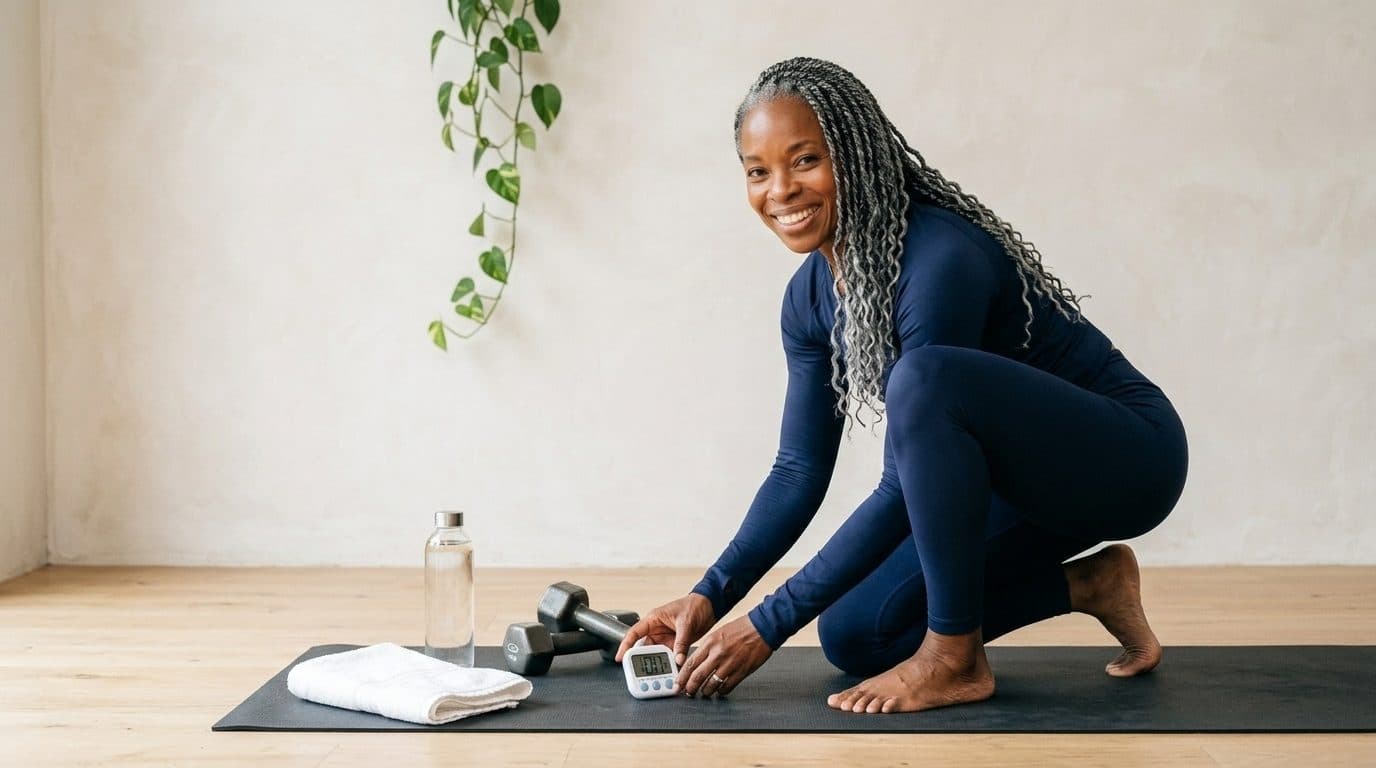
A 20-minute full body strength workout for women in midlife should combine compound, multi-joint movements, squats, hinges, presses, rows, with core and balance work done at a controlled tempo. In perimenopause, precision and consistency matter more than duration or intensity, so a shorter, well-sequenced session can build genuine strength without adding fatigue.
What should a 20-minute full body strength workout actually include?
A genuinely full body session isn't about touching every muscle for sixty seconds each. It means choosing movements that ask several muscle groups to work together: a squat pattern, a hinge pattern such as a deadlift shape, a push, a pull, and something for the deep core and balance. Those patterns, done properly, cover the body far more effectively than an hour spent moving between isolated machines.
The reason 20 minutes works comes down to sequencing. You start with the movement that needs the most coordination while you're fresh, then layer in work that combines strength and stability, such as a single-leg stance held under light tension, or a slow, controlled lowering phase on a squat. Tempo does a lot of the work that used to come from simply adding more weight.
Barre sits comfortably inside this structure because it was built around small ranges of motion, isometric holds and controlled tempo from the outset. Its balance element, the barre itself, or the back of a sturdy chair at home, means the stabilising muscles around the hips, ankles and spine are working throughout, not just during a separate core section at the end. That is full body training, organised with more attention than volume.
- Squat pattern: sit-to-stand strength
- Hinge pattern: hamstrings, glutes, low back
- Push and pull: upper body and posture
- Core and balance: deep stability, not just visible abs
Is 20 minutes really enough to build strength in midlife?
This is the question I get asked most, and it deserves a straight answer: yes, provided the training matches what your body is actually doing in perimenopause. Women are not small men, and training built for a physiology in its twenties doesn't automatically scale down for someone in her forties or fifties navigating shifting hormones. What matters is that the stimulus is aimed at the right target: a well-loaded twenty minutes can ask more of your muscles than an hour of steady cardio or circuit work that never gets past a light sweat.
What actually builds strength in this phase is well-chosen resistance, worked through a full range with control, done consistently across the week. That means picking a load or position that's still genuinely challenging on the last few reps, and slowing the tempo down enough to feel it working.
I'd rather someone did four properly loaded, well-sequenced 20-minute sessions a week than one long, unfocused hour on a Sunday they can't repeat. That's the whole case for a shorter session done with more attention rather than more time.
What does this look like without a gym or heavy weights?
You don't need a rack of dumbbells or a membership for a full body strength session to count. Bodyweight, gravity and control are genuinely enough to create a strength stimulus, particularly if you slow the tempo down and hold positions rather than rushing through reps to get to the next thing.
This is where barre earns its place. It's a fitness discipline inspired by ballet, not a dance class, and you need no dance background whatsoever to do it well. The barre itself, whether it's an actual barre or the back of a sturdy kitchen chair, is simply there to give you something to steady a hand on while you work through positions that challenge balance and small-range strength at the same time. It takes the fear out of wobbling mid-exercise, which matters more than people admit once balance starts to feel a little less automatic than it used to.
A few light hand weights, a resistance band or a cushion for kneeling work will extend what you can do, but none of it is essential to start. What matters far more than equipment is whether the session asks your muscles to work through a genuine range, under control, on a regular basis.
Why doesn't the training that used to work, work anymore?
If the workouts that once left you pleasantly tired now leave you wiped out for two days, your body is asking for a different approach than the one that worked a decade ago.
Recovery, hormone patterns and how your nervous system responds to stress all shift through perimenopause, and training that ignores that tends to add fatigue rather than strength. This is why longer, harder sessions can start to feel counterproductive: your body isn't rewarding the extra effort the way it once did, however hard you push through it.
What tends to respond instead is training built around control, held at an intensity your system can genuinely recover from between sessions. That's the argument for a focused 20 minutes over an exhausting 60: it works with the body you have now, not the one you trained a decade ago, and it doesn't need heroics to be effective.
How do I actually fit this into a busy week?
Practically, aim for three sessions a week as a starting rhythm, with at least a day between each so your muscles genuinely recover rather than just feeling sore. Two focused sessions most weeks will still move you forward; four is plenty for most people without needing more than that.
Missing a session doesn't undo the last one. Progress in strength training comes from the pattern across weeks and months, not from an unbroken streak, so a session lost to a late meeting or a sick child doesn't erase what the previous sessions built. Returning to it matters more than never missing one in the first place.
The other practical shift is treating 20 minutes as the whole session, not a warm-up for something longer you never get round to. Put it in the diary like any other appointment, keep the same corner of the room clear for it, and treat the 20 minutes as finished when it's finished.
If you want this as movement rather than another article, Awaken Barre is the twenty-minute programme I built for a body that has already changed.
Common questions
Do I need any equipment for a 20-minute full body strength workout?
No. Bodyweight and a sturdy chair back for balance support is enough to start. Light hand weights or a resistance band can add more later, but they're not essential.
How many days a week should I do a session like this?
Two to four sessions a week, with at least a day of recovery between them, is a realistic and effective rhythm for most women in midlife. Consistency across weeks matters more than doing it every single day.
Is a 20-minute session really enough, or should I be doing more?
In perimenopause, well-sequenced, controlled training tends to work better than longer sessions done without the same precision. Twenty minutes, done properly and repeated, is a genuine strength stimulus, not a compromise.
Is barre the same as a ballet class?
No. Barre is a fitness discipline inspired by ballet, but it needs no dance experience at all. The barre itself is simply a balance aid, much like the back of a sturdy chair.
What happens if I miss a session?
Nothing is undone. Progress builds from the pattern of sessions over weeks, not from a perfect streak, so returning to it matters far more than never missing one.