Core Strength in Perimenopause: Why the Old Approach Stops Working
Chrissy Sundt · Mindful Movement ·
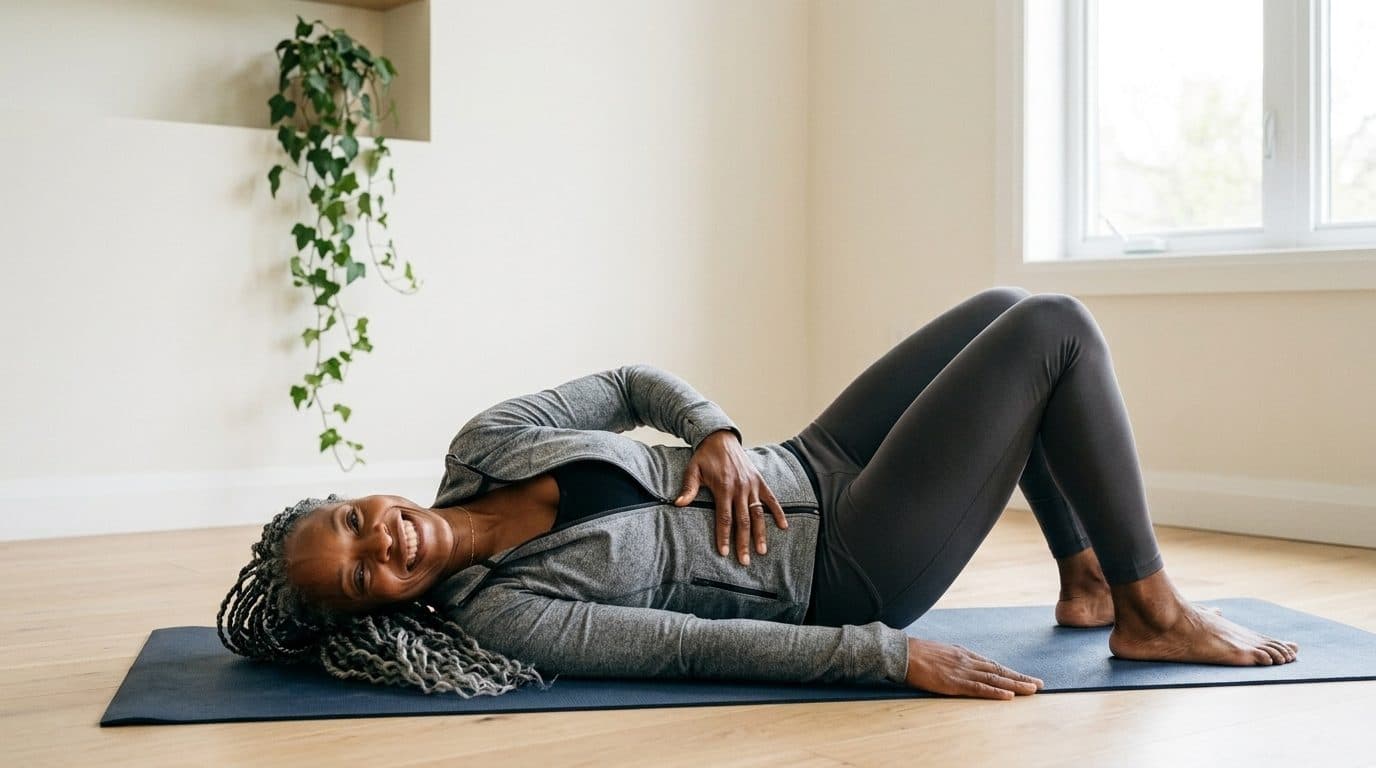
Core strength in perimenopause needs a different approach, because fluctuating hormones change how your connective tissue and deep core muscles respond to training. Real stability comes from breath-led, precise work on the diaphragm, pelvic floor and deep abdominal wall, not more crunches or longer planks.
Why does core strength feel different in perimenopause?
Core strength stops behaving the way it used to somewhere in your forties, and it isn't your imagination. The exercises that used to firm things up, the crunches, the planks held for as long as you could stand, can start to feel like they're working against you: gripping through the lower back, no real sense of connection through the middle, sometimes outright discomfort. That's not you doing it wrong.
Your hormones are shifting, and connective tissue, fascia, the web that wraps every muscle, responds differently to training when oestrogen is fluctuating rather than steady. Exercise physiologist Stacy Sims has spent her career arguing that women are not small men, and nowhere is that clearer than here: training built for a male physiology, or for your own body twenty years ago, doesn't automatically transfer to the body you're in now.
None of this means your core has gone soft or given up on you. It means the signals it responds to have changed, and the training needs to change with them. The deep core muscles that create real stability, the ones you can't see in a mirror, are just as trainable now as they've ever been. They simply need a different kind of attention than they used to.
What is 'deep core' strength, and how is it different from ab exercises?
Ab exercises and deep core strength are not the same thing, and mixing them up is where a lot of core training goes wrong. A crunch mostly targets the rectus abdominis, the muscle sitting on the surface, by curling the spine forward. It can build some superficial tone, but it does very little for the structures that actually hold you upright, protect your spine under load, and let you move without bracing every time you bend or twist.
Deep core strength lives underneath that layer: the transverse abdominis wrapping around like a corset, the multifidus running along the spine, the diaphragm and pelvic floor working as the top and bottom of what's sometimes called the core canister. These structures work together on every breath, whether you're lifting a shopping bag, getting up off the floor, or standing still in a queue.
That's the idea behind training the whole canister rather than just the surface: the deeper structures create the real stability, and the muscles you can see come along as part of that, not as the goal. It tends to feel less dramatic than a traditional ab workout. There's no burn building to failure. What you're building instead is control, the capacity to stabilise your spine and pelvis under everyday load, in a way that holds up whether you're thirty-five or seventy-five.
- Transverse abdominis: wraps around the trunk like a natural corset
- Multifidus: small muscles supporting the spine along its length
- Diaphragm and pelvic floor: the top and bottom of the core canister
How much core training do you actually need in perimenopause?
Twenty minutes, done well, is enough, and that's a deliberate choice, not a compromise. In perimenopause, volume isn't the lever it used to be. Long sessions, especially ones that push cortisol up further when it may already be running high, don't necessarily produce more stability; sometimes they produce more fatigue and less recovery. What moves things forward instead is precision: fewer repetitions done with proper breath and alignment, rather than more repetitions done on autopilot.
A deep core session built around twenty minutes has room for a warm-up that reconnects breath to movement, a focused block of controlled core work, and a cool-down that lets the nervous system settle rather than staying switched on. That structure matters more than the clock. Rushing through core work, or trying to grind through fatigue to finish a set, tends to recruit the wrong muscles, the back, the hip flexors, the neck, instead of the deep stabilisers you're training.
Consistency across the week counts for more than the length of any single session. Three focused twenty-minute sessions, spaced out, generally build more real capability than one long, effortful one squeezed in when energy allows. If a session gets missed, it doesn't erase what came before. Returning to it is what matters, not maintaining an unbroken run.
What does a deep core session actually involve?
A deep core session doesn't look like a traditional ab workout, and if you're expecting rows of crunches, it can take a moment to recalibrate what you're looking at. Much of the work happens lying down or seated, with small, controlled movements: tilting the pelvis, drawing the ribcage down over the hips, breathing into the sides and back of the ribs rather than just the chest.
Breath leads almost everything. Instead of holding your breath through an exertion, as you might in an old-style plank, you're coordinating an exhale with the moment of deepest activation, which is what actually switches on the transverse abdominis and pelvic floor rather than the muscles that compensate for them. It can feel underwhelming at first if you're used to training that leaves you shaking or sweating. That's not a sign it isn't working.
Barre-trained core work borrows some of its shapes from that discipline, small pulses, held positions, an emphasis on alignment, without needing any dance background or a literal barre; the back of a sturdy chair does the same job. Over a session you'll move between lying, seated and standing positions, always coming back to the same question: can you keep the deep structures switched on as the position gets harder. That's the actual training.
How will you know your core strength is improving?
Progress in deep core training rarely shows up as a visible change first. It shows up as an easier get-up off the floor, less bracing when you sneeze or laugh, a sense of your middle working as one connected unit rather than several parts fighting each other. Carrying shopping in one hand without your lower back complaining. Standing up from a low chair without needing to push off with your arms.
These are the markers worth paying attention to, more than a mirror or a measuring tape. They tend to show up gradually, over weeks rather than days, and not always in a straight line; a poor night's sleep or a stressful week can make a session feel harder even when your underlying strength hasn't gone anywhere. That's normal, not a setback worth abandoning the practice over.
The longer view matters more than any single week. Training your deep core now, consistently and without grinding, is what lets you keep doing the ordinary physical things, lifting, carrying, getting up and down off the floor, without a second thought, decades from now. That's the whole idea behind training to be Strong Enough for 85™: not chasing a flatter stomach this month, but building a middle that keeps working for you long after this year is over.
- Getting up off the floor with less effort
- Less bracing or gripping when you cough, sneeze or laugh
- Carrying shopping or lifting without your lower back taking the strain
Common questions
Is core work in perimenopause the same as doing ab exercises?
No. Ab exercises like crunches mostly work the surface muscles, while deep core training focuses on the diaphragm, pelvic floor and the muscles wrapping around your spine. Both can play a role, but the deep structures are what actually create stability for everyday movement.
Do I need any equipment or barre experience to start?
No dance background is needed and no barre is required at home. Barre-inspired work uses the back of a sturdy chair or a wall in exactly the same way a barre is used in class, purely as a balance aid.
Can strengthening my core help with back discomfort or bladder leaks?
This is movement education, not medical treatment, and it isn't designed to diagnose or treat any condition. Many women find that building strength and coordination through the deep core changes how comfortable and capable they feel day to day, and it's sensible to speak with a health professional about specific symptoms directly.
How long before I notice a difference?
There's no fixed timeline, and it depends on where you're starting from and how consistently you train. Most women notice functional changes, like an easier get-up off the floor, before they notice any visible change, and progress tends to build gradually over weeks rather than days.
What if I've had a baby, surgery, or an existing injury?
Everybody's history with their core is different, and this content doesn't replace individualised medical guidance. If you have a specific health condition or recent surgery, checking with a relevant health professional before starting is a sensible first step.