Deep Core vs Abs Exercises: What's Actually the Difference?
Chrissy Sundt · Mindful Movement ·
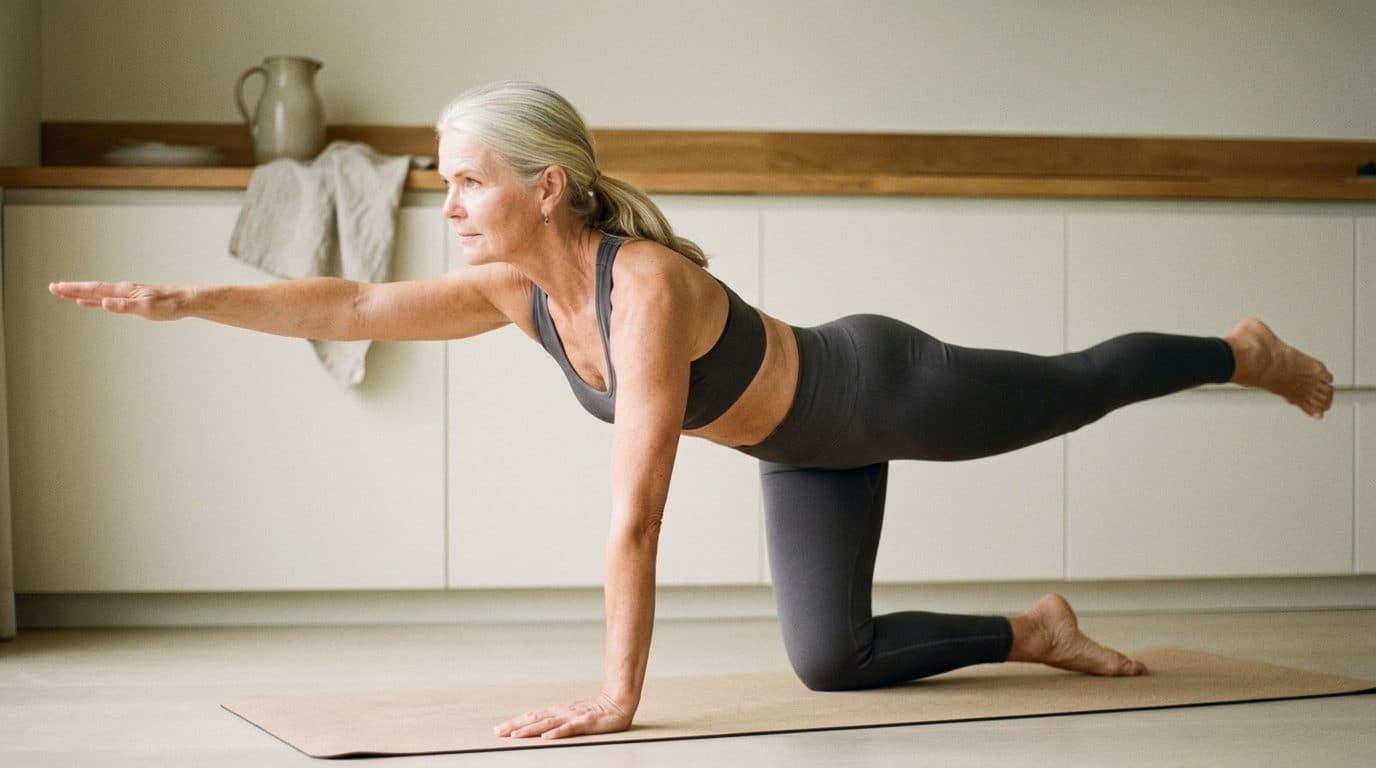
Deep core work and abs exercises train different things. Abs exercises like crunches target the surface rectus abdominis for visible tone. Deep core work trains the transverse abdominis, pelvic floor and diaphragm together, the structures that create real stability, breath control and support for lifting, twisting and balance in everyday midlife movement.
What's Actually the Difference Between Deep Core and Abs Exercises?
Abs exercises are the ones most of us grew up with: crunches, sit-ups, the odd flurry of bicycle kicks. They target the rectus abdominis, the long surface muscle that runs from your ribs to your pelvis and gives the front of your stomach its shape when it's toned and visible. It's a real muscle doing real work, but it's only one layer of a much deeper system.
Deep core is a different job entirely. It's the transverse abdominis wrapping around your midsection like a corset, your pelvic floor underneath, your diaphragm above, and the deeper fibres of your obliques and multifidus along your spine. Together they create a pressure system that stabilises your spine before your arms or legs even move. You don't see this layer in the mirror. You feel it when you pick up a laundry basket without your back complaining, or twist to check your blind spot without a twinge.
That's the real distinction. Abs exercises train shape. Deep core training trains function, the ability to brace, breathe and move through your day without your spine doing more than its share of the work. Both have a place. The confusion starts when women assume flatter abs mean a stronger core, and stop there.
- Transverse abdominis, the deep corset layer
- Pelvic floor
- Diaphragm
- Multifidus and the deeper oblique fibres
Why Do Crunches Stop Feeling Like Enough in Midlife?
If crunches used to feel like plenty and now leave you unconvinced, that's not your imagination. Women's training needs shift with hormonal change, and midlife bodies benefit from programming built for their own physiology rather than a scaled-down version of what worked at thirty. Rising and falling oestrogen affects how your connective tissue and nervous system respond to load, so training that never asks anything of your deeper stabilisers starts to feel thin.
Crunches are also a flexion exercise, repeated forward bending of the spine. Done occasionally that's fine. Done as your only core work for years, it trains one direction of movement and largely ignores rotation, anti-rotation and the bracing you need for real life, which rarely happens lying on your back with your knees bent.
None of this means crunches are wrong or that your abs stopped working. It means your priorities shift. The deep structures that support your spine, your pelvic floor and your breath need direct attention now in a way they may not have when you were twenty-five, because everything downstream of them, posture, balance, how your back feels after gardening, depends on it.
What Does Deep Core Training Actually Look Like?
Deep core work rarely looks dramatic. There's no crunching, no counting reps until your neck aches. A session might start lying down with your knees bent, breathing into your ribs and low belly, learning to feel your transverse abdominis switch on as you exhale, before you ever add a limb. That sounds simple. It's harder than it looks, because most of us have spent decades bracing from the wrong muscles.
From there the work builds: a dead bug pattern, where you extend opposite arm and leg while keeping your low back gently in contact with the floor, or a bird dog on hands and knees, testing whether your midsection stays steady while a limb moves. Standing work matters just as much, holding light resistance at your side while keeping your ribs stacked over your pelvis, or bracing through a slow squat with one hand resting on a chair for balance.
What ties it together is breath. Deep core training uses your exhale to cue the pelvic floor and transverse abdominis to work together, rather than holding your breath and gripping, which is what most of us default to under effort. It's slower than an abs circuit, and it should be. This is precision work, not a burnout.
How Do You Know You're Working Deep Core, Not Just Abs?
There are a few honest checks. Watch your belly during a plank or a standing brace: if it domes or bulges forward under effort, you're likely pushing from the surface rather than drawing in from the deep layer. A well-recruited deep core tends to flatten or stay quiet, not strain outward.
Notice your breath too. If you're holding it through an exercise, jaw clenched, that's a surface strategy. Deep core work asks you to keep breathing, usually exhaling on the effort, which is also how your pelvic floor gets involved rather than left out of the conversation entirely.
Pay attention to where you feel the work as well. Straightforward abs exercises tend to announce themselves at the front, right under your ribs. Deep core work is quieter and wraps further round, into your sides and lower back, and sometimes you barely feel it during the exercise at all, only afterwards, in how steady you feel standing up from the floor or carrying something awkward through a doorway.
If none of this feels familiar yet, that's normal. It's a different sense to build, and it takes a few sessions of paying attention before it starts to register.
- Does your belly dome or bulge under effort, or stay quiet?
- Are you holding your breath, or exhaling through the work?
- Where do you feel it: only at the front, or wrapping into your sides and back?
How Does Deep Core Work Fit Into a 20-Minute Session?
Deep core training doesn't need long sessions to matter, which is useful, because most of us aren't looking to add another hour to the week. Twenty minutes is enough to work through breath-led activation, a few standing or floor patterns, and some rotation or anti-rotation work, without the session sprawling into something you can't sustain.
What matters more than duration is what you do inside it. Deep core work responds to precision rather than volume: doing fewer repetitions well, with your breath and bracing actually coordinated, teaches your nervous system more than pushing through a long set with poor form. That's also why it fits into a short, focused window rather than needing an hour at the gym.
Consistency carries more weight than any single session. A short core practice done three or four times a week, returned to even after a missed week, builds the kind of stability you notice in ordinary moments, not because one workout changed anything, but because the pattern became familiar to your body over time.
That's the shape of the practice inside Love Your Core: short, breath-led sessions built specifically around the deep structures this article has been describing, rather than another abs circuit dressed up differently.
Common questions
Can I still do crunches if I enjoy them?
Yes, there's nothing wrong with the occasional crunch or sit-up. Just don't rely on them as your only core work, since they mostly train one direction of movement and skip the deeper stabilising layer altogether.
Will deep core training give me a flatter stomach?
Deep core work isn't designed around appearance, it's designed around function, stability and how your midsection supports the rest of your body. Some women notice how their posture and clothes sit change over time, but that's a side effect of function improving, not the goal.
How long before I notice a difference?
There's no fixed timeline, but many women describe noticing a difference in balance, posture or how their back feels doing everyday tasks after a few weeks of consistent short sessions. It's a gradual sense of steadiness rather than a single dramatic before-and-after.
Do I need any equipment to start?
No. Deep core training can be done on a mat with your own bodyweight and breath, sometimes with a chair nearby for balance during standing work. Nothing about it requires a gym or special kit.
Is deep core work suitable if I have back discomfort?
This is education about movement, not medical advice, so if you have ongoing back pain it's worth checking with a health professional before starting anything new. Many women find gentle, breath-led core work more comfortable than high-impact abs exercises, but your own situation should guide the pace.