How to Build Community as an Introvert in Midlife
Chrissy Sundt · Connection ·
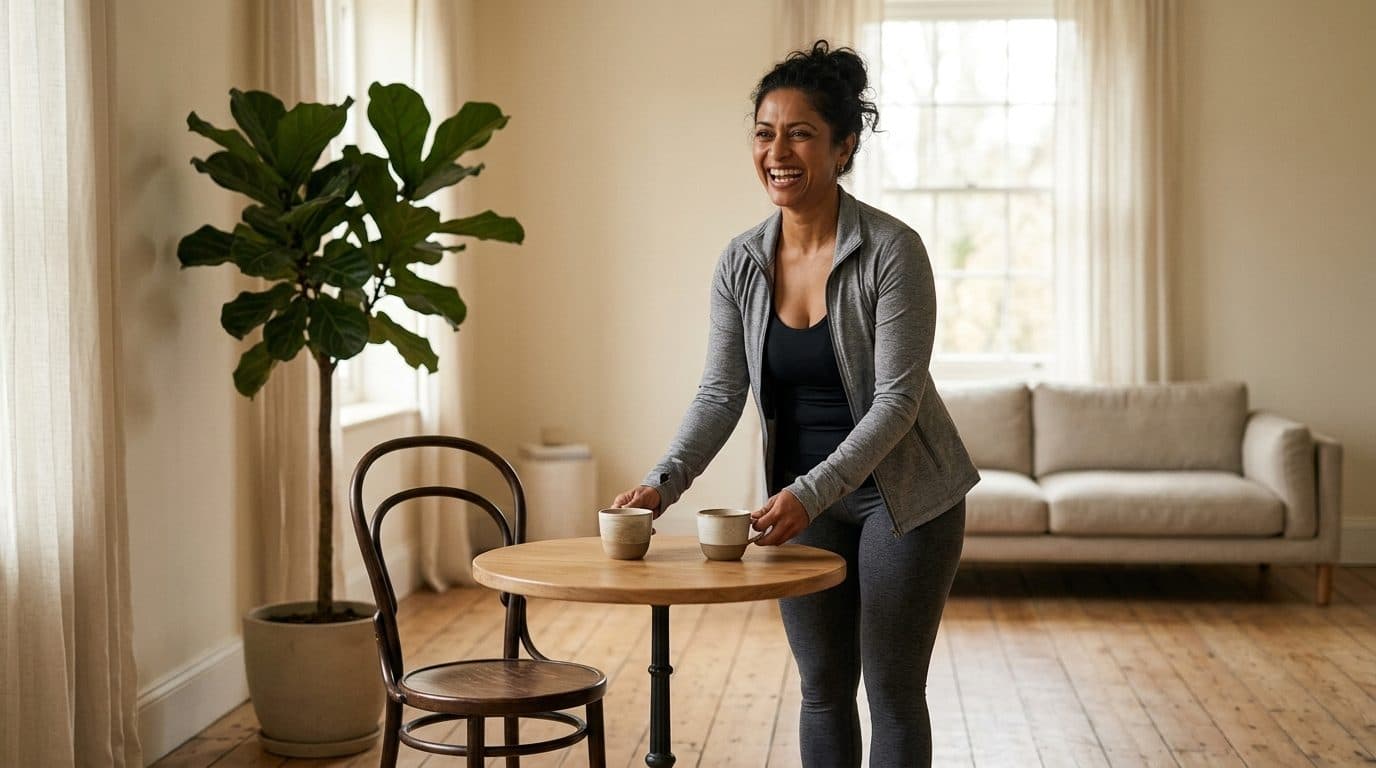
As an introvert in midlife, build community around depth: one or two small, recurring gatherings, with structure doing the socialising for you, a class, a walking group, a regular sit-down. Consistency in low-stimulation settings builds real connection, and it doesn't require forcing yourself into draining rooms.
Why has it gotten harder to make friends now than it used to?
In your twenties and thirties, friendship mostly happened by proximity: university corridors, first jobs, the school gate, the same nursery run. You didn't have to build community, you were already standing inside one. Midlife strips a lot of that scaffolding away. Kids get older and need you less at the gate, careers shift into different rhythms or wind down, people move away, marriages change shape, and if perimenopause has you running on less sleep and shorter patience, the energy for casual socialising is often the first thing to go.
If you're an introvert, this shift lands differently. Adult friendship increasingly requires initiation, you have to actively choose it and keep choosing it, when circumstance no longer hands it to you. For someone who has always found large groups and small talk more draining than energising, that move from passive to active can feel like starting again from nothing, with no obvious first step.
None of this means something has gone wrong with you personally. It means the automatic systems that used to generate connection have quietly switched off, and nobody sent a memo. Rebuilding community in midlife comes down to deliberately designing new, smaller systems to replace the ones you've outgrown.
Do introverts even need community, or is solitude enough?
Solitude has real value, and there is nothing wrong with a life that includes long stretches of it. But needing less social contact than someone else is not the same as needing none. Loneliness and social isolation take a real toll over time, on mood, on resilience, on how supported you feel when things get hard, and that's true regardless of personality type or how someone prefers to spend a Saturday.
That doesn't mean everyone needs the same amount, or the same kind, of contact. An introvert's version of well-connected might be two or three people she can be fully honest with, seen a handful of times a month. It doesn't have to look like a packed social calendar. You're not trying to manufacture an extrovert's social life, or force yourself into rooms that leave you flattened. What matters is keeping the few connections you do have real, current, and not left to quietly disappear under the weight of a busy decade.
That reframe matters, because a lot of introverts avoid community-building altogether once they've decided they'd have to become a different kind of person to manage it. You don't. You simply need less input, delivered more deliberately and more often than you might assume.
How do you build connection without small talk or big groups?
The easiest way to bypass small talk is to remove the empty space it usually fills. Shared-activity settings work better for introverts than mingling events because there's a third thing in the room, a task, a class, a walk, and conversation happens around it. It never has to carry the whole event. You're not required to perform sociability; you're simply present while something else is going on.
This is one reason a recurring class works differently to a one-off social event. Turning up to the same short session most weeks, an Awaken Barre class, say, puts you in a small, familiar room with the same few faces, at a pace that never demands performance. Over weeks, that low-effort repetition does more for a sense of belonging than a single big night out ever could, because it's built on recognition that grows week after week, and nobody expects you to make conversation while you're mid-exercise.
The same logic holds outside a studio. A walking group of three, a monthly chapter shared with one friend, a standing coffee, all work on the same principle: structure carries the socialising, so you don't have to generate it from nothing every time. Look for anything with a fixed time, a small headcount, and a reason to be there beyond talking, and let the activity do the work small talk usually has to do.
What does sustainable, low-key connection look like week to week?
Community doesn't have to mean a wide circle. For most introverts in midlife, it looks smaller and more repeatable than that: the same one or two people, contacted often enough that you're never starting the relationship from scratch each time you speak. Breadth is expensive to maintain, and depth, kept up in small doses, costs very little.
In practice that might mean a weekly voice note to one friend, a standing twenty-minute coffee before work, or hosting two people for soup on a weeknight. None of it needs to be a group chat you mostly scroll past, a big catch-up that takes weeks to arrange, or a dinner party for eight that you'll spend all evening managing. The scale of the gesture matters far less than its regularity. A small, boring, repeated contact beats an impressive one that only happens twice a year.
None of this needs to be dramatic, and it isn't a checklist to complete all at once. Aim for a shorter list of people who actually know what's going on in your life, kept warm through small, ordinary contact. Big gestures are easy to keep postponing for months; small, regular ones rarely need postponing at all.
- Pick one recurring, structured activity over one-off invitations
- Message one person on the same day each week, whether or not you feel like it
- Host smaller and more often: two people round a table beats eight, twice a year
- Say yes to a second invitation even if the first felt effortful
- Let go of any gathering that requires performing energy you don't have
How do you keep showing up when cancelling feels easier?
Introverted or not, the hardest part of any of this shows up in the fourth week, not the first coffee or the first class: when your energy is low, the sofa is right there, and cancelling feels like self-care. Sometimes it genuinely is the rest you need. But if cancelling keeps happening week after week, it's worth noticing that avoidance and rest can look identical from the outside, even though they aren't the same thing.
Missing a week doesn't erase the ones before it. Returning is what counts. If you skip a session or a standing coffee, just go back next time; the habit hasn't failed. That's true of a barre class and it's just as true of a friendship: the relationship survives the gap far better than it survives you quietly giving up on it.
Set the bar low enough that showing up is nearly always possible: arriving for twenty minutes and leaving early still counts, and a short message still counts as reaching out. Community, for an introvert, gets built by a long string of ordinary, low-stakes appearances that add up quietly over months.
If you want this as movement rather than another article, Awaken Barre is the twenty-minute programme I built for a body that has already changed.
Common questions
Is it normal to have fewer friends in midlife than in your twenties?
Yes. The settings that used to generate friendship automatically, school gates, offices, shared early-adult milestones, thin out with age. A smaller circle in midlife reflects changed circumstances. It says nothing about your ability to make friends.
Do I need to become more extroverted to build community?
No. The goal is right-sized connection, and that doesn't require changing who you are. A small number of real, regularly maintained relationships does more for you than a wide social circle you can't sustain.
What's a low-effort first step if I've lost touch with most people?
Pick one recurring activity with a fixed time and a small group, a class, a walk, a regular sit-down. You don't need to reconnect with everyone at once. Structure does the work small talk usually has to.
What if I keep cancelling plans once I make them?
Notice whether it's rest or avoidance becoming a pattern. Missing a week doesn't undo the ones before it, and the habit is far more likely to survive if you just go back next time.