Barre for Women Who Hate the Gym: A Kinder Way Back to Movement
Chrissy Sundt · Connection ·
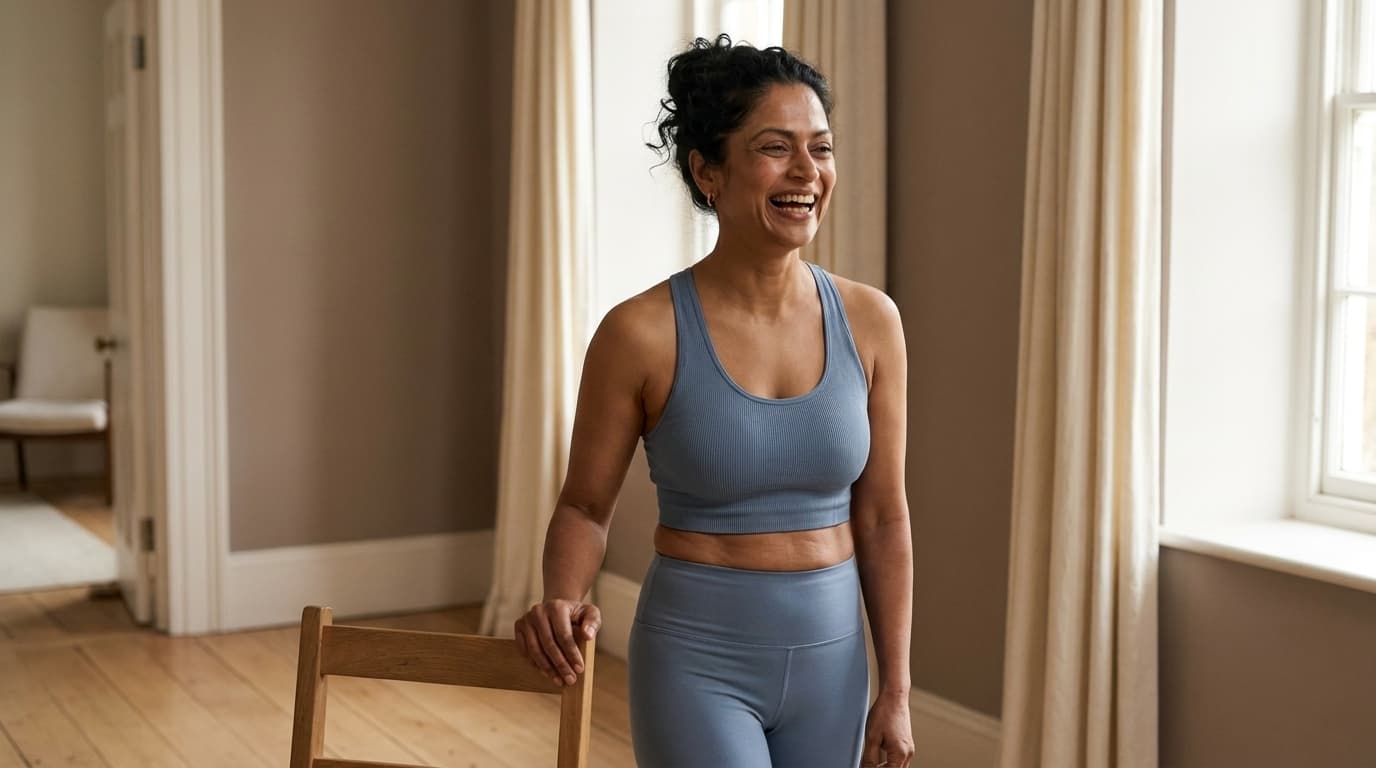
If you hate the gym, barre works because it removes exactly what you dislike: no machines, no mirrors lined with strangers, no feeling watched. Awaken Barre sessions run around 20 minutes, using a chair or wall as a simple balance aid, so you build strength and confidence in your own space, at your own pace.
Why does the gym feel like the wrong fit for so many of us in midlife?
Most gyms were designed around a fairly narrow idea of a body: young, already confident, comfortable being watched. Add fluorescent lighting, a wall of mirrors, machines that need an instruction manual, and a room full of people who all seem to already know the routine, and it is no wonder so many women quietly stop going. That discomfort is not vanity, and it is not laziness. It is your body accurately reading a room that was never built with you in mind.
In midlife the mismatch tends to get sharper. Your energy shifts from one week to the next, your joints and balance feel different, and a class designed for someone's twenty-something recovery capacity can leave you sore, discouraged, or simply unwilling to go back. That is not you failing at exercise. It is a sign you are using the wrong map for the terrain you are now in.
Barre for women who hate the gym works because it strips out the parts that never worked for you in the first place: the mirrors, the noise, the sense of being compared to everyone around you. Awaken Barre is practised with nothing more than a sturdy chair or a wall for balance, in your own room, on your own schedule, so the only person you are answering to is yourself.
What actually happens in a barre class, if there are no weights or machines?
Barre is a fitness discipline inspired by ballet, not a ballet class, and it needs no dance background whatsoever. The barre itself is simply a balance aid, the same job as the back of a sturdy chair. You use it to steady yourself while you work through small, controlled movements that target the legs, glutes, seat and deep core, often held or pulsed rather than swung through quickly.
The approach is different from a typical gym session, and that is deliberate. Instead of chasing a burn through speed or heavy load, barre builds strength through precise, repeatable positions that ask your muscles to hold and stabilise, which suits a body looking for something steadier than another rushed, sweaty circuit.
A typical session moves through a simple arc: a short warm-up to wake up mobility, a series of standing or chair-supported holds for the lower body, some floor-based core work, and a slower stretch to finish. Nothing about it is rushed, and nothing requires you to already know what you're doing.
- A few minutes of gentle mobility to warm up
- Small, controlled holds and pulses at the chair for legs and seat
- Deep core work, not just the surface abs
- A short stretch to close the session
Do I need to be flexible, coordinated or already fit to start?
No. This is one of the most common worries, and it comes from confusing barre with dance, which is an easy mistake given the name. You do not need turned-out feet, prior ballet training, or any existing fitness base. The movements are small, slow and clearly guided, and the chair or wall is there specifically so you always have something to steady yourself on.
If you have fallen out of the habit of exercise entirely, whether that was months ago or years ago, this is built to be the easiest way back in, not a test you might fail on day one. There is no choreography to memorise and no pace you are expected to match. You move at the speed your body can actually manage that day, and that is enough.
What matters far more than flexibility or coordination is simply showing up and starting where you are. Your body isn't broken and it isn't behind. It is evolving, and barre meets it there rather than asking it to perform like it did twenty years ago. Not less ambition, more intelligence, applied to movement you can actually sustain.
How does barre help me reconnect with my own body, not just move it?
Away from mirrors and other people's pace, something shifts. Without a room to compare yourself against, attention naturally turns inward, to how a hold actually feels in your thigh, how your breath changes as you steady on the chair, how your balance is a little different on the left than the right. That noticing is the practice, as much as the movement itself.
Barre asks you to work the deep core through small, controlled positions that invite you to feel where you are, rather than override it, and the same attentiveness runs through the rest of the body too. Over repeated 20-minute sessions, that builds a kind of trust between you and your body that a rushed, noisy gym circuit rarely leaves room for.
This is what connection looks like in practice: not performing for an audience, real or imagined, but reclaiming your centre one honest, unhurried session at a time. It is a quieter kind of confidence, built from the inside, and it tends to stay with you well beyond the twenty minutes on the mat.
What if I've been out of exercise for a long time, can I really start again with this?
Yes, and this is exactly who barre for women who hate the gym is built around. You need no equipment beyond a sturdy chair or a clear stretch of wall, no gym membership, and no history of recent training. Sessions run around 20 minutes, which is intentional rather than a compromise, because in midlife your body responds to precision far more than it responds to volume.
Restarting after a long gap is often less about physical capacity and more about the fear of getting it wrong in front of people, or not knowing where to begin. Barre removes both of those barriers. Each movement is small enough to learn on the spot, and because you are at home, there is no one watching your first, imperfect attempt but you.
Missed sessions don't erase progress either. This isn't a streak app and it isn't Duolingo. Returning matters far more than never stopping, so if a week slips or life gets in the way, the next twenty minutes still counts. That forgiving structure is often what makes it possible to stay with movement long enough for it to actually change how you feel.
Common questions
Is barre just a ballet class in disguise?
No. Barre is a fitness discipline inspired by ballet, not a dance class, and it needs no dance experience. The barre itself is only a balance aid, doing the same job as the back of a sturdy chair.
What equipment do I actually need at home?
Just a sturdy chair or a section of wall to steady yourself against. There is no need for a gym membership, weights or specialist kit.
How long are the sessions?
Around 20 minutes. That length is intentional, built around precision rather than volume, so a full session fits into an ordinary morning or evening without needing to clear your whole day.
What happens if I miss a few sessions or fall off track?
Nothing is lost. Missed sessions don't erase progress, and returning matters far more than an unbroken streak. You simply pick back up at the next twenty minutes.
Is this suitable if I've never exercised regularly before?
Yes. It is designed as a beginner-friendly route back to movement for women who have fallen out of the exercise habit, with no prior fitness or dance background required.