How to Find a Women's Fitness Community in Midlife
Chrissy Sundt · Connection ·
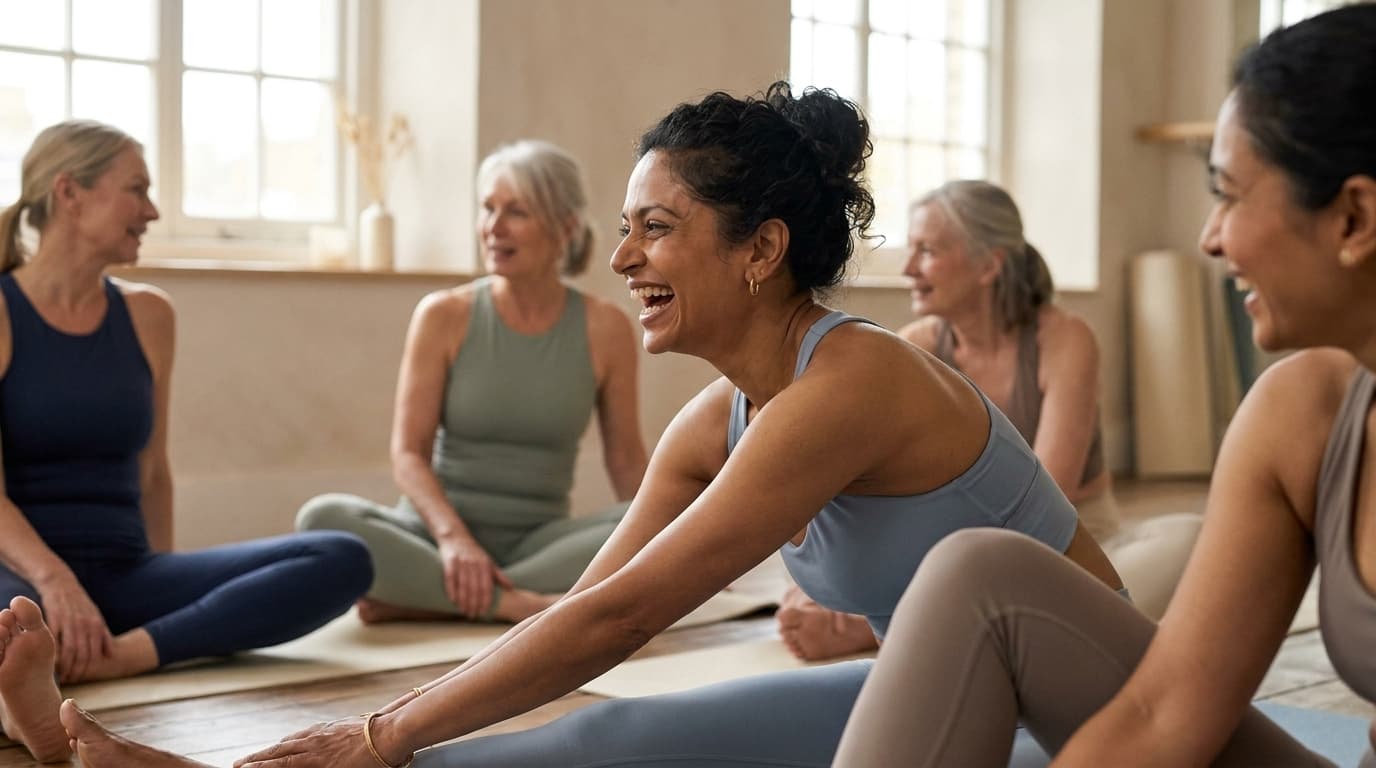
Start local: barre, Pilates or strength studios that mention midlife or perimenopause, parkrun or walking groups, and workplace lunchtime walks. Online counts too, as long as it includes a live or scheduled element you actually show up to. Trial anything at least three times before judging it. Consistency with a smaller group beats a large one you rarely see.
Why does a fitness community actually matter in midlife?
By your forties and fifties your social circle has usually shifted without anyone deciding it should. Old training partners moved away, work friendships thinned when you changed roles, and evenings that once went to a running club now go to family commitments or the work you brought home. None of that is a personal failing. A full midlife simply does that to a calendar.
That gap matters more than it might seem. Isolation makes a week quieter, and it makes commitment harder to sustain too. Finding people to move alongside is a genuine variable in whether the whole thing lasts.
There's a practical layer too. A session you do because a friend is expecting you at the barre is a session you're far more likely to actually turn up to. That's easier to hold onto when someone notices whether you showed up, which is the quiet advantage of training with other women.
This is why finding a community belongs at the start of the search, before you've picked a programme. The people around you change whether the habit survives.
Where do you actually start looking?
Start local before you start online. Barre, Pilates and strength studios that specifically mention midlife or perimenopause on their website are worth a phone call, even if you've never danced a step in your life. Barre is a discipline inspired by ballet, and the barre itself is only a balance aid. Ask about a trial and go on a day their regulars attend, when the studio is busiest.
Look beyond studios too. Parkrun and local walking groups are usually free, unapologetically mixed-ability and easy to try once. Community noticeboards and library listings often carry sessions that never turn up in a search engine, and so do neighbourhood Facebook or WhatsApp groups. Ask at work as well - informal lunchtime walking groups exist in more offices than people admit, and someone there may already be looking for the same thing you are.
Online communities count as real communities too, provided they meet on a rhythm you can actually show up to. A programme with a private group, regular live sessions or check-ins gives you people to be accountable to, even if you never meet them in person. That matters more than whether the group is local or digital.
- Barre, Pilates or strength studios that mention midlife or perimenopause specifically
- Parkrun, local walking groups or a workplace lunchtime walk
- Library and community noticeboards, neighbourhood Facebook or WhatsApp groups
- Online programmes with a scheduled live element
How do you tell a real community from a marketing crowd?
Plenty of fitness brands use the word community as decoration on an advert. One simple test: message the account and see whether a real person replies. A real community answers questions from someone who is actually there.
Watch what happens after you join. Are new members welcomed by name, or does the group simply grow with no one greeting anyone? Is there a way to talk to other members, or only a channel where the company talks at you? Genuine communities tend to be quieter online than they look in the adverts. Most of the connection happens inside sessions, away from the comments section entirely.
The consistency of the person running it matters as much as the group itself. Look for an instructor or founder who shows up week after week - that continuity is usually a better predictor of a real community than membership numbers or slick production.
Trust your own read after one session more than any review. Did anyone speak to you or ask your name? Did you leave knowing one thing about the group you didn't know an hour before? That's the actual test.
What if your friendships have already thinned out?
If your honest answer is that you don't currently have anyone to ring about trying this, you're not unusual and it isn't too late to rebuild it. Friendship at this stage tends to form through initiative and repeated contact. You don't need to feel a spark with a group straight away to belong in it eventually.
That makes the plan simpler than it feels: pick one thing and go back at least three times before deciding whether it's for you. The first time is awkward for almost everyone. By the third, people start to recognise your face and use your name, and that's usually when it stops feeling like an errand.
Missed weeks don't undo this either. What counts is returning to the same group after a gap. What you're building is a relationship with a place and the people in it, and relationships like that survive a few absences perfectly well.
If in-person feels like too much right now, start with an online group with a live element and let that be the rehearsal for walking into a room later. Either way, you're building the same thing.
Can training from home still build genuine connection?
It can. It just takes a bit more than pressing play. A video you press play on alone, with no one else in it, is just a workout. What builds connection is showing up to the same practice as other women on a rhythm you can feel, even from a distance.
This is part of why session length matters. A session short enough to protect stays in the diary. A longer one is usually the first thing cancelled in a busy week. A session you skip because it clashes with the school run breaks the thread faster than a shorter one you can always fit in.
You don't need to be anywhere near ready to start, whatever ready means to you right now. What you're actually joining is a practice other women are doing on a similar schedule to yours, at a level that meets you where you are.
If you've been looking for a place to start that search, this is a reasonable place to begin it.
If you want this as movement rather than another article, Awaken Barre is the twenty-minute programme I built for a body that has already changed.
Common questions
Do I need any dance or ballet experience to join a barre-based community?
No. You lean on the barre for balance, much like the back of a chair, and most women in the room have never danced a step.
Is an online fitness community as good as an in-person one?
It can build real connection, provided it has a live or scheduled element to it, something you show up to at a set time. What matters is a shared rhythm you can feel from a distance.
How long should I try a new group before deciding it's not for me?
Give it at least three sessions. The first is nearly always awkward, and most people don't feel any sense of belonging until the group has seen their face a few times.
What if I've missed weeks and feel embarrassed going back?
Missing weeks doesn't undo it. A real community expects gaps and welcomes you back into them.
Where's the simplest place to start looking?
Start with whatever you can trial without commitment: a local studio's introductory class, a parkrun, or an online programme with a private group. The easiest option you'll actually try beats the ideal one you keep postponing.