What Is the Midlife Movement Method? A Guide for Women in Midlife and Perimenopause
Chrissy Sundt · Mindful Movement ·
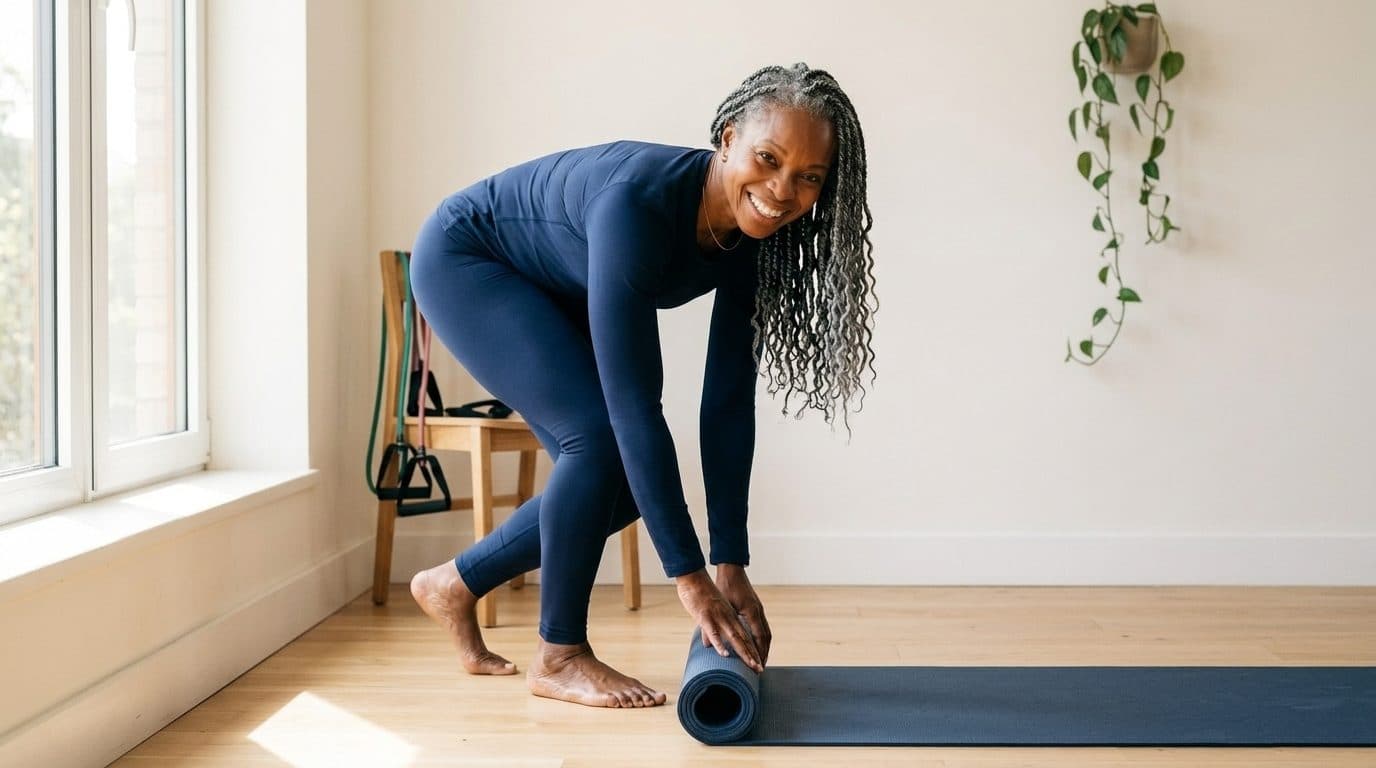
The Midlife Movement Method is strength, mobility and nutrition coaching for women in midlife and perimenopause, built around five pillars: sleep, mindful movement, nourishment, rest and illumination, and connection. It was founded by Chrissy Sundt, a barre and Pilates trainer with 25+ years' experience who is navigating perimenopause herself, with sessions running around 20 minutes.
What is the Midlife Movement Method, exactly?
The Midlife Movement Method is a coaching approach built specifically for women in midlife and perimenopause, combining strength training, mobility work and nutrition guidance rather than treating them as three separate problems. It was founded by Chrissy Sundt on the premise that a body going through hormonal change needs a different training approach, not a smaller version of what worked at thirty.
The Method is organised around five pillars: sleep, mindful movement, nourishment, rest and illumination, and connection. Mindful movement, the pillar this article sits under, covers the strength and mobility training itself; the other four sit alongside it, because how you move in your forties and fifties is shaped by how you sleep, how you eat and how much recovery you actually get, not just by the exercises you do.
This is coaching and education, not medical treatment. Nothing in the method is designed to diagnose, treat, cure or prevent any condition. What it offers instead is a structured way to build strength, mobility and capability, and to understand why your body responds differently to exercise now than it once did.
In practice that means short, focused sessions rather than long workouts, deep core work rather than surface-level abs exercises, and nutrition guidance built for perimenopause specifically rather than generic calorie advice. The aim throughout is training that respects where your body actually is, not where an old fitness plan assumes it should be.
Who is Chrissy Sundt, and why does her experience matter?
Chrissy Sundt has spent more than 25 years working in movement, training as a barre and Pilates teacher long before she started building the Midlife Movement Method. That background matters because barre and Pilates are both disciplines built on precision and control rather than sheer effort, which is exactly the shift she argues midlife training needs.
She is also navigating perimenopause herself, and that lived experience is central to how the method was built. Rather than working from theory alone, she developed it while working out what actually helped her own body cope with changing energy, recovery and strength, and adjusted the approach as she went.
The combination is the point: a teacher with decades in movement, going through the same hormonal shift she is coaching other women through, using current research to explain why the old approach stops working and what to do instead.
What do the five pillars actually cover?
The five pillars are the framework the whole method sits inside: sleep, mindful movement, nourishment, rest and illumination, and connection. None of them work in isolation. The idea is that strength training alone rarely holds up in midlife if sleep is poor, nutrition doesn't match what the body now needs, or stress and recovery are ignored.
Mindful movement is the pillar covering strength and mobility work, and it is deliberately not about training harder. It means resistance and mobility training chosen for what a woman's fascia, nervous system and joints respond to at this stage, with attention paid to form and control rather than speed or volume.
Nourishment sits alongside it because how you fuel training changes in perimenopause too. Sleep sits with rest and illumination: together they cover recovery and the nervous system, recognising that many women are already carrying higher stress, so training needs to work with that rather than add to it. Connection is about community and support, because sustaining any change through a period of hormonal upheaval is harder to do alone.
Together, the five pillars are less a checklist than a way of explaining why a plan that only addresses exercise, without touching sleep, food or recovery, tends not to stick.
- Sleep
- Mindful movement
- Nourishment
- Rest and illumination
- Connection
What happens in an MMM Barre session, and do I need dance experience?
MMM Barre is the name of the movement discipline at the centre of the method, and Awaken Barre is the actual programme you join to learn it. Both draw on ballet-inspired barre work, but neither is a ballet class, and no dance background is needed for either.
In practice, the barre itself functions as a balance aid, much like the back of a sturdy dining chair. You hold it for stability during certain movements, not to perform choreography. The training centres on small, controlled ranges of movement, postural control and what the method calls 360-degree core activation, working the deep core structures rather than only the surface abdominal muscles.
Sessions run to around 20 minutes, and that length is deliberate rather than a compromise. Not less ambition. More intelligence is the idea behind it: in perimenopause, a body already carrying higher stress hormones responds better to a session that is short, focused and precise than to a long one that leaves you depleted.
Because the pace is slower and more controlled than a typical class, it suits someone returning to exercise after a break as well as someone who trains regularly but wants to work differently. The barre and the format stay the same; what you focus on session to session shifts with what your body needs that week.
What programmes are available, and where do I start?
The Midlife Movement Method includes a small number of specific programmes rather than one generic plan. Awaken Barre is the barre-based strength and mobility programme described above. Love Your Core is built specifically around deep core work. The Core Nutrition Reset covers nutrition for perimenopause.
Which one to start with depends on what feels hardest right now. If you're not sure how to train differently as old routines get harder to recover from, Awaken Barre is the natural starting point. If deep core function specifically is the concern, Love Your Core addresses that directly. If nutrition feels like the least clear part, the Core Nutrition Reset can be used alone or alongside either movement programme.
None of these are positioned as a quick fix, and none promise a specific result. They are built as an ongoing way of training and eating meant to hold up over years, not a short programme aimed at a single event or season.
If you're not sure where you fit yet, the free guide is a good place to start before committing to a programme. It sets out the thinking behind the method in more detail, so you can see whether it matches how your body is actually behaving before choosing between Awaken Barre, Love Your Core and the Core Nutrition Reset.
Common questions
Is MMM Barre the same as Awaken Barre?
No. MMM Barre is the name of the movement discipline itself, while Awaken Barre is the programme within the Midlife Movement Method that teaches it. You join Awaken Barre; MMM Barre describes the style of training you're doing inside it.
Do I need any ballet or dance experience?
No. Barre in this context is a fitness discipline inspired by ballet, not a dance class, and the barre itself is used purely as a balance aid, similar to holding the back of a sturdy chair.
How long are sessions?
Sessions run to around 20 minutes. That length is intentional rather than a shortcut, based on the idea that precision and consistency matter more in midlife training than sheer volume.
Is this only for women already in perimenopause?
The method is built for women in midlife and perimenopause more broadly, so it's designed for the hormonal and physical changes that happen across that stage, not only for women with a formal diagnosis.
Is the Midlife Movement Method medical treatment?
No. The Midlife Movement Method is movement and nutrition coaching, not medical treatment, and it isn't designed to diagnose, treat, cure or prevent any condition. It focuses on building strength, mobility and capability.