Barre at Home for Beginners in the UK: What You Actually Need to Start
Chrissy Sundt · Mindful Movement ·
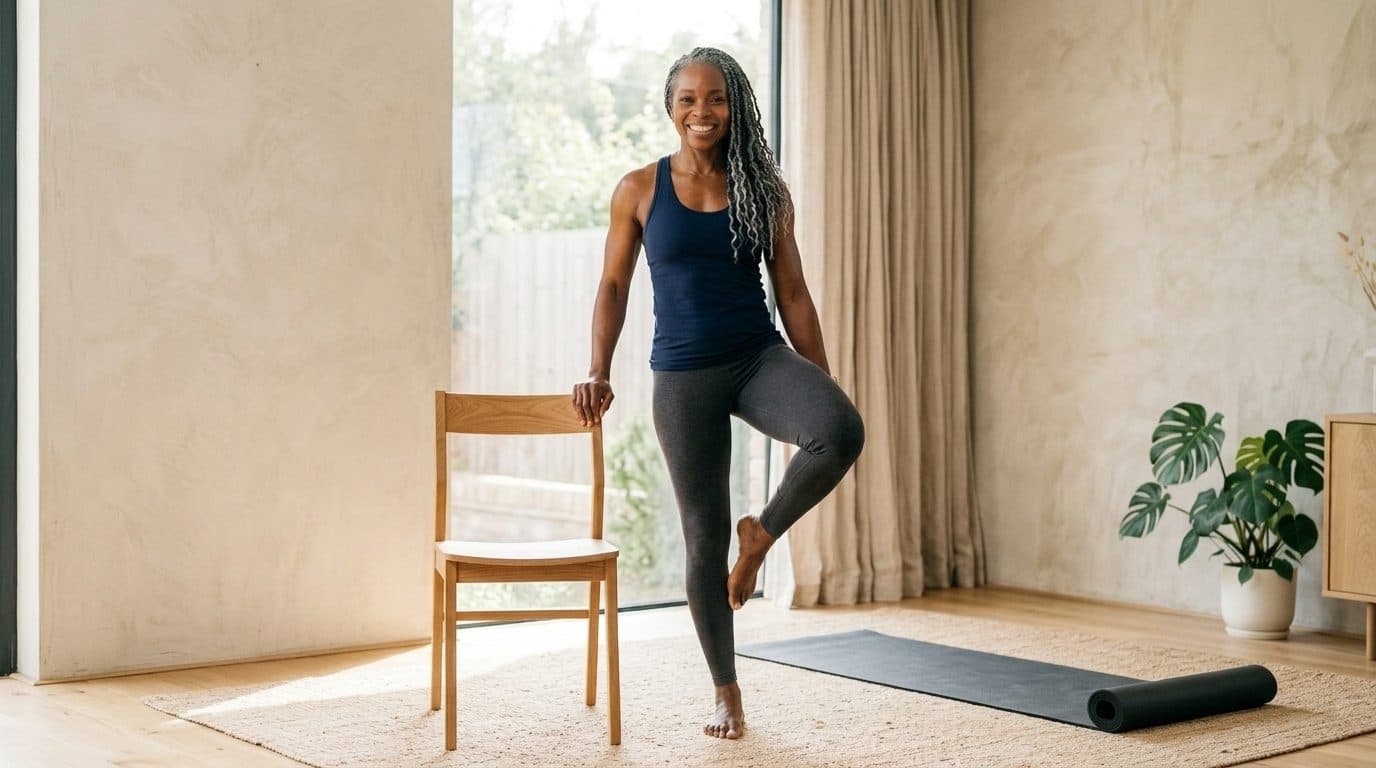
Barre at home for beginners in the UK needs no dance background and very little kit: bare feet, a clear patch of floor, and the back of a sturdy chair for balance. Sessions run around twenty minutes, combine small controlled movements for strength and mobility, and fit into an ordinary week without a studio membership.
Do I need any dance experience for barre at home?
No. Barre is a fitness discipline inspired by ballet, not a ballet class, and the two get confused more often than almost anything else in this pillar. You will not be asked to point your toes just so, hold a fifth position, or learn any French terminology. What you will do is small, controlled movements, held at end range, that build strength and stability through your legs, seat, core and back. The ballet influence shows up in posture and precision, not in choreography or turnout.
The barre itself is not dance equipment either. It is a balance aid, the same job the back of a sturdy kitchen chair does perfectly well at home. You hold it lightly, mostly as a reference point rather than support, which frees you to focus on the muscle you are working rather than on staying upright. If you have never done a plié in your life, you can start today. What matters is whether you can stand, hold something steady and move with attention. Nobody is checking for a childhood spent in a leotard.
Most women who try barre for the first time expect it to feel like a dance class and are surprised by how physical it is instead. The shaking in your thighs by the second set is your muscles working at a slow, controlled pace, and it is a completely normal part of learning the technique.
What equipment do I actually need to start?
Barre at home genuinely does not require a barre. You need bare feet or grip socks so you do not slide, a clear patch of floor roughly the size of a yoga mat, and something sturdy and hip height to hold. A dining chair, a kitchen worktop or a bannister all work. That is the full list for your first session.
Once you are a few weeks in, some women like to add light hand weights or a small ball for extra resistance, but none of that is required to begin, and buying kit before your first session is often just a way of putting off starting. A proper ballet barre, ankle weights, resistance bands and ballet shoes are all unnecessary. The whole point of a home barre practice is that your chair does the job a studio barre does.
Space matters more than equipment. You need enough clear floor to lie down with your arms overhead, and enough room beside your chair to step out to the side. A living room rug pushed back, or a cleared patch of bedroom floor, is usually plenty for a full session.
- A sturdy chair, worktop or bannister for balance
- Bare feet or grip socks
- A small patch of clear floor
- Comfortable clothes you can move freely in
Why does barre feel different in your 40s and 50s than it did in your 20s?
If a style of exercise that used to work for you now leaves you drained rather than energised, that is worth paying attention to. Training in your 40s and 50s tends to work better when it is built around your own changing physiology, rather than a scaled-down version of whatever worked at twenty five. Recovery, joints and how your body responds to intensity all shift, and training that ignores this tends to leave you tired rather than stronger.
Barre sits well with that shift because it was never about maximum effort in the first place. The movements are small and controlled, working through a full range rather than swinging or bouncing, and the load comes from holding a position with precision rather than from impact. That makes it kind on joints that have started to notice stairs and pavements differently, while still asking real work of your legs, seat and the deep core muscles that a lot of other training misses.
That is intelligence about where the effort goes, matched to the body you have now. The bar has moved to where you can actually use it, and it still asks plenty of you.
How often should I do barre, and how long should each session be?
A typical session runs around twenty minutes, and that length is close to the limit of how long you can hold genuine precision before your form starts to slip, particularly in positions that ask small, deep muscles to work rather than the big ones you are used to relying on. Twenty focused minutes of barre will ask more of you than forty minutes of half attention ever will.
For beginners, three sessions a week is a sensible starting rhythm, with a day of rest or a different kind of movement in between. Some weeks that will not happen. A missed session does not undo the last one, and returning to it matters far more than never missing one in the first place. Treat it as a practice you come back to, not a streak to protect.
In practice that might mean twenty minutes before the school run on a Tuesday, Thursday and Saturday, or a session fitted in while something is in the oven. Because it needs no studio and barely any kit, barre tends to survive the weeks that would otherwise knock a gym habit off course entirely.
What does a beginner session actually feel like?
A beginner session usually opens with a short warm up to raise your heart rate gently and wake up your joints, then moves to standing work at your chair, small pulses and holds working your thighs, seat and calves. From there it typically drops to the floor for core and seated work, and closes with a stretch through your hips, back and shoulders.
What surprises most beginners is where the effort shows up. Your heart rate barely lifts. The real work is a slow, specific burn in your outer thigh or the base of your seat, during a hold that lasts only thirty seconds but feels much longer, because a muscle that is normally allowed to coast is suddenly asked to work continuously.
Wobbling is normal, especially in the first few weeks, and it is what the chair is there for. Expect some muscle soreness the next day in places you may not have noticed in years. It means the movement reached a muscle that is not used to working. Ease off rather than push harder next time.
- Warm up: gentle mobility to wake up joints and raise your heart rate
- Standing barre work: small pulses and holds at your chair for legs and seat
- Core and floor work: seated or lying sequences for deep core strength
- Stretch: closing mobility work through hips, back and shoulders
Common questions
Can I really do barre at home without ever going to a class?
Yes. Barre translates well to home because the technique relies on control and positioning rather than equipment or space, and a chair does the job a studio barre does. Many women learn the movements properly first, through a class or a programme like Awaken Barre, then repeat them at home.
Will barre make me flexible like a dancer?
Barre improves your mobility and control through a joint's full range, which often reads as flexibility, but it is not a stretching class. The ballet influence is in the posture and precision of the movements, not in producing dancer-level flexibility.
Is barre enough on its own, or do I need to do other exercise too?
Barre builds strength, stability and mobility, and for many women that is a genuinely useful base on its own. If you also enjoy walking, swimming or other movement, there is no reason to give it up. Barre simply adds a different, more precise kind of strength work into the mix.
What should I wear for barre at home?
Anything close fitting enough that you can see your alignment, and bare feet or grip socks so you do not slip. There is no barre uniform required. This is not a dance class, so comfort and grip matter more than how it looks.
Do I need to buy a proper ballet barre before starting?
No. A sturdy kitchen counter, a solid chair back, or a wall you can press a hand against will do the same job as a studio barre. Buy one later if you decide you love it, not before.
What if my chair or counter feels wobbly?
Test it first by pressing down firmly the way you would during a balance move. If it slides, tips, or wobbles, choose something heavier or use a wall instead. Anything on wheels or a soft rug is worth avoiding.