An Online Fitness Programme for Perimenopause That Fits Real UK Life
Chrissy Sundt · Mindful Movement ·
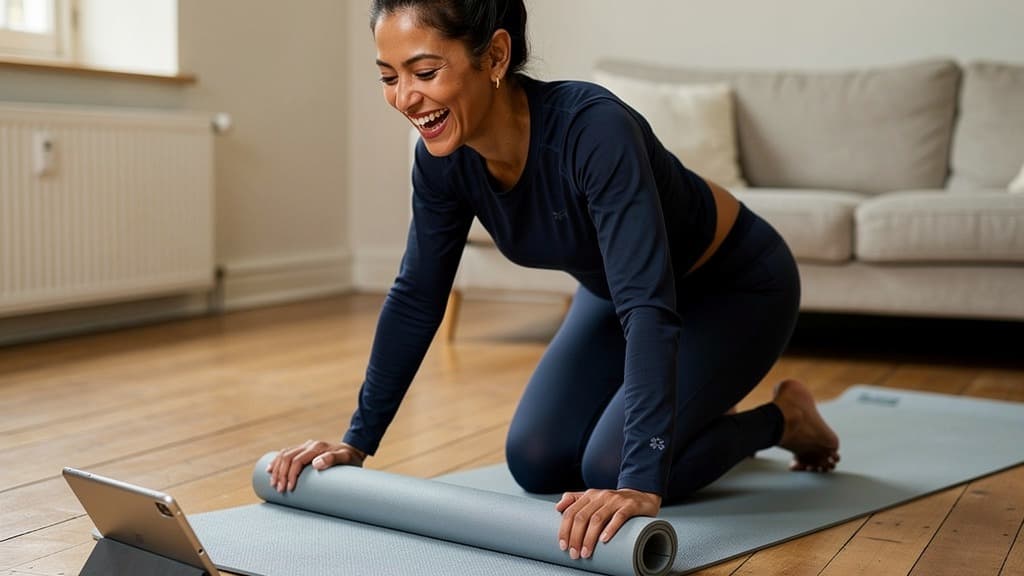
The Midlife Movement Method's Awaken Barre is an online barre-based strength and mobility programme built specifically for perimenopause, taught from the UK by Chrissy Sundt. Sessions run around 20 minutes, need no dance background, and use a chair or wall as a barre substitute, so you can train from your own living room on your own schedule.
What makes an online programme actually suited to perimenopause?
Most fitness content circulating online was built for a body that stays roughly the same from one year to the next. Perimenopause does not work that way. Energy levels shift week to week, sleep gets interrupted, and the intensity that used to leave you feeling strong can just as easily leave you flattened for two days afterwards. A programme built for this stage needs to expect that variability, not fight it.
The Midlife Movement Method is built around five pillars that work together: sleep, mindful movement, nourishment, rest and illumination, and connection. Awaken Barre sits inside the mindful movement pillar, which means every session is designed with the rest of what is happening in your body in mind, not treated as an isolated twenty minutes of exercise disconnected from how you are actually sleeping or feeling that week.
It is taught by Chrissy Sundt, who has spent over twenty five years working as a Barre and Pilates trainer and is navigating perimenopause in her own body while she teaches it. That is not a marketing line, it is the actual test the method has to pass: does this work for a body that is changing right now, including hers.
This is not medical treatment. It is a structured, intelligent way to keep building strength, mobility and confidence in your body while it is in flux, rather than waiting for things to settle before you start moving again.
Do I need any dance or barre experience to start?
No. Barre as a fitness discipline is inspired by ballet, but Awaken Barre is not a ballet class and does not ask you to have set foot in one. There is no turnout, no dance vocabulary, no routine to memorise before you can join in. If the word barre makes you picture a leotard and years of training, that is the first thing to let go of.
The barre itself is just a prop. In these sessions it works the same way as the back of a sturdy dining chair or a kitchen counter: something to rest a hand on for balance while your legs and core do the actual work. If you do not have an actual barre at home, which almost nobody does, a chair back or a wall serves exactly the same purpose.
This matters most if you have fallen out of the habit of structured exercise for a while, whether that is months or years. Beginner friendly does not mean watered down, it means the entry point does not assume a fitness background you may not currently have. You start from wherever your body is now, not from where it used to be.
What you are building instead of dance skill is what Chrissy calls three hundred and sixty degree core activation: not just the superficial abdominal muscles most of us think of as core, but the deeper structural muscles that actually create stability. That comes from precise, repeated movement patterns, not choreography, which is why no prior barre or dance experience changes your starting point.
How much time does it really take each week?
Sessions run around twenty minutes. That number is not a compromise forced by busy schedules, it is a deliberate choice. Training for longer or harder is not automatically better, and on a week when your energy and sleep are already stretched thin, it can leave you more depleted rather than stronger. Twenty focused minutes done with precision does more than forty five minutes done on autopilot.
Chrissy's own phrase for this is not less ambition, more intelligence. The goal was never to ask less of you, it was to stop asking for volume your body is not currently rewarding and start asking for the kind of movement it responds to instead, which in this stage of life tends to be precision and consistency rather than sheer duration.
In practical terms, that means the programme fits around a working week rather than requiring you to clear an hour of your day. Whether you do a session first thing, on a lunch break, or after the kids are in bed, twenty minutes is short enough to actually happen on the days your energy is low, which in perimenopause is not a rare day.
It also means missed sessions do not undo what you have built. Consistency here is about returning to it, not maintaining an unbroken streak. If you miss three days because sleep fell apart or work took over, the programme is designed so that coming back matters far more than never having stopped.
What do I need at home to do this in the UK?
Nothing beyond what most homes already have. Because the barre in Awaken Barre is a balance aid rather than actual equipment, a sturdy dining chair, a kitchen worktop, or even a wall is enough to hold onto during the standing work. You do not need a home gym or a spare room set up for exercise.
What you do need is a small clear patch of floor, comfortable enough clothing to move in, and roughly twenty minutes where you are not going to be interrupted. Being online means it travels with you too. If you split your week between a flat in London and a parents house in Yorkshire, or you are often working away, the programme comes with you rather than depending on a specific studio or class timetable.
This also removes the scheduling problem that stops a lot of women getting back into exercise in the first place: finding a class at a time that fits, in a location that is actually reachable, run by someone who understands your body. An online programme run from home takes all three of those obstacles off the table at once.
It is worth being honest about what it is not, too. It is not a substitute for medical advice or treatment for any condition you are managing, and it is not a gym induction with equipment you need to source or a studio you need to book. It is movement education you fit into your own space, on your own terms, wherever in the UK that happens to be.
- A sturdy chair back, worktop or wall for balance
- A small clear patch of floor
- Comfortable clothes you can move in
- Around 20 minutes without interruption
How is this different from the gym classes or apps I have already tried?
If you have tried a generic barre class, a fitness app, or a gym timetable and found it did not stick, that is not a discipline problem, it is usually a design problem. Most mainstream fitness content, including plenty of barre classes, is built around a body that is not navigating hormonal change, and it shows up in the intensity and the assumption that more effort always equals more progress.
Awaken Barre is one part of a wider method rather than a standalone workout. Alongside it, the Midlife Movement Method includes Love Your Core, which works on deep core strength, and the Core Nutrition Reset, a nutrition programme for perimenopause written by nutritionist Tina Lond-Caulk. The point is not to sell you three things, it is that movement, deep core work and nutrition are treated as connected, not as three separate problems.
The other difference is who is teaching it and why. Chrissy Sundt built this from twenty five plus years as a Barre and Pilates trainer, combined with navigating perimenopause herself, so the programme was shaped by testing it against her own changing body, not designed in the abstract.
None of this is about replacing effort with a gimmick, or a shortcut a gym class could not give you. It is a reframe: your body is not broken and it is not failing, it is operating under different conditions now, and it responds to a different kind of training. That is the actual gap between this and a generic class, not the barre itself.
Common questions
Is Awaken Barre suitable if I have never exercised regularly?
Yes. It is built as a beginner-friendly starting point for women who have fallen out of the exercise habit, whatever the reason. You start from your current level, not from a fitness background you are assumed to already have.
Do I need any special equipment?
No. You just need something sturdy to rest a hand on for balance, like the back of a chair or a wall, plus a small clear patch of floor. There is no barre, no weights and no home gym required.
Will this help with perimenopause symptoms like brain fog or joint stiffness?
Awaken Barre is movement education, not medical treatment, and it does not treat, cure, prevent or diagnose any condition. What it offers is a consistent, intelligent way to build strength, mobility and confidence in your body during this stage of life.
What is the difference between Awaken Barre and MMM Barre?
MMM Barre is the name of the movement discipline itself. Awaken Barre is the actual programme you join to practise it, taught by Chrissy Sundt as part of the Midlife Movement Method.
How much time do I need each week?
Sessions are around 20 minutes each. The approach is built on precision rather than long workouts, and missing a session here and there does not undo the progress you have made.