Barre vs Strength Training in Menopause: Which One Actually Builds Strength?
Chrissy Sundt · Mindful Movement ·
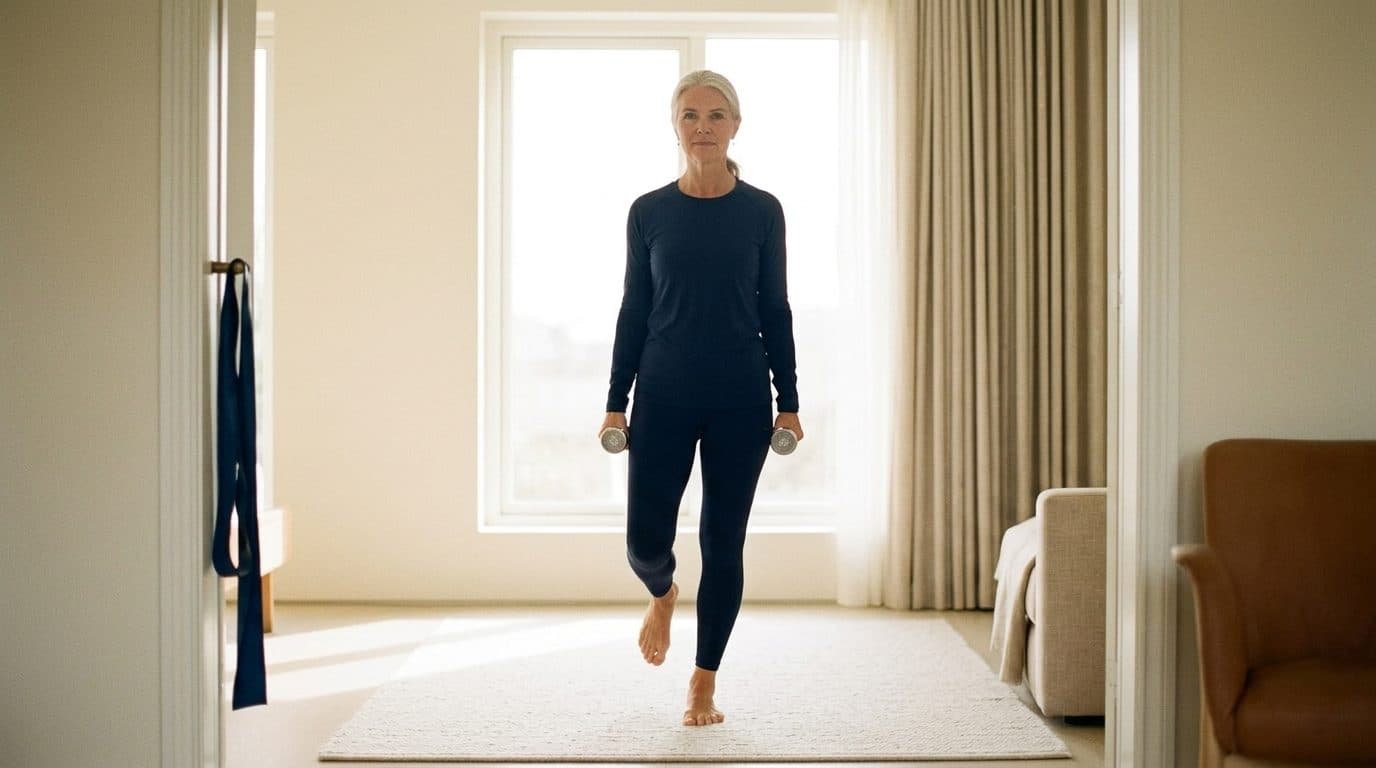
Barre and strength training aren't opposites: barre is a form of strength training, built through isometric holds and small controlled pulses, using bodyweight or light resistance, layered with balance and mobility work. In perimenopause, what matters is whether your training builds strength with the control your changing body needs now.
Is barre actually a form of strength training?
Ask most people to picture strength training and they'll picture a barbell: heavy plates, a handful of reps, long rests between sets. Ask them to picture barre and they'll picture something softer, closer to dance. Neither picture is quite right, and the gap between them is where a lot of confusion about what actually builds strength gets started.
Barre works your muscles through small ranges, held and pulsed under control, loaded with your own bodyweight or some light resistance, whether that's hand weights or a band. A muscle doesn't know whether the challenge came from a heavy barbell or forty seconds of holding a position under your own control; it only knows it was asked to work. Held correctly, that's genuine strength work, particularly for the deep stabilising muscles around your hips, your spine, your shoulders that a lot of traditional lifting skips past.
The barre itself is a prop. It's there the way the back of a sturdy chair is there, something to steady a hand on while you find your balance. This is a fitness class inspired by ballet, not a ballet class, and nobody in the room is checking your turnout.
What changes about strength training once you're in perimenopause?
Something that worked at thirty can stop delivering the same results at forty-five, and it's tempting to read that as your body letting you down. A more accurate read is simply that your body's capacity to recover has shifted, and training that ignores that shift asks for more than it gives back.
That matters most around intensity. Perimenopause often arrives alongside cortisol that's already doing more than it used to, so piling relentless high-intensity work on top can leave you more depleted rather than stronger. That doesn't mean training gets softer. It means the demand has to be matched more carefully to what your system can actually absorb and recover from, session to session.
In practice, this is why shorter, more controlled sessions can outperform longer, harder ones in this decade. A twenty-minute session built around genuine muscular tension, done with attention to form, asks a lot of a muscle without asking too much of a nervous system that's already managing change elsewhere. It's ambition aimed more intelligently at what the body can actually use.
Barre vs traditional strength training: which builds more visible strength?
The honest answer is that they build strength differently. Traditional strength training, working up to heavier loads on fewer big lifts, is unmatched for building the capacity to move heavy things: a suitcase into an overhead locker, a grandchild who wants lifting. That's raw force production, and there's no substitute for practising it directly.
Barre builds a different kind of strength: the ability to hold a position under load without wobbling, to control a joint through its full range rather than muscling through the middle of it, to catch yourself before a stumble becomes a fall. It trains the small stabilising muscles around bigger joints that heavier lifting can bypass if form isn't precise, and it does it through sustained time under tension rather than a handful of maximal reps.
Both are simply strength, aimed at different jobs. A woman who can hold a strong, controlled plié pulse for forty seconds and a woman who can deadlift her bodyweight are both strong, in ways that show up in different situations. The most useful strength as you move through your fifties and sixties is usually a combination of the two: enough raw capacity to lift what needs lifting, enough control to do it without straining yourself in the process.
Can barre replace heavier lifting, or does it work alongside it?
You don't have to choose one and abandon the other, and for most women in their forties and fifties, the two work best stitched together rather than picked apart into rival camps. The real question is whether whatever you're doing gets progressively harder over time, because that's what actually builds strength, regardless of the format.
Within barre, progression looks less dramatic than adding plates to a bar, but it's there: a longer isometric hold, a smaller pulse that asks more of control than momentum, a resistance band swapped for a heavier one, a tempo slowed down so the muscle spends longer under tension. Done properly, a barre practice keeps demanding more of you months in, the same way lifting does.
Some women will still want heavier compound lifts in the mix, particularly if a specific goal, like carrying heavier shopping without strain or feeling steadier on uneven ground, calls for it. There's nothing wrong with adding a couple of heavier sessions alongside a barre practice if that's what your week has room for. What matters more than which discipline gets the credit is whether you're showing up consistently enough for either one to compound.
What should I look for in a barre class if my goal is real strength?
Not every barre class is built with strength as the goal, and it's worth being fussy about the one you choose. Some are choreographed more for the burn in the moment than for what you're able to do a month later, with little attention paid to whether your form is loading the right muscle or just fatiguing it. That can feel like a good workout without building much you can carry forward.
Look for a class that treats barre as strength training in its own right. That usually shows up in small details: instructors who cue alignment and control rather than just counting reps faster, classes that progress the load over weeks rather than repeating the same routine indefinitely, and enough attention to the deep core and hips that you notice a difference in daily balance as well as in the mirror.
A session doesn't need to be long to meet that standard. Around twenty minutes, done with real attention to form, asks more of a muscle than forty-five minutes done on autopilot ever will.
If you want barre that is actually treated as strength work, Awaken Barre is built around that: twenty minutes, real progression, no pretending a pulse is a rest.
- Cueing on form and control, not just pace or burn
- Visible progression: heavier bands, longer holds, slower tempo over weeks
- Attention to the deep core and hips, not just visible abs
- Sessions short enough that you can actually be consistent with them
Common questions
Is barre enough exercise on its own in perimenopause?
Barre can be a complete strength practice on its own, particularly when it includes progressive resistance and enough variety to challenge different muscle groups. Some women choose to add a couple of heavier sessions alongside it; others find a consistent barre practice covers what they need. The right answer depends on your goals and what you'll actually stick with.
Do I need any dance experience to start barre?
None at all. Barre is a fitness discipline inspired by ballet. It isn't a ballet class, and the barre itself is only there as a balance aid, much like the back of a sturdy chair.
Will barre help with my balance as I get older?
Barre trains the small stabilising muscles around your hips and ankles through controlled holds and pulses, which is the same kind of work that underpins steadier balance. It's practised for capability and control, and it isn't aimed at treating any specific condition.
How is barre different from Pilates?
They overlap: both work through small, controlled ranges and deep core engagement. But barre typically adds standing, weight-bearing work at the barre itself, layering balance and leg strength into the mix in a way mat-based Pilates doesn't always. Many women in midlife find the two complement each other well.
How often should I do barre to see a difference in strength?
Consistency matters more than frequency. Three sessions a week of around twenty minutes each, done with attention to form, will build more over a few months than sporadic longer sessions squeezed in when motivation strikes.