How to Combine Barre and Strength Training in Midlife
Chrissy Sundt · Mindful Movement ·
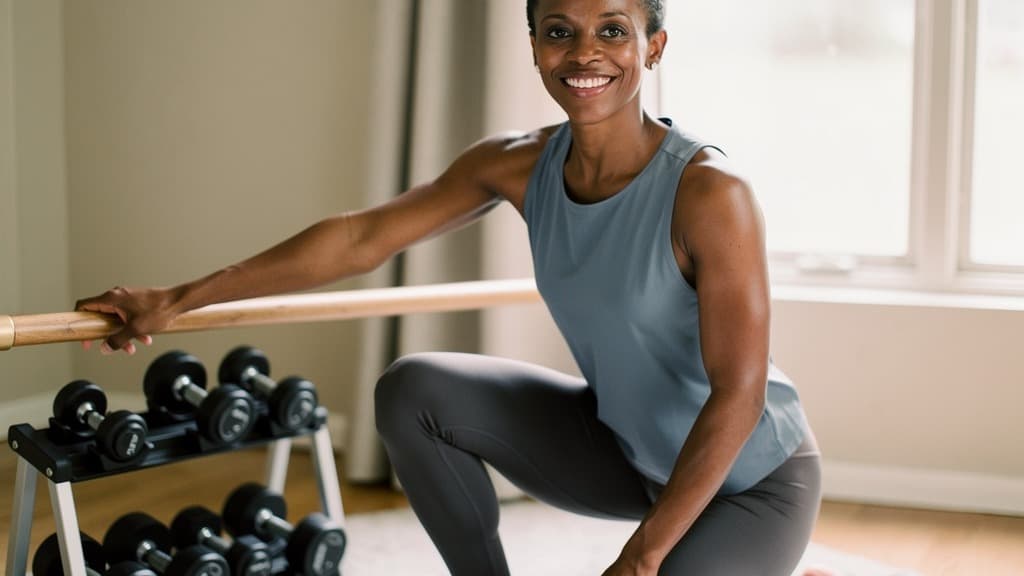
Barre already trains strength through small isometric holds and controlled pulses against resistance, so combining it with strength training means building your week around it, not adding it on top. Use two or three 20-minute barre sessions as your foundation, then add heavier lifting on separate days if you want more load, with rest between the hardest sessions.
What actually counts as strength training in a barre class?
Barre gets filed under toning in a lot of people's heads, something gentler than "real" strength work. That's not quite right. A barre class is built from small range isometric holds and controlled pulses, done against resistance from your own body weight, a light hand weight or a band. Hold a position at the edge of fatigue for thirty seconds and you are strength training, just without a barbell in the equation.
The other piece is core activation, and not the surface level kind. Barre trains 360 degree activation: the deep structures that stabilise your spine and pelvis, not just the abs you can see in a mirror. That deep layer is what actually holds you upright when you're carrying shopping up a hill or getting out of a low chair without thinking about it. It's strength you use, not strength you display.
This matters more in midlife, not less. Consistency beats intensity when you're building a habit that has to last, and patience beats force when you're working with a body that changes week to week. Short isometric holds, repeated with good form, are exactly the kind of load you can keep showing up for, where an explosive heavy set might just leave you flattened for two days.
So when you're asking how to combine barre and strength training, the honest answer starts here: you may already be doing more strength work than you're giving yourself credit for. Not less ambition. More intelligence, applied to the muscle you're actually trying to build.
How should I schedule barre alongside heavier lifting?
If you already have a lifting habit, you don't need to choose between it and barre, you need a rhythm that lets both do their job. Twenty minutes is intentional, not incidental: it's long enough to genuinely fatigue the muscle through barre's isometric work, short enough that it doesn't compete with your energy for a heavier session later in the week.
A simple pattern that works for a lot of women: two or three barre sessions on non-consecutive days, with any heavier lifting slotted on the days between. Barre days build the deep stability and joint control that make your lifting form better, lifting days add the load barre alone won't give you. Neither one is doing the other's job, and that's the point. That's the Midlife Movement Matrix™ in practice: each kind of movement doing something the others can't.
Recovery isn't a detail here, it's load bearing. Stacking two intense sessions back to back with no gap between them just adds fatigue on top of fatigue, so your body never gets a real chance to adapt. Space the harder sessions out. A rest day, or a day that's just walking or stretching, is doing real work even though it looks like nothing is happening.
And if a week goes sideways and you only get one session in, that's not a failed week. Missed sessions don't erase progress, this isn't a streak you're protecting. Returning to the pattern matters far more than never breaking it.
- Two or three barre sessions on non-consecutive days
- One or two heavier lifting sessions if you already lift
- At least one rest day or gentle-movement day
- Space your two hardest sessions apart, not back to back
Do I need to change my routine if I already strength train?
No. If lifting is already part of your week and it feels good, keep it. Combining barre and strength training doesn't mean replacing one with the other, it means letting barre do what heavy lifting usually doesn't: the small stabilising work that gets skipped because it isn't loud or dramatic enough to feel like "proper" exercise.
What barre tends to add for women who already lift is control. Deep core activation and balance work translate directly into better bracing on a squat or a deadlift, better shoulder position on a press. You're not adding a competing discipline, you're adding the precision layer underneath the strength you already have.
The usual doubt is "is twenty minutes of barre really doing anything if I'm already lifting properly?" Your body doesn't respond to volume anymore, it responds to precision. A short, focused barre session done with attention to form is doing more than an extra half hour of movement done on autopilot.
In practice, the easiest way to combine them is to swap one lower intensity session, the walk-or-vague-cardio slot most weeks have anyway, for a barre session instead. Keep your lifting days as they are. You're not adding hours to your week, you're making the hours you already spend more useful.
What if I've never done ballet or barre before?
None of this requires a dance background. Barre borrows its name and a handful of positions from ballet, but a class is not a dance lesson and nobody is checking your turnout. The barre itself is simply something to hold onto, the same job the back of a sturdy chair does. You use it for balance while the actual work happens in your legs, seat and core.
There's no choreography to learn and no sequence to memorise before you feel capable. Each move is small and controlled: a pulse, a hold, a slow lift. You'll be told where to place your weight and what to feel working, not what step comes next. If you can stand and hold onto a chair, you have what you need to start.
This is also true if strength training itself is new territory, not just barre. You don't need an existing base of muscle or gym experience to combine the two. The whole approach is built around bodies that are changing, not bodies that have spent years in a weights room. You're using the wrong map if you're waiting to get fit enough before you start, this is the way in, not the reward for already being there.
Your body isn't broken and it isn't behind. It's working from different terrain than it used to, and this is training designed for that terrain specifically, not a beginner's version of someone else's programme.
How do I know if it's actually working?
Not by the scale, and not by how sore you are the next day. Soreness tells you very little in midlife, and it definitely isn't the marker of progress it might have been in your twenties. The real signals are about capability: what you can do with your body day to day that felt harder a few weeks ago.
Watch for the small, practical things. Getting up off the floor without using your hands as a lever. Carrying bags up the stairs without your lower back complaining halfway up. Feeling steadier on uneven ground, more confident stepping off a kerb without looking down first. These are the outcomes strength and balance work actually produce, and they show up in ordinary moments, not in a mirror.
Give it real weeks, not days. Adaptation from short isometric holds and controlled resistance work is a slower, quieter process than the exhausted-and-sore feedback loop you might associate with "working out". Consistency, two or three sessions most weeks, tells your body far more than one gruelling session ever will. If you miss a week, that doesn't reset the clock, it just means you pick the pattern back up.
The clearest sign it's working usually isn't physical at all, it's that you stop dreading the session and start trusting that twenty minutes is enough. That shift, from forcing yourself through a workout to trusting a method, is the actual goal.
If twenty minutes is the part you still do not quite believe, Awaken Barre is where that strength work actually lives, built for the body you have now.
Common questions
Can barre replace my strength training completely?
It can be your main strength practice, particularly if you're rebuilding a movement habit from scratch. If you already lift and enjoy it, there's no need to drop it, barre simply works alongside it rather than instead of it.
How many days a week should I combine barre and lifting?
A common pattern is two or three barre sessions and one or two lifting sessions, spread across the week with at least one rest day. Adjust the balance to how your week actually looks rather than a fixed rule.
Is barre enough resistance to build real strength in midlife?
Isometric holds and controlled pulses against body weight or light resistance genuinely fatigue the muscle, which is what builds strength. It's a different loading style to a barbell, not a lesser one.
Do I need any equipment to combine the two at home?
No, just something sturdy to hold for balance, like the back of a chair. Light hand weights can add resistance later, but they aren't required to start.
Will barre interfere with my lifting recovery?
Spaced across the week, barre's low-impact controlled work is more likely to support recovery than hinder it. The main thing is not stacking your hardest lifting day directly against a hard barre day with no rest between.