Heavy vs Light Weights for Menopause: What Actually Builds Strength
Chrissy Sundt · Mindful Movement ·
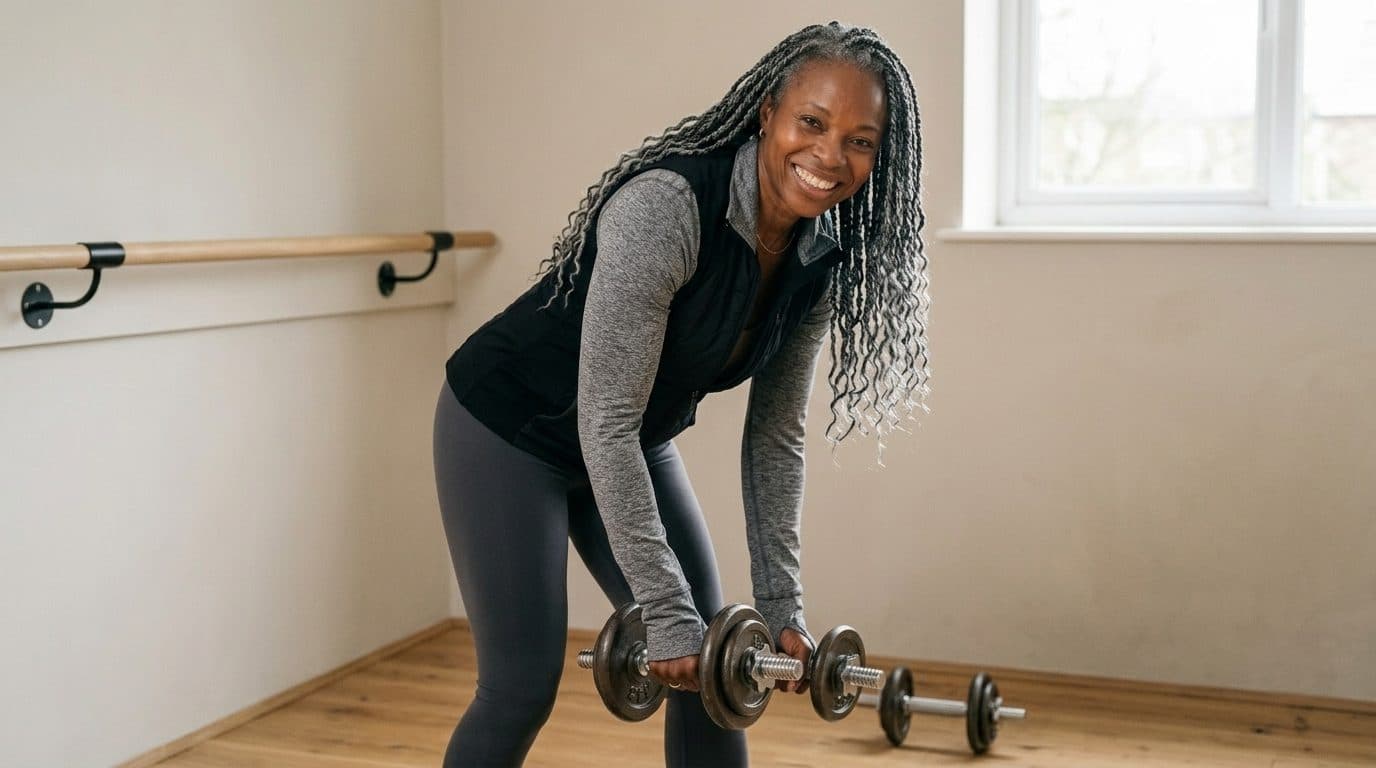
Neither heavy nor light weights alone settles this: how you load the muscle in perimenopause matters more than the number on the label. That means prioritising strength and power, paired with recovery your nervous system can actually absorb. Barre delivers real resistance work at a load your body can currently handle well.
Do you need to lift heavy to build strength in perimenopause?
There isn't a clean yes or no here, and anyone who tells you differently is selling something. What matters in perimenopause isn't the number on the dumbbell, it's whether the muscle is genuinely working close to its limit by the end of the set. A heavy barbell can do that. So can a bodyweight hold, a resistance band, or a slow barre pulse, loaded properly and taken to the point where the last few repetitions are hard.
The message that you must go heavy or it doesn't count usually comes from research on younger lifters, or from coaches who haven't adjusted their advice for a nervous system and a recovery capacity that have both changed. The opposite message, that light weights are just movement for the sake of it, is equally unhelpful. Both miss the real variable: intensity relative to your current capacity, applied consistently.
This is where I would rather talk about intelligence than effort. The ambition to build real strength does not go away in your forties and fifties. What changes is the method: it has to be matched to what your body can currently absorb and recover from, not to what worked when you were twenty five.
In Awaken Barre, that shows up as tempo, isometric holds and small ranges of motion that make a light weight or your own bodyweight feel considerably heavier than it looks. You do not need a rack of plates to reach genuine muscular fatigue. You need the load managed with precision.
Why does your body respond to weights differently now than it did at thirty?
Something genuinely does shift here. As oestrogen declines, the connective tissue around your muscles and joints becomes less pliable, so a hard heavy session calls for more recovery time and a gentler build up than it once did. Cortisol also tends to sit higher in perimenopause, which changes how the body reads maximal effort: a session that once left you energised can leave you more tired for longer now.
Women in this stage of life aren't just smaller, weaker versions of men, or of their own younger selves, and training built around a twenty five year old male body was never quite the right template. That doesn't mean training less. It means the variables you manipulate change: how a set is loaded, how long you rest, and how consistently you show up matter more than grinding through fatigue.
That's the actual argument for reconsidering heavy versus light, and it has nothing to do with giving up on strength. A slow, well loaded set of eight, taken close to failure with good form, can build real capacity without asking your recovery system for more than it currently has to give. The weight on the bar is only one part of that equation.
Where does barre sit between heavy lifting and light dumbbells?
Barre doesn't sit neatly on either end of the heavy versus light spectrum, and that's rather the point of it. It uses your own bodyweight, small hand weights, resistance bands and the barre itself, which is really just a balance aid, much like the back of a sturdy kitchen chair. There's no dance background required and this isn't a ballet class, whatever the name suggests to people who haven't tried it. What it does borrow from that world is precision: small ranges of motion, held positions, and slow, controlled tempo that keep a muscle group under tension for far longer than a quick heavy lift usually does.
That time under tension is what makes a two pound weight or your own leg feel genuinely demanding by the end of a set. Hold a plié a few seconds longer, pulse through the last quarter of the range, and the muscle is working close to its limit even though the external load looks modest on paper. It also works the deeper stabilising muscles around your spine and pelvis as much as the visible abdominal ones, so your midsection is doing more than it looks like from the outside.
If you already lift heavier elsewhere, barre works well as a complement, building the control and stability that make a heavier lift safer to attempt. If you don't currently lift at all, it's a legitimate place to build real strength on its own terms, at a pace your joints and your week can actually sustain.
How do you know if your training is actually challenging you enough?
Weight on a label tells you almost nothing on its own. Pay attention instead to how the last few repetitions of a set feel, whether your form holds up under fatigue, and how the muscle feels the next day, or two days later, which is often when soreness from resistance work actually shows up in this decade of life. If you can breeze through an entire set without any change in effort by the final few reps, the load isn't doing much for you, whether that load is a dumbbell, a resistance band, or your own bodyweight against gravity.
A few practical checks help here. The final two or three repetitions of a set should require real concentration to complete with good form, hard enough to test you but not so hard your form breaks down. Your joints should feel worked, not sharp or painful, during or after a session; muscle fatigue and joint pain are different sensations and worth learning to tell apart. And progress should show up somewhere measurable over a few weeks: more repetitions at the same tempo, a longer hold, a slower controlled lowering phase, or simply less rest needed between sets.
None of this requires a heavy barbell. It comes down to attention, and a structure that actually asks something of you each session rather than repeating the same comfortable routine indefinitely. This is also why twenty minutes done with real focus tends to outperform an hour done on autopilot.
What does a sensible weekly mix of heavy and light work look like?
You don't have to pick a side between the barbell and the barre. A sensible week often includes both, if you have access to and enjoy heavier lifting: perhaps two sessions built around a small number of heavy compound moves, like a squat or a deadlift pattern, alongside two or three shorter sessions built around the kind of controlled, high repetition, tempo based work that barre specialises in. The two approaches build different qualities and they complement each other rather than competing.
If heavy lifting isn't available to you, whether that's equipment, a gym membership, confidence, or simply time, barre on its own is a legitimate strength practice. Consistency across the week matters more than any single session's intensity, and missing a day here or there doesn't undo the work you've already put in; returning matters more than a perfect streak.
What I'd steer you away from is chasing heaviness for its own sake, especially early on, before your form and your recovery capacity can actually support it. Build the base first: control, full range of motion, and a nervous system that trusts the movement pattern. From there, adding load, whether that's a heavier weight or a longer, harder held position, is something your body is genuinely ready for. That sequencing matters more than which type of weight you reach for first.
Common questions
Is barre a substitute for heavy weightlifting?
It works differently: real muscular fatigue built through tempo and range of motion rather than external load. If you already lift heavy elsewhere, barre works well alongside it.
Can light weights actually build muscle in perimenopause?
Yes, when the set is taken close to genuine fatigue rather than stopped early out of habit. The weight matters less than whether the final few repetitions are hard.
How much weight should I lift during menopause?
There's no universal number, since it depends on your current strength, joint health and how your body is recovering that week. A better measure than the figure on the dumbbell is whether the last few reps of a set genuinely challenge you.
Is it safe to lift heavy weights in perimenopause?
For many women, yes, provided form is solid and the load builds up gradually. If you're newer to resistance work or managing joint discomfort, building a base with lighter, controlled work first is often the more sensible way in.
Does barre count as strength training?
Yes. It uses bodyweight, small weights and resistance bands with tempo and holds to load muscles under tension. That's a recognised way to build strength, and it goes well beyond mobility or flexibility work.