Planks for Women Over 50: A Practical Guide to Real Core Strength
Chrissy Sundt · Mindful Movement ·
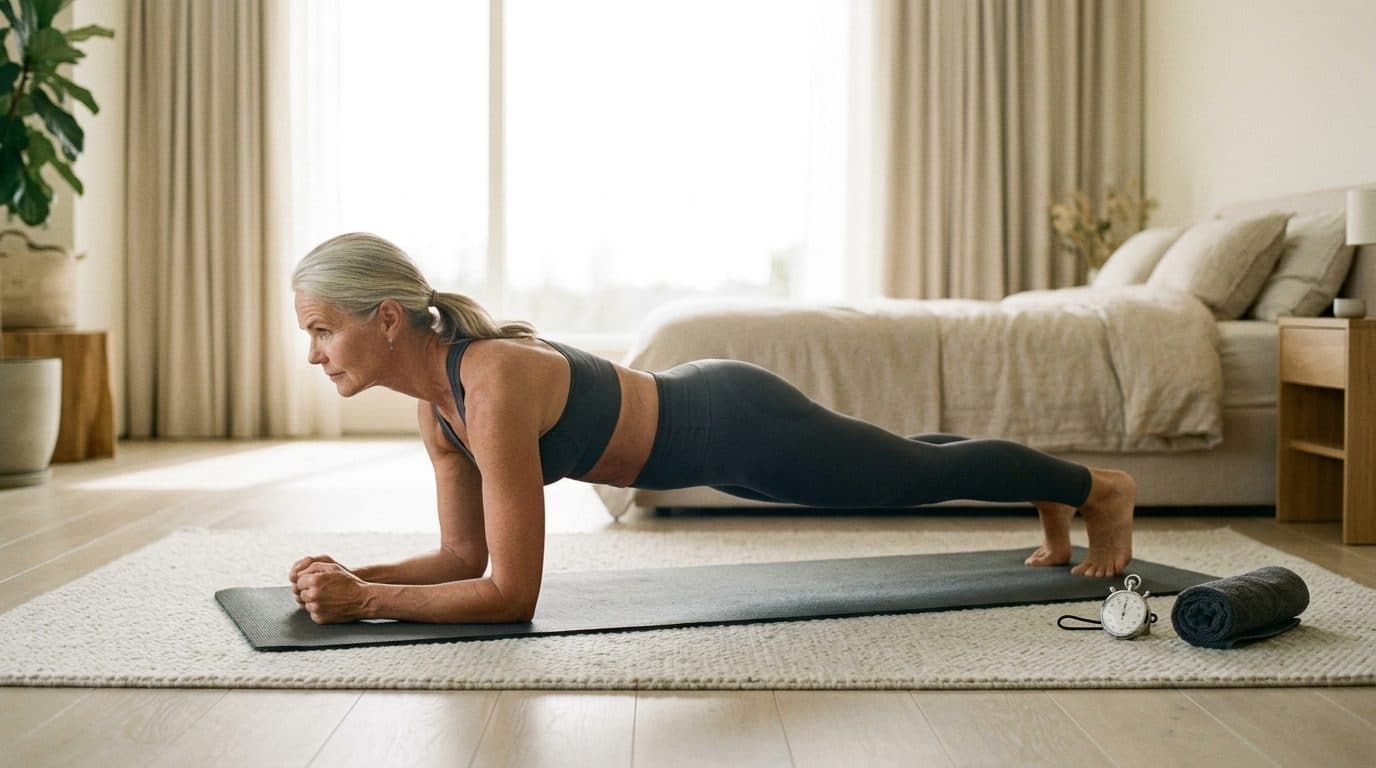
Planks for women over 50 work best when held for shorter, well-controlled bouts rather than long endurance holds, from forearms or an incline where wrists and shoulders stay comfortable, with ribs stacked over hips and steady breathing. Practised two to three times a week, they build genuine deep core strength without straining connective tissue that responds differently now.
Why do planks feel different after 50?
If a plank that used to feel simple now shakes your whole body after twenty seconds, that isn't decline, it's information. Hormonal shifts through perimenopause change how your fascia and connective tissue behave, and your nervous system stops responding to sheer effort the way it once did. The old approach, brace hard and grind out the clock, was built for a body that doesn't quite exist the same way anymore.
Training built for a much younger frame was never designed with this stage of life in mind. Your joints, tendons and connective tissue can still take real work, but they tend to respond better when load builds gradually rather than arriving all at once. The deep core system, the muscles you can't see in a mirror, responds better to controlled, repeatable practice than to one hard push.
Hold planks differently rather than avoiding them. The aim shifts from proving you can grit through discomfort to teaching your deep core, the transverse abdominis, the deep spinal stabilisers, the pelvic floor, to switch on reliably and work together. That takes patience more than force, and it's a different skill to the plank you might have learned in a gym class twenty years ago.
What does good plank form actually look like now?
Forget the version where you drop into position and simply wait for the timer. Start by noticing where your ribs sit. If they're flaring up and forward, your lower back is doing work it shouldn't, so draw them gently down towards your hips before you even lift off the floor.
From forearms or hands, wrists stacked directly under shoulders, or elbows under shoulders if you're on your forearms, build a long line from crown to heels. Don't hunt for a dramatic dip in the lower back or an exaggerated tuck under, either extreme switches off the deep core muscles you're actually trying to train. A slight, natural lengthening through the tailbone is enough.
Breathe. Holding your breath spikes pressure through your abdomen and pelvic floor in a way that works against you, not for you. Exhale as you set the position, then keep breathing normally, feeling your ribs move and your deep abdominals stay gently engaged underneath, rather than gripped and rigid.
- Wrists or elbows stacked directly under shoulders
- Ribs drawn down, not flared towards the ceiling
- A long line from crown to heels, no sagging or piking
- Steady breathing throughout, never held
How long should you actually hold a plank after 50?
Not as long as you think, and that's by design. Volume matters less now than precision, so a wobbling ninety second hold with your form falling apart in the last thirty seconds is training the wrong pattern. Once your hips sag or your shoulders creep towards your ears, the set is over, whatever the clock says.
A more useful target for most women in their fifties is three to five rounds of twenty to thirty seconds, each one held with genuinely good form, rather than one long grind. Rest properly between rounds, long enough that the next one starts as clean as the first.
This is the same thinking behind why MMM sessions run around twenty minutes: focused practice that builds real strength beats a longer session spent compensating with the wrong muscles. As your deep core gets more efficient at switching on, the quality of thirty seconds will do more than a shaky two minutes ever did.
What if a full plank doesn't feel right yet?
A plank on the floor is one version, not the only valid one. If your wrists ache, your shoulders feel unstable, or you simply can't hold good form for even ten seconds, an incline plank against a kitchen counter or a sturdy bench does the same job with far less load.
Working from your knees rather than your toes shortens the lever and lets you focus entirely on the ribs-down, deep core engaged pattern before you add the challenge of your full body weight. There's no ranking system where floor planks are the real version and everything else is a consolation prize. Your deep core doesn't know the difference between a knee plank done well and a full plank done badly.
Side planks, planks with a gentle single arm reach, or planks held on an incline all train the same system from a different angle, which matters, because your deep core works in more directions than straight ahead.
- Incline plank, hands on a counter or bench, feet back
- Knee plank on a mat for a shorter lever
- Side plank from knees or feet, whichever keeps form clean
- Single arm reach for added rotational control
How often should you practise planks for real core strength?
Two to three sessions a week is enough, provided the form stays honest each time. A scattered week built around one brutal long hold does less for your deep core than three short, well controlled sessions spread across the week.
Planks work best as one part of a broader deep core practice, not an isolated party trick. Paired with breathing work, gentle rotation and the kind of controlled loading that teaches the transverse abdominis and pelvic floor to work together, the plank becomes far more useful than it is on its own.
This is exactly the territory Love Your Core was built for, deep core training designed around how your body works now, not around a generic plank challenge. If you'd like a structured way to build this properly, with the sequencing and progressions worked out for you, that's where the programme picks up.
Common questions
Is it normal for planks to feel harder after 50 than they used to?
Yes. Hormonal changes through perimenopause affect how your fascia and connective tissue respond to load, so the same plank can feel like a different exercise. It isn't a sign anything is wrong, it's a sign your training needs to adjust with you.
Do I need to hold a plank for a full minute to get anything from it?
No. Several shorter holds of twenty to thirty seconds, done with genuinely good form, build more real strength than one long hold where your technique falls apart towards the end.
What if I have concerns about diastasis recti or pelvic floor pressure?
This is educational content, not medical advice, so speak with a women's health physiotherapist about specific concerns. In general, breathing steadily and noticing any doming or bulging through your midline during a plank is a useful habit.
Can I do planks without any equipment?
Yes, a plank needs only floor space and, if you want the easier incline version, a sturdy counter or bench. Nothing else is required.