Gentle Movement for Low Energy Days in Perimenopause
Chrissy Sundt · Rest & Illumination ·
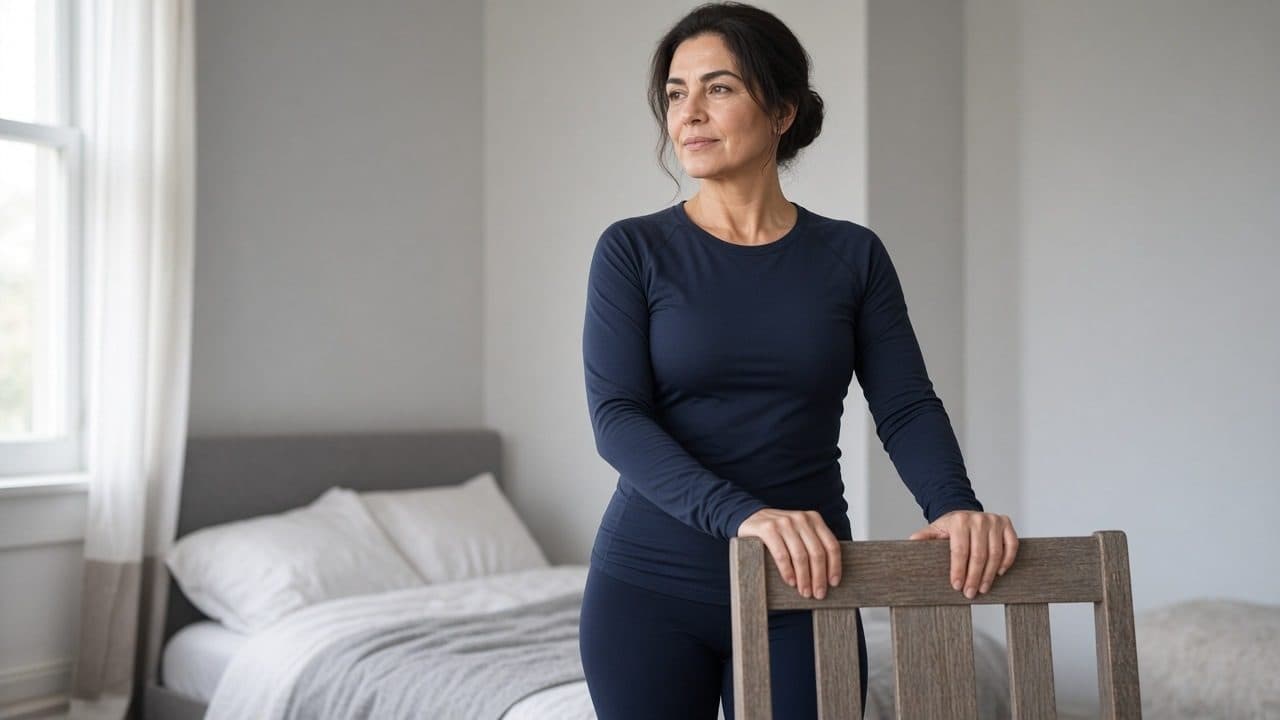
On a low energy day, gentle movement means short, supported sessions - slow mobility, standing stretches using a chair for balance, or an easy walk - chosen for how your body feels that day rather than a fixed target. It keeps the habit alive without adding load, which matters far more than pushing through fatigue.
Why does perimenopause drain your energy on some days?
On a low energy day in perimenopause, the tiredness rarely has a single cause. Oestrogen and progesterone are no longer moving in the predictable rhythm they once had, sleep is lighter and more easily broken, and the body is running background processes you cannot see from the outside. If you have been wondering why some weeks leave you flat for no obvious reason, it is worth reading why you feel exhausted all the time in perimenopause - the fatigue itself is well documented, not a personal failing.
There's a useful distinction between stress that resolves quickly and stress that grinds on without a clear endpoint - the first is recoverable, the second accumulates a cost the body has to carry. Perimenopause often puts you in that second category even on days when nothing dramatic has happened - the body is simply managing more than it used to, quietly, in the background.
Fluctuating hormones also show up in mood and cognition - brain fog, a shorter fuse, concentration that frays faster than it used to. None of that is about effort or discipline.
A flat, heavy day is information, not a verdict on your fitness. The useful question isn't why you feel so tired - it's what your body actually needs right now.
Is it still worth moving at all when you have no energy?
There's a particular kind of guilt that shows up on a low energy day: the sense that if you can't do a full session, there's no point doing anything. That's the wrong question. Movement on a flat day doesn't need to match movement on a good day. It needs to match the day you're actually having.
This is where Intelligent Movement™ matters more than the idea of doing more. The aim was never a fixed number of minutes or a fixed intensity regardless of how you feel - it's choosing the dose that suits the body in front of you today. Some days that's a full barre session. Some days it's five minutes of slow mobility, holding the back of a chair for balance. Both count.
It helps to know the difference between a day that genuinely needs rest and a day that needs gentle movement instead, because they can feel similar from the inside. If you're not sure which one you're in, how to tell if you're burnt out or just in perimenopause is a useful way to separate the two before deciding what to do with your body today.
Gentle movement on a low day isn't a lesser version of real training - staying consistent through flat weeks is often what keeps you training six months from now.
What gentle movement actually looks like on a low energy day
Gentle doesn't mean vague. On a flat day, useful movement tends to be slow, supported and short - working with your body's current state rather than pushing through it. Think ankle circles and hip openers at the kitchen counter, a slow few minutes of spinal rotation, or standing holds using the back of a sturdy chair for balance. The chair is a balance aid, not an instruction to perform.
This is the territory covered in restorative movement for midlife women - movement chosen for how it leaves you feeling, not for how many calories it burned or how hard it was. On the lowest days, a slow walk outside, a few minutes of hip and thoracic mobility before bed, or breath-led stretching through the hamstrings and lower back can all count as the day's movement, full stop.
The movements are simple and done at your own pace, with the back of a sturdy chair there simply to hold onto for balance.
What you're doing on these days is keeping the pattern alive rather than adding load - and that pattern is what makes the good days easier to return to.
- Standing mobility at the back of a chair: ankle rolls, slow hip circles, gentle side bends
- A ten-minute walk with no target pace
- Seated or lying spinal twists and hamstring stretches
- Slow shoulder and neck rolls at a desk or kitchen counter
How do you know if it's rest you need, not movement?
Some low energy days aren't asking for five minutes of gentle movement at all - they're asking for an actual rest day, and the honest answer is you need both tools in the kit, not just one. Knowing which one applies today is less about willpower and more about paying attention to what's actually going on in your body and your week.
Fatigue that follows a hard strength session feels different from the flat, heavy mood that comes with hormone fluctuation - one eases with sleep, food and a bit of time, the other can linger regardless of what you do that day. A disrupted night, a stretch of poor sleep, or a particularly demanding week at work can all tip the scale toward rest rather than movement, even a gentle version of it.
Guilt is often the loudest voice in the room on a rest day, louder than anything your body is actually telling you. How to build a rest day into your week without the guilt is worth reading if you notice you're arguing yourself out of rest you clearly need.
A rest day taken on purpose is not the same as avoidance. Avoidance tends to repeat itself for weeks; a genuine rest day tends to leave you wanting to move again.
Building a rhythm that holds even on the hard weeks
The real skill in perimenopause isn't finding more energy from somewhere - it's building a way of moving that survives weeks when energy is unpredictable. That means having more than one plan: a fuller plan for good weeks, a gentle plan for flat ones, and permission to move between the two without feeling like you're starting over each time.
Protecting the energy you do have often starts outside the gym entirely. How to set boundaries that protect your energy in midlife is as relevant to a low energy week as anything you do in a session, because what you say yes to during the day shapes what you have left for yourself by evening.
This is part of why Awaken Barre sessions run to around twenty minutes rather than longer. The length is intentional - built for a body that needs precision more than volume, so a gentle, well-chosen twenty minutes can still be a real session, not a consolation prize for a day you couldn't manage more.
Consistency across years, not streaks across weeks, is what training for Strong Enough for 85™ actually looks like. A low energy day handled well is still part of that - not a gap in it.
If you want this as movement rather than another article, Awaken Barre is the twenty-minute programme I built for a body that has already changed.
Common questions
Is it better to skip a session entirely than do a weak one?
Not usually. A short, gentle version - slow mobility or a few supported stretches - keeps the habit alive without adding load, and the habit is what matters on the days you're trying to protect. Skipping altogether is sometimes right too, particularly after a poor night's sleep, but it shouldn't be the automatic default.
How do I know if I'm just low on energy or heading toward burnout?
Low energy tends to lift with sleep, food and a gentler day. Burnout tends to persist regardless of what you do about it, and often comes with a flatness that doesn't shift even after rest. If it's lasted more than a couple of weeks, it's worth treating as burnout rather than a bad day.
Do I need any dance experience for barre-inspired movement?
None at all. Barre here is a fitness approach inspired by ballet, not a dance class, and the barre itself - or the back of a sturdy chair at home - is simply something to hold for balance while you move.
Will gentle movement undo my progress on a low energy week?
No. Missed or lightened sessions don't erase what you've built; returning consistently matters far more than an unbroken streak. A gentle week is still movement, just dosed differently.
What's the minimum that still counts as movement on a bad day?
A few minutes of slow mobility, a short walk, or some supported stretching at home all count. The aim on these days is keeping the pattern going, not hitting a target.