How Many Rest Days Do You Need Between Strength Workouts in Midlife?
Chrissy Sundt · Rest & Illumination ·
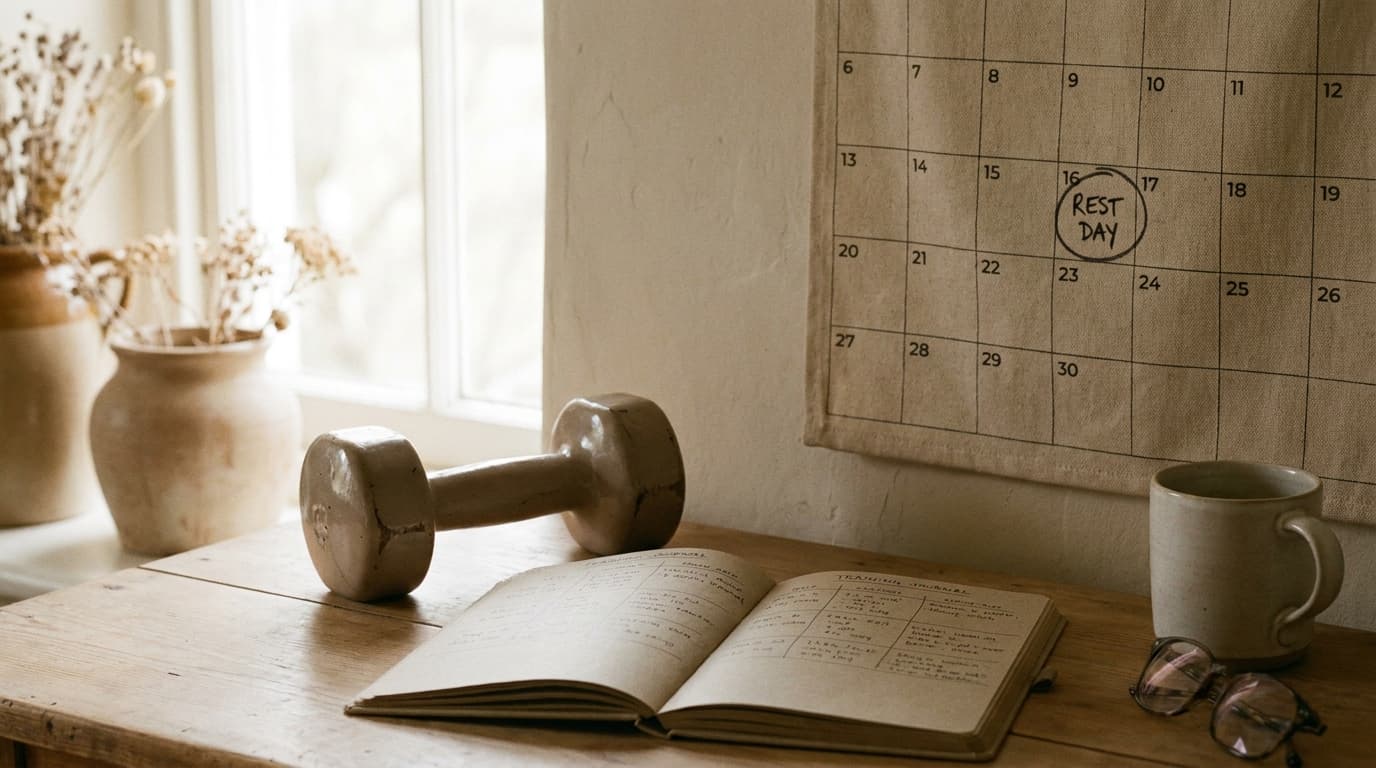
Most women need at least one full rest day between strength sessions that train the same muscles, and 48 hours is a sensible default in perimenopause. Recovery capacity can shift with hormonal change, so the honest answer is fewer, better sessions with proper rest beats daily training pushed through fatigue.
How many rest days do you need between strength sessions?
There's a genuine baseline here: leave at least 48 hours before you load the same muscle group hard again. If you're doing full-body strength work, that usually means training on alternate days instead of back to back, so three sessions across a week with rest or lighter movement between them. That window roughly reflects how long muscle tissue takes to repair and adapt after a session with real effort behind it.
What actually happened in the session is the better guide, not the calendar. A session where you pushed close to your limit on squats, presses and rows needs more recovery than a mobility-focused day or a lighter technique session. Two hard sessions on the same muscle groups with only a night's sleep between them rarely gives your body enough time to catch up, whatever the workout looked like on paper. Judge recovery by what a session actually demanded.
For most women, two to three focused strength sessions a week, spaced with at least a day between sessions hitting the same areas, is a sensible working pattern. That leaves room for gentler movement, like walking or mobility work, on the days in between if you want to keep moving without adding load. The aim is training days spaced so each one has time to finish its job before the next starts.
Why can recovery feel harder in perimenopause?
Sessions that used to leave you fine but now leave you wiped out for two days aren't a willpower problem. They're telling you something about capacity this month. Hormonal changes through perimenopause affect sleep quality and how quickly tissue repairs itself, as well as the way your nervous system handles stress. The training that worked in your thirties can ask more of a body that's now running on a different hormonal pattern, which is why the same weekly volume can suddenly feel like too much.
A hard strength session is a short, deliberate stressor, the kind your body is built to adapt to and recover from given the chance. But stack it on poor sleep, a demanding week and no real rest days, and it stops behaving like an isolated effort. It starts adding load onto load, instead of prompting the adaptation you're training for.
None of this means your body is failing you. The terrain has changed, and the old maths of daily training regardless of how you feel doesn't hold the way it used to. Paying attention to your own recovery has become part of the training itself.
What should a rest day actually look like?
Most rest days work best with some gentle movement in them, though an occasional full day on the sofa does no harm either. For most women, a rest day means no loaded strength training, but movement is still welcome: a walk or some gentle stretching that keeps joints moving without asking muscles to work hard again so soon.
Sleep does more of the recovery work than anything you do while awake, so a rest day is also a reasonable place to protect an early night rather than a late one. Food matters too. Bodies rebuild tissue from what you eat, so a rest day isn't the moment to skip meals or under-eat because you didn't train.
Stress outside the gym counts as load as well. A demanding work day or a bad night's sleep draws on the same recovery resources as a hard training session, and so does a stretch of high pressure at home. On a rest day, anything that genuinely lowers the noise, whether that's ten minutes outside or simply going to bed earlier, is doing real work even though it doesn't look like training.
How do you know you're not getting enough recovery?
Some signs are obvious: soreness that hasn't eased by the next session, or workouts that feel disproportionately hard compared with the effort you're putting in. Others are easier to miss because they show up outside the gym rather than during it.
Any one of these on its own might just be a rough week. A pattern of several together, especially alongside training that hasn't let up, is worth listening to. Often the answer is an extra rest day or a lighter session in place of a hard one. Sometimes it's simply admitting that this week needs less than last week did.
This is where consistency counts. Missing a day or scaling one back because your body is asking for it doesn't undo progress. Training through genuine fatigue week after week sets you back. One quiet week never will.
- Sleep that feels lighter or more broken than usual
- Persistent low-grade fatigue that a good night's sleep doesn't fix
- Irritability or a shorter fuse than normal
- Strength or form that feels worse than it did last session
- Motivation to train dropping off for no obvious reason
Does a shorter, more intelligent session change how much rest you need?
A 20-minute session still changes the recovery equation, though it doesn't automatically need less rest as a result. Sessions built around precise, controlled work put a different kind of demand on the body than long stretches of volume: focused effort in a short window, not an hour of steadily accumulating fatigue.
That's part of the thinking behind Awaken Barre sessions, which are built to be around 20 minutes, using controlled, low-impact strength and mobility work. A short session can still be demanding, and you still need rest days between sessions that hit the same muscles. But it does mean recovery has less accumulated fatigue to deal with, which is one reason a realistic weekly rhythm tends to hold up better over time than daily training.
How many rest days you need depends on effort, sleep, stress and how your body is responding that particular week. What stays constant is that rest is where a good deal of the actual progress happens.
Common questions
Can I do strength training on consecutive days if I'm not sore?
Soreness isn't the only recovery marker, so it's possible if you're rotating which muscle groups you load. Training the same major muscle groups on back-to-back days is still best avoided in perimenopause, even without visible soreness.
Is walking on rest days okay?
Yes. Walking and gentle stretching are usually fine on a rest day because they don't ask the muscles you just trained to work hard again. A rest day is about avoiding load on the muscles you just trained, while gentle movement itself is still fine.
Do rest day needs change during perimenopause?
Many women notice their recovery needs shift as sleep and stress patterns change through perimenopause. Paying attention to how a particular week feels works better than sticking to a fixed schedule regardless of circumstances.
How long should a strength session be to fit around proper rest?
Around 20 minutes of focused, well-structured work is enough to build strength without adding excessive recovery demand. Awaken Barre sessions are built around that length for this reason.