Finding a Workout Community in Midlife: Where to Look and What to Expect
Chrissy Sundt · Connection ·
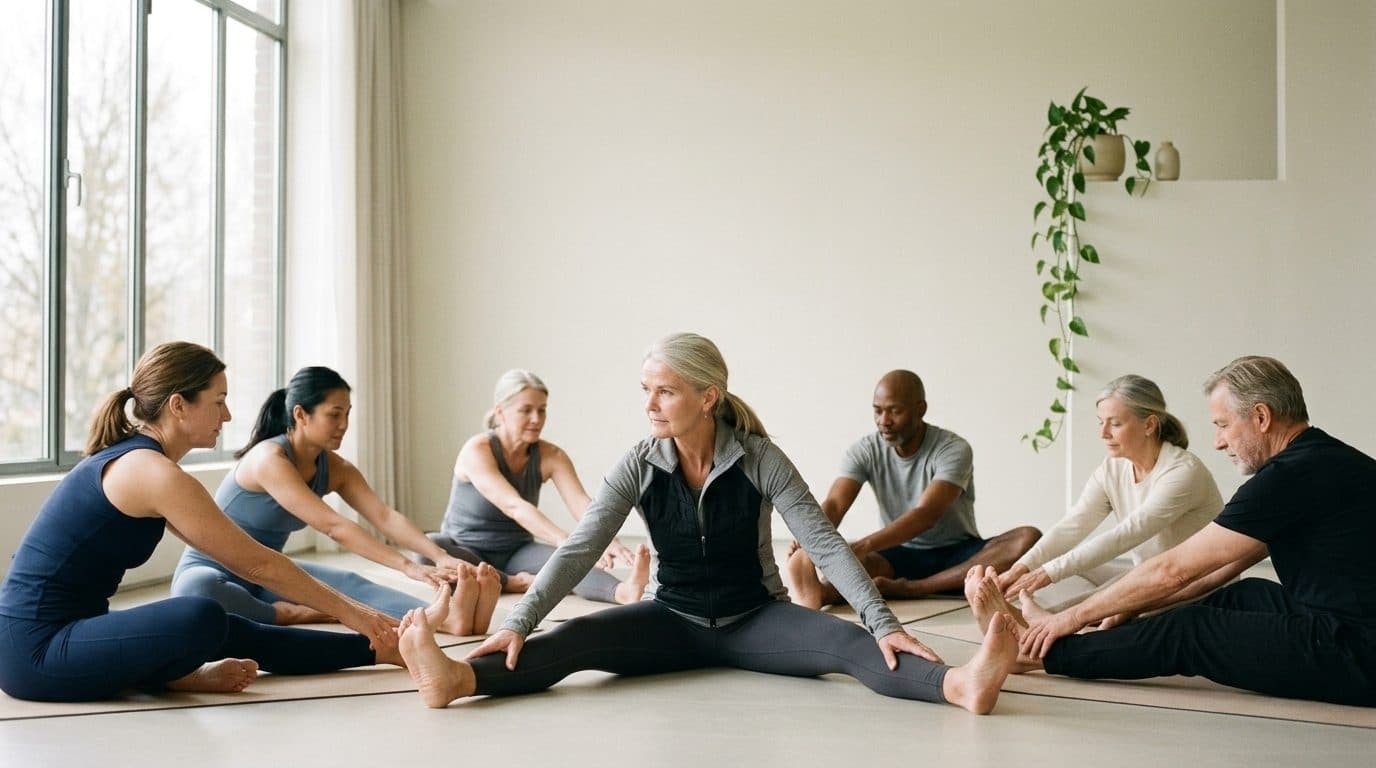
Finding a workout community in midlife means choosing small, repeatable sessions over big anonymous gyms: the same instructor, the same time slot, and few enough faces to be noticed. Look at local barre, Pilates or walking groups, bring one person along if you can, and give any new group at least four or five visits before deciding whether it's yours.
Why does it feel harder to find your workout people now?
There's a reason it feels harder to find your fitness people now than it did in your twenties or thirties. Back then, community mostly found you. You had the same faces at the same time in the same place, whether that was a work five-a-side team, the school gate, or a housemate who dragged you to spin class. Midlife tends to quietly dismantle a lot of that scaffolding at once. Careers shift or wind down, children need you differently or not at all, some friendships fade because the thing that held them together (proximity, a shared season of life) has simply moved on. The structures just aren't automatic any more, so you have to go and build them on purpose, which feels like a much bigger ask than it should.
It's worth taking that seriously rather than treating it as a nice-to-have. Losing your people in midlife isn't just an inconvenience to sort out once the rest of life calms down. Who you move with is worth treating as a genuine question, not an afterthought. If you want to understand why this stage in particular makes friendship harder to sustain, why is it harder to make friends in midlife goes into the mechanics of it in more detail.
What makes a workout community different from a class?
A workout community isn't the same thing as a workout class, and conflating the two is why so many women try one drop-in session, feel nothing, and conclude community "isn't really their thing." A class is content. A community is what happens when you see the same women often enough that a nod becomes a name, a name becomes a conversation, and eventually someone notices when you're not there. That takes repetition, not intensity. It also takes a setting small enough that you're seen in it, rather than one face in sixty on a gym floor.
This is part of why studio-style sessions tend to work better for this than big anonymous gyms. Smaller rooms, the same instructor, a format you get better at over weeks rather than one you're re-learning every visit. None of that requires you to already be fit, confident or particularly social. It just requires showing up somewhere small enough to be noticed.
If the barrier is the gym itself, not the people, barre for women who hate the gym is worth reading before you write off group movement altogether. And if you want a broader look at what to search for locally, how to find a women's fitness community covers the practical groundwork: what to ask, what to notice on a first visit, and what tends to signal a room that's genuinely welcoming rather than just busy.
Where do you start looking?
Start closer to home than you think you need to. A studio within walking or short driving distance that runs small group classes at a consistent time slot beats a highly rated one across town that you'll only manage sporadically, because community is built by frequency, not by finding the objectively best session. Barre and Pilates studios, walking groups, local strength classes for women, and swimming groups all work on the same principle: same time, same room, same faces, repeated.
Bringing one person with you changes the maths considerably. Arriving somewhere new alone is a bigger ask than arriving with even one familiar face, and it gives you someone to debrief with afterwards, which is often where the actual bonding happens. How to stay motivated with a workout buddy has practical detail on making that arrangement stick past the first few enthusiastic weeks.
If nobody in your current circle is available or interested, there's still plenty of ground to cover: options for starting from scratch, without already knowing someone going in. Online communities can be a genuine first step too, particularly for finding women in a similar season of life before you ever meet in person, though they work best as a bridge to something in-person rather than a replacement for it.
What if the idea of walking in alone fills you with dread?
For a lot of women the honest barrier isn't logistics, it's dread. The idea of walking into a room where everyone else already seems to know each other, of being the new face, of not knowing where to stand or what the etiquette is. That reaction is common, and plenty of women who'd call themselves confident elsewhere still feel it walking into a new class. Wanting to feel your way into a group slowly, rather than announcing yourself to a room, is just a different temperament.
Forcing yourself into the busiest, loudest option as a kind of exposure therapy rarely works. Choose formats that don't demand performance instead. A class where everyone faces the same direction, following the same instructor, asks far less of you socially in the first few weeks than one built around partner work or open conversation. You can be fully present in the room, get the benefit of the same faces returning week after week, and let any talking happen at your own pace, often near a chair or the barre rather than in the middle of the floor.
How to build community as an introvert in midlife goes further into this, including how to contribute to a group without needing to be the person who talks the most. Showing up in a format that doesn't ask you to be someone you're not matters more than being naturally outgoing.
How long should you give a new group before deciding it's not for you?
Give any new group more time than one session before deciding it's not for you. The first visit is almost always about logistics, where to park, what to bring, where the changing room is, and none of that leaves much room to notice whether you like the people yet. Community reveals itself slowly, usually somewhere around the fourth or fifth visit, once you've stopped concentrating on the format and started noticing who's actually next to you.
Missed weeks don't undo this either. Life in midlife is genuinely full, and a fortnight away doesn't erase the familiarity you'd built before it. What matters more than perfect attendance is returning to the same place rather than restarting somewhere new every time you have a gap, because it's the returning, not the streak, that builds recognition.
It's also fair to expect this to take more than one attempt. Not every studio, class or group will be the right fit, and a room that doesn't work still tells you something useful about what to look for next. If the first one doesn't feel like yours, try another rather than concluding the whole idea isn't for you.
If you want this as movement rather than another article, Awaken Barre is the twenty-minute programme I built for a body that has already changed.
Common questions
How is a workout community different from just going to a gym?
A gym gives you equipment and space. A community comes from seeing the same faces in the same small setting often enough that people start to notice you. That's much likelier in a small studio class than on an open gym floor.
I feel too old to make new gym friends. Is that realistic in midlife?
It's realistic, it just looks different from how it did at twenty. Friendships built around repetition, the same class, the same time slot, tend to form more naturally than ones you have to force through small talk.
How many sessions should I try before deciding a class isn't for me?
Give it at least four or five visits. The first one or two are usually spent working out logistics rather than getting a real feel for the people in the room.
Do online fitness groups count as real community?
They can be a useful starting point, especially for finding other women in a similar stage of life. They tend to work best as a bridge towards an in-person group rather than a permanent substitute for one.
Do I need to be fit or have danced before to join a small group barre class?
No. Barre is inspired by ballet but isn't a dance class, and the barre itself works like the back of a sturdy chair, there to steady your balance, not to test your technique.