I Think I’ve Forgotten to Dance
Chrissy Sundt · Mindful Movement ·
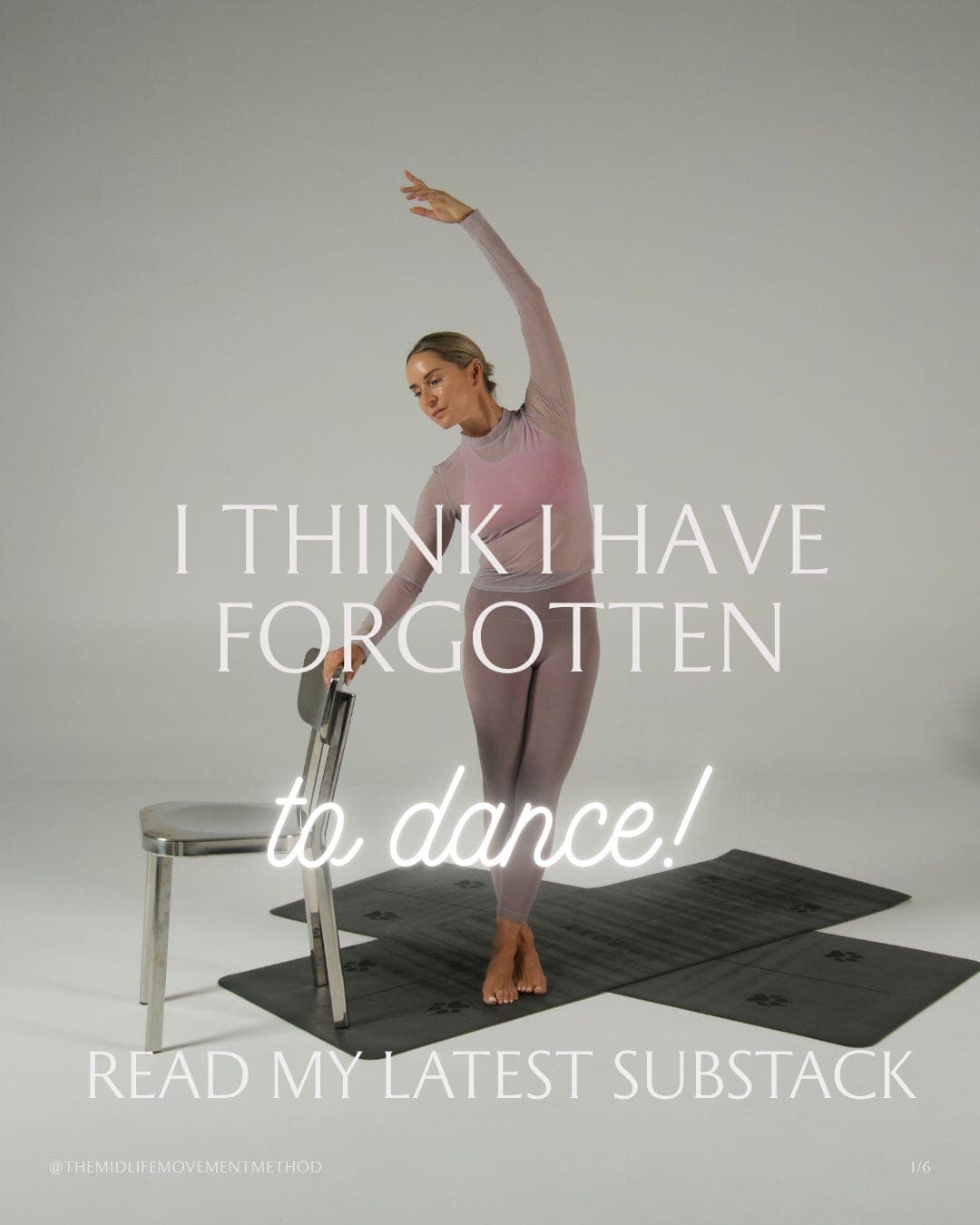
And although dance has remained woven through everything I have done professionally, somewhere along the way I stopped thinking about how important that particular combination of movement and music might actually be.
I realised something recently. I think I have slightly left behind one of my greatest loves: dancing.
As a child, I danced anywhere and everywhere. Put music on and I moved. When all the other little girls in my kindergarten had a nap, I danced round the room. The Aga was my barre, and the back garden was my stage!
I went into professional ballet training at ten years old and, for many years, dancing for eight hours a day was completely normal. Music, movement, choreography and learning combinations weren’t things I consciously added to my life. They were my life.
Not just for fitness but for the brain.
The bit we sometimes miss about Barre
When we talk about Barre, particularly in the fitness world, the conversation tends to centre around the physical. The legs. The glutes. The core. The infamous shake and burn!
And as I’ve developed The Midlife Movement Method, I’ve deliberately moved the conversation much further towards strength, progressive resistance, balance, mobility and maintaining the physical capabilities we want for the decades ahead and all of that matters.
But I think there is another part of Barre that we have underestimated, the choreography.
Think about what happens when you’re following a really good Barre session. You’re listening to the teacher while moving and you’re remembering a sequence.
You’re coordinating your arms and legs whilst changing direction. And hopefully you’re responding to rhythm amd you’re anticipating what comes next.
Then the choreography changes again and your brain has to catch up.
Add a brilliant, energising playlist and suddenly this isn’t simply a series of exercises.
It is movement + music + memory + coordination + attention.
You can’t really think about your shopping list and you can’t check your phone (I am hoping you are doing this with me on a big screen by the way!) and you can’t spend the next five minutes mentally replaying the irritating email you received that morning.
You have to be there. What my Pilates teacher trainers used to call ‘present time consciousness’. Barre forces you into the moment.
And perhaps that’s one of the reasons so many of my clients have loved it over the years without necessarily being able to articulate why.
We used to dance more
This made me think about something else. So many women I know danced when they were younger.
Perhaps you had dance lessons as a child. Perhaps you didn’t. But then there were school discos. University nights. Weddings. Parties. Clubs. Holidays. Kitchens at two o’clock in the morning (sooooo many of those!).
We moved to music because it felt good.
And then somewhere in adulthood, movement became something rather more serious.
We started working out. We measured it and counted it.
We started tracking our heart rate and our steps and our zones and our weights. And, particularly in midlife, we’re now presented with an ever-growing list of things we’re told we must do:
• Lift heavy.
• Do HIIT.
• Walk 10,000 steps.
• Train Zone 2.
• Improve your VO₂ max.
• Protect your bones.
• Maintain your muscle.
All of these conversations can have value but I sometimes wonder whether, in our determination to optimise movement, we’ve forgotten something wonderfully basic.
Moving can also be joyful.
And this is where the science gets interesting. Researchers have become increasingly interested in dance precisely because it isn’t purely cardiovascular exercise.
Dance combines physical exertion with cognitive and sensory demands: rhythm, sequencing, coordination, spatial awareness, learning and often social interaction.
A systematic review and meta-analysis of randomised trials in adults aged 55 and over found evidence that dance can improve aspects of cognitive function. Importantly, the evidence isn’t a licence to claim that dancing prevents dementia or that it’s somehow the “best” exercise for your brain. Different studies have produced different results across memory, attention and executive function, and researchers are still working out which elements of dance may matter most.
There are interesting physical findings too. A large British observational study following more than 48,000 adults over 40 found that moderate-intensity dancing was associated with lower cardiovascular mortality. That is an association, rather than proof that dancing itself caused the reduction, but the researchers suggested intensity, long-term adherence and psychosocial benefits as possible explanations.
And this is what fascinates me. Dance doesn’t neatly fit into one little fitness box.
The body is working while the brain is working and perhaps that complexity is part of its magic.
Which brings me back to Barre as a fitness modality. Barre isn’t dance in the traditional sense. I’m certainly not going to ask you to perform Swan Lake in your living room (unless you want to of course) But so many of the elements I have loved about dance all my life are embedded within the way I teach Barre.
• The music.
• The rhythm.
• The sequencing.
• The coordination.
• The concentration.
• The satisfaction of finally getting a combination that initially felt impossible.
And, of course, the physical work: resistance, strength, balance, mobility, stability and cardiovascular challenge.
That makes Barre a rather interesting piece of the Midlife Movement Matrix. Not instead of strength training and not instead of walking, cardiovascular fitness, mobility or recovery but alongside them.
Because the body I want us to build for our 60s, 70s and 80s isn’t simply strong. I want it to be adaptable.
• Coordinated.
• Balanced.
• Responsive.
• Confident.
And still capable of learning new things. Perhaps we need a little less exercise and a little more movement – freestyle!
There is something else here that I don’t want to lose beneath the science: joy.
One of the things I hear most often from women who return to Barre is how quickly they remember how good it feels to move to music. Not because they’ve burnt a certain number of calories and not because their watch has congratulated them but because for 20 or 30 minutes they have been completely absorbed in what their body is doing.
And perhaps that is something we need more of in midlife. Not another punishing workout and not another thing to optimise.
Something that challenges us physically and mentally while simultaneously making us feel more alive.
Writing this has actually made me realise that I want to put more dancing back into my own life. Not because I’ve discovered another longevity hack but simply because I love it. And perhaps that’s reason enough.
And if you haven’t danced for a while either, maybe this is your invitation to turn the music up.
A gentle place to begin
If Barre has always intrigued you but you’ve thought, I’m not coordinated enough, I’m not a dancer or I wouldn’t know what I was doing, please know that none of those things are prerequisites.
In fact, learning is part of the point.
Awaken Barre is my four-week introduction to Barre for women in perimenopause and menopause.
Sixteen 20-minute sessions, at home, with nothing more complicated than a mat and a chair.
We start simply. We learn. We build.
And hopefully, somewhere amongst the strength work, the wobbles, the combinations and the playlists, you rediscover some of the joy of simply moving.
Come and Awaken your Barre journey with my 4-week, midlife-friendly programme
Explore Awaken Barre 🤍
If you want this as movement rather than another article, Awaken Barre is the twenty-minute programme I built for a body that has already changed.
First published in The Midlife Movement, Chrissy’s newsletter.
Common questions
What is the connection between dance and brain health?
Dance combines physical movement with rhythm, sequencing, coordination and often social interaction, which sets it apart from purely cardiovascular exercise. Reviews of research in older adults have found some evidence that dance can support aspects of cognitive function, though results vary across memory, attention and executive function, and this is not a claim that dance prevents any condition.
Is Barre the same as dance?
Not exactly. Barre isn't dance in the traditional sense, but it borrows many of its elements, including music, rhythm, sequencing, coordination and concentration, alongside the physical work of strength, balance, mobility and stability.
Why do so many women stop dancing as adults?
In childhood and early adulthood, movement to music often happens naturally, at discos, weddings, parties or in the kitchen at midnight. As life gets busier, movement can become something more structured and measured, tracked through steps, heart rate and workout targets, and the simple joy of moving to music can get left behind.
Does dancing improve heart health?
A large British observational study following more than 48,000 adults over 40 found that moderate intensity dancing was associated with lower cardiovascular mortality. This is an association rather than proof of cause, and researchers pointed to intensity, long term adherence and psychosocial benefits as possible explanations.
What makes Barre more than just a physical workout?
Following choreography while listening to music asks the brain to remember sequences, coordinate arms and legs, and anticipate what comes next, all at once. That combination of movement, music, memory and attention brings a mental focus to Barre that goes beyond the physical work on legs, glutes and core.