Finding the Right Perimenopause Fitness Coach in the UK: What Actually Matters
Chrissy Sundt · Mindful Movement ·
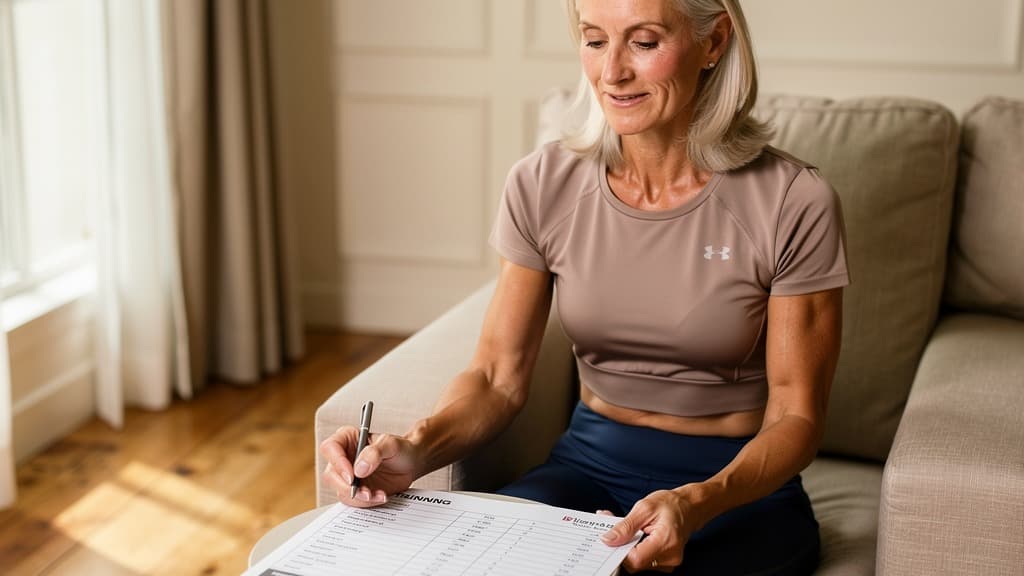
A good perimenopause fitness coach in the UK trains the body you have now, not the one you had at twenty: shorter, more precise sessions, strength and mobility work that respects a nervous system under more load, and coaching from someone with lived experience of the transition themselves, not just a certificate in general fitness.
What should a perimenopause fitness coach actually understand that a general PT doesn't?
Most personal trainers were taught to build programmes around a body that responds predictably to more: more sets, more sweat, more intensity. Perimenopause doesn't play by those rules. Your hormones are shifting week to week, not on a neat monthly cycle, and a coach who doesn't understand that will keep using the same approach that worked in your thirties, then wonder why you're wiped out for two days afterwards.
What you actually need is someone who trains the nervous system as much as the muscle. In perimenopause, cortisol is often already doing more work than usual, so a coach who understands the phase keeps intensity intelligent and contained rather than maxing you out every session. That's not a lesser workout. It's a different, more precise one.
Lived experience matters here too. I've spent twenty-five-plus years working in movement, first as a Barre and Pilates trainer, and I'm navigating perimenopause myself right now, which means I'm not coaching from a textbook I read once. When a client tells me her sleep was rubbish and her joints feel stiff before she's even out of bed, I know that morning too, not just professionally.
None of this is about diagnosing or treating anything, and a coach worth working with should be upfront about that. What you're looking for is someone who can help you build strength, mobility and confidence for the body you have now, and who understands why the old approach stopped working.
- How intensity is adjusted week to week, not fixed in a rigid twelve-week block
- Whether recovery and sleep are part of the conversation, not just reps and sets
- Whether the coach has personal experience of this transition, not only a qualification in general fitness
Why did the exercise that used to work suddenly stop working?
This is the question I get asked more than any other, usually with real frustration behind it, and often alongside something quieter: not recognising your own body anymore. You're doing what you've always done, maybe even doing it religiously, and your body isn't responding the way it used to. It's not you doing it wrong. Your body is different now, and you're using the wrong map for the terrain you're currently standing on.
Fascia, the connective tissue running through every muscle, doesn't respond to force the way it once did. It responds to patience, to movement that builds through range rather than pushing through it. Your nervous system has shifted too. It doesn't trust intensity the way it did in your twenties and thirties. It trusts consistency: showing up in a way your body can actually predict and recover from.
This is why generic fitness content, built for a much younger recovery capacity, tends to leave you flatter rather than stronger. Your body doesn't respond to volume anymore. It responds to precision: fewer, better-chosen movements, done with control, done regularly. Twenty minutes done with intelligence and attention beats an hour done on autopilot.
So if you've been quietly wondering whether something's wrong with you because your usual routine stopped delivering, it isn't. Your body isn't broken. It's evolving, and it needs a different kind of training conversation, one built around mindful movement rather than sheer effort.
What does mindful movement coaching actually look like day to day?
Mindful movement is one of five pillars I coach around, alongside sleep, nourishment, rest and illumination, and connection, because strength training in isolation rarely holds up when the rest of your life is running on empty. Movement is usually where women start, though, because it's the part you can feel changing week by week.
In practice, that means sessions built around MMM Barre, the discipline behind Awaken Barre, the programme I teach: barre-based work inspired by ballet, using slow, controlled positions to build strength through the deep core, glutes and stabilising muscles most workouts skip past. You're not learning choreography. The barre itself is simply a balance aid, similar to holding the back of a sturdy chair, there to steady you while the real work happens underneath.
Sessions run to around twenty minutes, and that length is intentional, not a compromise. In midlife, your body responds to precision rather than duration, so we work in short, focused blocks that target full core activation, not just the surface abs but the deeper structures that actually create stability, and leave you feeling steadier rather than wired.
This is deliberately different from a punishing class or a long, generic gym session. It's movement designed to work with a changing body, not push against it, which is exactly what mindful movement means here.
- Sleep
- Mindful movement
- Nourishment
- Rest and illumination
- Connection
Do I need dance experience or a home gym to start?
No, and this is one of the most common things women ask before they'll even try a class. Barre gets its name and its inspiration from ballet, but that's where the connection to dance ends. There's no choreography to memorise, no turnout, no dance background required at any point.
The 'barre' itself is simply something to hold onto for balance, doing the same job as the back of a sturdy kitchen chair. In fact, that's often exactly what women use at home. You don't need a studio, a ballet barre, or any specialist kit. A clear patch of floor and something stable at hand height is genuinely enough.
That matters because one of the biggest barriers to getting back into movement in midlife isn't motivation, it's logistics. If a programme requires a gym membership, a class schedule and travel time, it quietly becomes another thing you don't get round to. Twenty minutes at home, barefoot, in your own living room, removes most of the reasons this slips down the list.
So if the word 'barre' has been putting you off because you're picturing leotards and years of ballet training, let that go. What you're picturing isn't what this is. What you actually need is a chair, some floor space and twenty minutes, and a coach who'll show you exactly what to do with them.
- A clear patch of floor, roughly the size of a yoga mat
- Something sturdy and about hip height: a dining chair, a worktop edge, a bannister
- Bare feet or grippy socks
- Twenty minutes, ideally at a time you can protect
How do I know if this is the right kind of coaching for me?
A useful test: does the coaching acknowledge that missing sessions is normal, or does it quietly guilt you for it? This isn't Duolingo. Missed sessions don't erase progress, and a coach who understands perimenopause will build a programme around returning consistently over months, not punishing streaks or unbroken chains.
It's also worth noticing whether movement is treated as the whole answer or one part of a bigger picture. In my own coaching, mindful movement sits alongside sleep, nourishment, rest and illumination, and connection, because a brilliant barre session won't undo a body that's chronically under-slept and under-fed. If nutrition support appeals, that's a separate, deeper piece of work, which is why the Core Nutrition Reset exists, written with nutritionist Tina Lond-Caulk specifically for perimenopause, alongside Love Your Core for women wanting to go further with deep core work.
Be wary, too, of anything promising to shrink you, fix you, or bounce you back to an earlier version of yourself. That framing has no place in midlife coaching. The aim isn't less of you. It's reclaiming your centre, strength and capability for the body and life you have right now, not the one you had two decades ago.
If a coach's approach ticks those boxes, understands the physiology, respects your recovery, treats missed weeks as normal and builds you up rather than shrinking you down, you're looking in the right place.
- Missed sessions aren't treated as failure
- Movement is one part of a wider picture, not the whole answer
- Nothing promises to shrink, fix or bounce you back
- The coach has lived experience of the transition, not only a certificate
Common questions
Is perimenopause fitness coaching different from a general personal trainer?
Yes. A perimenopause-aware coach trains around shifting hormones, a more reactive nervous system and changing recovery needs, rather than applying a generic strength programme built for a younger body. It's a different intensity strategy, not a lesser one.
Do I need to already be fit to start?
No, this is designed as a way back in for women who've fallen out of the exercise habit altogether. Sessions are beginner-friendly, around twenty minutes, and build gradually rather than assuming existing fitness.
Can I do this if I'm not near a studio?
Yes, sessions are built to work anywhere in the UK, at home, with just floor space and something sturdy to hold for balance. You don't need a gym or a studio to take part.
Is this coaching or clinical treatment?
Coaching. This is movement and nutrition support, focused on strength, mobility and how your body feels day to day. For anything beyond that, your GP is the right person to speak to.