Online Barre Classes for Women Over 50 in the UK: What to Expect
Chrissy Sundt · Mindful Movement ·
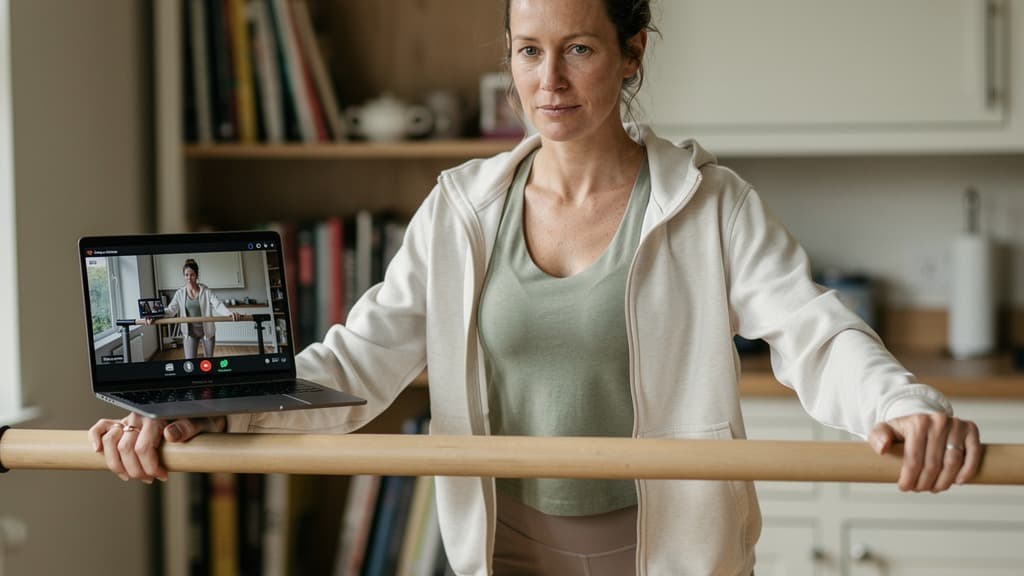
Yes: online barre classes for women over 50 in the UK exist and are built for this stage of life. Expect short, low-impact sessions around 20 minutes at home with a sturdy chair for balance, and no dance background. [Awaken Barre](/awaken-barre) is one option designed around a changing midlife body; see also [do you need dance experience for barre](/blog/do-you-need-dance-experience-for-barre).
Do you need dance experience to try barre?
No. Barre borrows a few shapes from ballet, small pulses, held positions, a long spine, but that is where the resemblance ends. Nobody is watching your turnout and there is no choreography to learn. The word 'barre' simply refers to something sturdy you hold onto for balance while you work, in exactly the same way you would use the back of a kitchen chair. That is genuinely the whole idea.
If ballet as a child put you off the word entirely, let that go. This training is built for a body that has never stood at a barre in its life. What matters is what is happening underneath the shapes: small, controlled movements that switch on your deep core and stabilising muscles, rather than big, ballistic ones that ask you to push through. That difference, precision over force, is the whole training philosophy in miniature.
In practice, that might mean holding the chair with feet hip-width apart and lifting both heels an inch off the floor, then holding there. Or standing side-on to the chair, one hand resting on it, lifting one leg a few inches out to the side and pulsing it slowly for a count of eight. The movements are small on purpose, and if a position does not suit your knees or shoulders that day, you take it smaller or skip ahead to the next section. There is no instructor in the room watching to correct you. You can pause, rewind, mute the class, or repeat a section you liked. The screen does not mind.
What actually happens in an online barre class?
A session moves through a handful of short, focused sections rather than one long, undifferentiated sweat. Expect something like this:
None of it is long. Around 20 minutes is intentional, not incidental, when you are working with energy that fluctuates. You will feel it working, but not in the way a boot camp does.
To put more detail on that outline: the warm-up is standing work, gentle circles at the ankles, knees, hips and shoulders, paired with slow breathing, so your body catches up rather than moving fast from a standing start. The leg and seat section is where the chair earns its keep, small shallow squats with a hand on the chair back, a gentle lunge held and pulsed, then side-on with a leg lifted a few inches out in a slow, controlled rhythm. The core section usually moves to a mat or a folded towel on the floor, curls, holds and gentle rotations through the centre and sides of your torso, rather than anything explosive. The final stretch is unhurried, longer holds for the backs of the legs, the hips and the lower back, finishing seated or lying down.
- A brief warm-up to wake up the joints and get your breathing settled
- Barre work for the legs and seat, using your chair for balance
- Core work, often floor-based, focused on the deep stabilising muscles rather than a six-pack
- A stretch and reset to finish
Is barre suitable for women over 50, in perimenopause or beyond?
A lot of what brings women to this search isn't really about barre at all. It's a body that has changed, energy that comes and goes, sleep that isn't what it used to be, a sense of not quite recognising how you move anymore. None of that means your body is working against you. It usually means the approach that worked at 30 no longer matches the body you're in now, and it's worth using a different map for different terrain.
Barre suits this stage well because it is low-impact. There is no jumping, no sprinting, nothing designed to shock the system. Chrissy Sundt, who created Awaken Barre, trains this way herself while navigating her own perimenopause, alongside her experience as a Barre and Pilates trainer. What it offers is a way to build strength, mobility and confidence in how your body moves, at a pace that body can actually sustain.
There is also a practical side to doing this online rather than in a studio class. You are not keeping pace with a room full of people moving to a shared tempo, and you are not stood at the back trying to see over someone's shoulder. The instructor is close up, at your eye level, on your own screen, which makes it easier to watch what her feet and hands are doing. If a particular class asks more of you than you have that day, you can take the next set of pulses smaller, rest through a section, or choose a different class from the library instead. The format flexes around whatever your energy happens to be that morning.
What do you need at home to do it?
This is part of why online barre suits UK women over 50 so well in practice: there is no studio membership, no drive across town, no changing room. The list of what you actually need is short.
A word on each of those. The chair matters more than people expect: a dining or kitchen chair with four legs on the floor works best, not one on castors, and it is worth checking it will not slide first. For floor space, you need roughly the length and width of a yoga mat, enough to lie down with arms stretched overhead without hitting furniture. A mat or folded towel helps for the floor section but is not essential on carpet. Bare feet or socks with grip both work. For the screen, a laptop or tablet propped at chair height, or a phone cast to a TV, works fine. Beyond that, a glass of water nearby covers it.
- A sturdy chair or worktop that will not slide
- Enough floor space to stand with your arms out to the side
- Comfortable clothes you can move in
- A screen, laptop, tablet or TV
Why is a session only 20 minutes?
It is tempting to assume more time automatically means more result. In midlife, that maths does not hold up the way it used to. An hour of hard training rarely fits well into a day that already asks a great deal of you. Twenty minutes, done with attention to form and to how your body actually feels that day, tends to do more than an hour done on autopilot.
It also solves the real problem, which is rarely motivation. A full class plus travel plus changing rarely fits into a life that is already stretched thin. Twenty minutes fits. And a missed session does not erase what you have built. Coming back matters more than never missing one. Not less ambition. More intelligence.
In practical terms, that is roughly the length of the kettle boiling twice, or the gap between getting everyone out the door and starting work. It can be easier to fit twenty minutes in first thing, before the day fills up around you, though there is nothing that says it has to be morning. Some weeks that might be four short sessions, other weeks two. Either way, showing up for twenty minutes counts as a full session, not a compromise on a longer one you did not have time for. You are not working towards some longer version you are supposed to graduate to eventually. Twenty minutes, done consistently, is the whole model, not a stepping stone to something bigger.
You may also find restorative movement for midlife women useful alongside this.
Common questions
Do I need an actual ballet barre at home?
No. A dining chair or a sturdy worktop does the same job, giving you something to rest a hand on for balance. There is no equipment to buy for this part.
I haven't exercised properly in years. Is that a problem?
That is exactly who this is built for. Awaken Barre is designed as a way back into movement, not a programme for people already mid-training. You start where you are.
Will this help with menopause symptoms like joint pain or poor sleep?
Awaken Barre is movement education, not medical treatment, and it is not designed to treat, cure or prevent any particular symptom. It offers low-impact strength and mobility work designed to be sustainable while your body is changing, rather than a fix for any specific symptom.
How many sessions a week should I aim for?
Consistency matters more than volume. Two to three short sessions a week suit most changing bodies better than one long blast. Detail lives in [how often should I do barre](/blog/how-often-should-i-do-barre).
Can I do this with dodgy knees or a bad back?
Barre is low-impact and most positions can be adapted, but this is general movement education rather than a substitute for advice from a physiotherapist or GP about a specific joint or injury. If you have a diagnosed condition, check with your practitioner before starting.
Do I need a ballet background to try barre?
No. Barre borrows some ballet positions and vocabulary, but it is a fitness discipline, not a dance class, and no prior experience is expected. The barre, or a sturdy chair at home, is simply there to help with balance.
Is online barre useful in menopause or perimenopause?
It can be a practical fit: low-impact strength and balance at home, without studio travel. It is movement education, not medical treatment. More context in [is barre good for menopause](/blog/is-barre-good-for-menopause) and [barre for perimenopause](/blog/barre-for-perimenopause).