Barre for Posture Over 40: Why It Changes and What Actually Helps
Chrissy Sundt · Mindful Movement ·
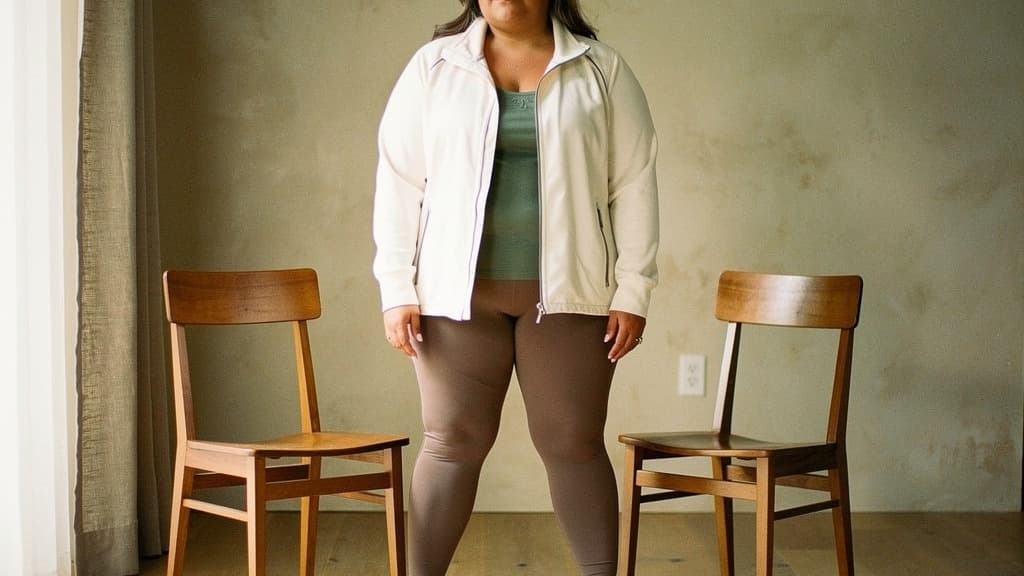
Barre helps posture over 40 by training the small stabilising muscles around your spine, hips and shoulders through slow, controlled holds at the barre, rather than stretching alone. Combined with deep core awareness, this rebuilds the strength that lets you stand tall with less effort. No dance background needed; the barre is simply something to hold for balance.
Why does posture change in your 40s?
Posture rarely collapses overnight. In your 40s, the muscles that used to hold you upright without much thought start asking for more deliberate input. Years of desk work, driving, carrying a bag on the same shoulder and simply not testing your range of motion mean some muscles have quietly gone underused, while others have tightened to compensate. Add the hormonal shifts of perimenopause, which affect muscle tone and how quickly your body recovers between efforts, and the old advice to "just stand up straighter" stops working, because it was never addressing the actual cause.
This is not your body failing you. It is more useful to think of it as running outdated software on new hardware: the postural habits you built in your 20s and 30s were shaped for a body that responded differently to load and repetition. Your body in your 40s needs an updated map, not more willpower or a stricter reminder to pull your shoulders back.
That is why barre training focuses on the deep stabilising muscles around your spine, pelvis and shoulder blades, rather than simply cueing you to sit up. The muscles most involved in comfortable, upright posture, your deep core, glutes, mid-back and the small stabilisers around your shoulders, respond best to slow, controlled, weight-bearing work. Passive stretching alone rarely reaches them. That is the specific gap barre is built to close.
Can barre really improve posture, or is it just a stretching class?
Barre is often mistaken for a gentle stretch class, but the mechanism is different. Most of the work happens in small, controlled ranges, tiny lifts, holds and pulses at the barre, that keep a muscle under tension rather than lengthening it and moving on. That sustained, low-load tension is what teaches a muscle to switch on reliably, which is exactly what postural muscles need if they have gone quiet from underuse.
This matters more in midlife than it did at twenty. Your fascia and nervous system respond less to forceful, fast movement and more to patience and repetition. A single hard session does very little for posture; a shorter, well-structured one that you can repeat does a great deal. That is the logic behind 360-degree core activation, working the deep core alongside the back and hips, rather than isolating the abdominals and hoping the rest follows.
Gentle, done with intelligence and precision, is genuinely one of the more effective ways to work on how you carry yourself, precisely because it does not spike stress on a system that may already be under enough of it. This is education about movement, not a medical treatment, but the postural improvements people notice, standing taller with less conscious effort, moving through a doorway or a flight of stairs with more ease, come from real strength being rebuilt, not from a temporary stretch.
Do you need dance experience or good flexibility to start?
No. Barre is a fitness discipline inspired by ballet, not a ballet class, and it needs no dance background at all. The barre itself is a balance aid, nothing more, similar to holding the back of a sturdy chair. You are not learning positions or performing for anyone; you are using something stable to hold onto while your legs, hips and core do the work.
This distinction matters most for posture work specifically, because so much of it involves standing still or moving slowly enough to notice what your body is actually doing. If you have never taken a barre class, or any class, before, the barre gives you something to steady yourself with while you build that awareness, rather than asking you to balance unsupported from day one.
Flexibility is not a prerequisite either. A stiff lower back or tight hips are simply the starting point, not a barrier to entry. The movements are designed to be small and controlled precisely so that a beginner and someone with years of movement experience can do the same sequence, at their own range. Nobody is checking your flexibility at the door; the barre exists to meet you exactly where your body is today.
What does a barre session for posture actually look like?
A typical session runs around 20 minutes, which is intentional rather than a compromise. In midlife your body responds to precision, not volume, so a focused 20 minutes with proper alignment does more for posture than a long session where form slips halfway through. The structure usually moves through a small number of clear phases rather than a long, varied circuit.
You can expect something like this shape:
The through-line across all of it is control. Nothing is rushed, and holds matter more than repetitions, because a muscle held correctly for a few extra seconds is doing more postural work than the same movement done quickly twenty times. That is also why the barre itself keeps appearing: it lets you focus fully on alignment in your spine and shoulders without also having to manage your balance from scratch.
- A short warm-up to wake up the feet, hips and spine before any load is added
- Standing sequences at the barre working the legs and glutes, which support the pelvis that your spine sits on
- Deep core work targeting the muscles that hold your midsection steady, not just visible abdominal muscles
- Upper back and shoulder focused movements to counter the forward pull of desk and phone posture
- A brief cool-down that reinforces the alignment you have just built
How often should you practise to notice a difference in how you stand?
Consistency does more here than intensity ever will. Three shorter sessions a week, done regularly over several weeks, tend to produce far more noticeable change in how you carry yourself than one long, occasional session. This is because postural muscles are trained by repetition and familiarity, teaching your nervous system a pattern it can return to without thinking, rather than by how hard any single session felt.
It also helps to let go of the idea that a missed week undoes your progress. This is not a streak to protect. Returning to the practice matters far more than never missing a day, and the strength you have already built does not disappear because life got in the way for a fortnight.
Notice the small, practical signals rather than looking for a dramatic before-and-after: standing at the kitchen counter without shifting your weight onto one hip, getting up from a low chair without needing to brace yourself, or sitting through a long meeting with less of that familiar mid-afternoon slump. Those everyday moments are where postural change actually shows up first, long before anyone else would consciously notice a difference.
If you want the strength behind how you stand rebuilt with that same attention, Awaken Barre is where I put it: short sessions, no gym, no performance.
Common questions
Do I need an actual ballet barre at home?
No. The back of a sturdy chair or a stable kitchen counter works exactly the same way. The barre is only there for balance, not for any ballet-specific technique.
Will barre fix my rounded shoulders from years at a desk?
Barre is not a treatment or a fix for any condition. What it can do is build strength and awareness in the muscles around your upper back and shoulders, which supports a more upright, comfortable position over time.
Is barre safe if my joints feel stiffer than they used to?
Barre uses small, controlled, low-impact movements, which many people find comfortable even with general stiffness. This is educational movement content rather than medical advice, so speak with a healthcare professional first if you have a specific concern.
How long before I notice a difference in my posture?
This varies from person to person, but noticeable ease usually comes from weeks of consistent, short practice rather than from any single session. Precision and regularity matter more than how long or hard any one class feels.
I've never really exercised regularly. Is barre still for me?
Yes. Barre is designed to be beginner-friendly, with no dance or fitness background required. The barre itself gives you support, so you can build strength and confidence gradually rather than needing to arrive already capable.