Barre vs Reformer Pilates: Which One Fits a Midlife Body?
Chrissy Sundt · Mindful Movement ·
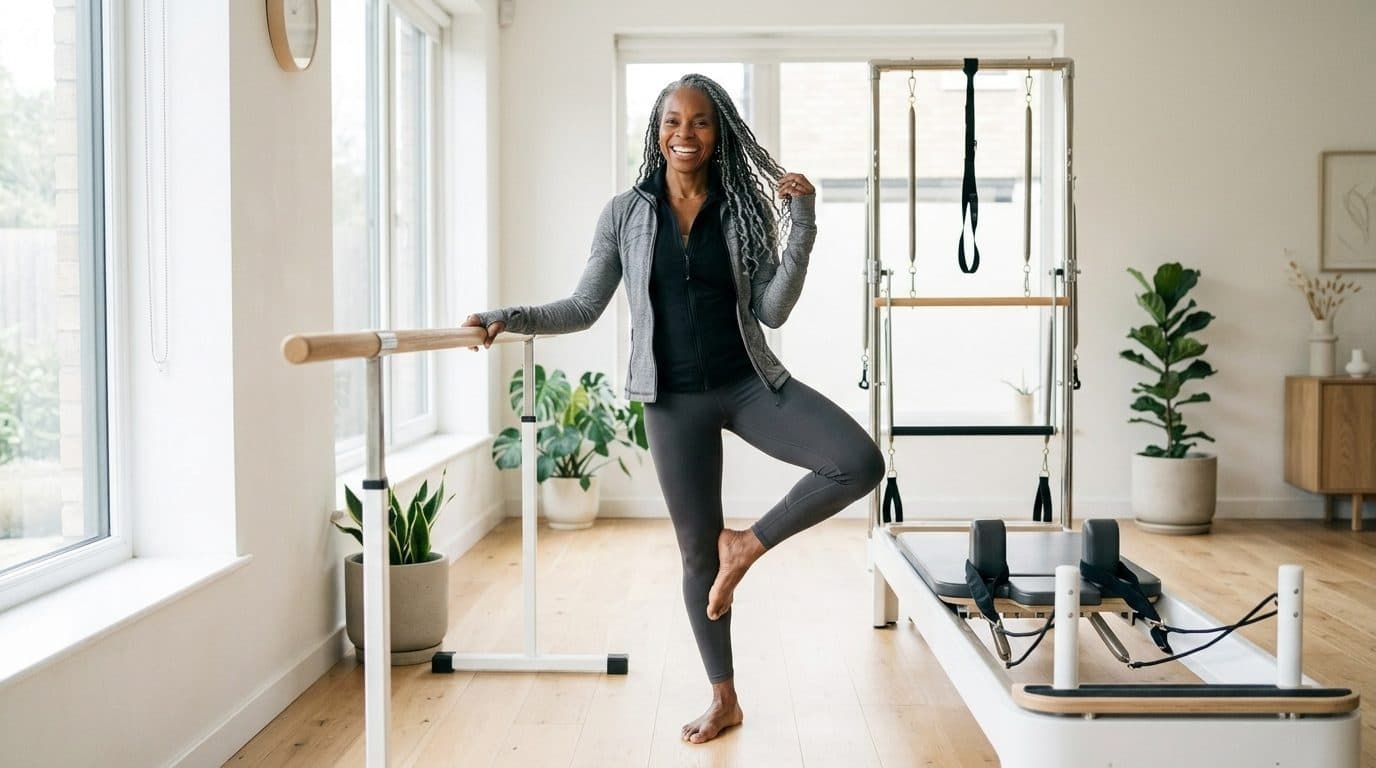
Barre is standing, bodyweight work using a chair or barre purely for balance, building standing strength and deep core control. Reformer Pilates uses a spring-loaded machine for supported, controlled-range movement while lying or seated, sometimes kneeling. Both are low-impact; barre suits functional standing strength and portability, reformer suits supported range of motion and studio-based sessions.
What's the real difference between barre and reformer Pilates?
Barre is done standing, on your own two feet, using a barre or the back of a sturdy chair purely as a balance aid. It's a fitness discipline inspired by ballet positions, not a ballet class, and you don't need any dance background to follow it. Most of the work is bodyweight, sometimes with a small hand weight or a resistance band. The movements are small and controlled: tiny pulses, slow lifts, held positions. That builds heat through the glutes and thighs, and the deep core switches on to keep you upright.
Reformer Pilates uses a sprung carriage machine. You move on it lying down or seated, sometimes kneeling, and push or pull against springs that adjust for more or less resistance. The frame and straps do some of the stabilising work for you, so a teacher can guide you through a fuller range of motion than you might attempt unsupported, at whatever tension suits the day.
The practical difference is what's doing the steadying. In barre, you are your own stabiliser. The chair is there so you don't wobble off balance, and that's exactly the kind of work that builds standing strength for daily life. On the reformer, the springs and carriage share some of that load. That suits controlled range and gentler entry points, particularly if balance itself needs building first.
Which is better for perimenopause: barre or reformer Pilates?
Neither is objectively better. They suit different priorities, and in perimenopause the more useful question is which one meets your body where it actually is. Training in this decade doesn't need to look like training at thirty. Your body simply responds differently now, and that's reason enough to choose deliberately rather than default to whatever you did a decade ago.
Barre tends to reward you for showing up standing. It trains the balance and functional strength that everyday tasks depend on, like carrying shopping or getting up off the floor, and it does that without impact on the joints. Reformer Pilates tends to reward you for controlled range. The spring resistance lets you work through a full stretch and contraction with support, which can feel steadier on days when your joints or energy are asking for something gentler.
What both share matters more than what separates them: low impact and controlled tempo, with a deep core focus rather than a superficial-abs one. The real question isn't which one does more. It's which one you'll actually keep coming back to.
Do I need dance or Pilates experience to start either?
No. This is worth being direct about because it's the question that stops most women before they start. Barre borrows its shapes from ballet: small pliés, controlled leg lifts, work in parallel and turned-out positions. It is not a dance class, and nobody is watching your turnout. The barre itself, or the back of a kitchen chair, is there purely so you have something to hold onto while you find your balance.
Reformer Pilates has its own learning curve. It's about learning the machine, not proving your fitness history. A teacher sets the springs, shows you where your hands and feet go, and adjusts resistance to where you are that day. You don't need prior Pilates experience or a dance background before you begin. The equipment adapts to you rather than the other way round.
What actually matters more than either background is simply starting somewhere your body can succeed straight away. If you've spent years assuming fitness classes were built for people fitter or younger than you, both barre and reformer Pilates are designed to be entered from wherever you currently stand. There's no assumed baseline you're meant to already have.
What does a 20-minute barre session actually involve?
A session usually opens with a short warm-up, to wake up the joints and find your footing at the barre or chair. Then it moves into standing sequences: small pulses at the thigh or seat, slow controlled lifts, holds that ask the deep core to switch on to keep you steady rather than just to look tight. Twenty minutes is the length on purpose, sized for a week that's already full.
Because the sets are short and specific, there's little wasted movement. A typical structure works through standing leg work, then core sequences on the mat, then closes with mobility and a stretch through the hips and spine, the areas that tend to feel tightest by midlife. Small props show up throughout to add resistance without adding impact, a light weight or a band.
That's the shape Awaken Barre is built around: barre-based strength and mobility work in sessions designed to fit around a real week rather than dominate it. You don't need a dance background or a home studio, just a sturdy chair to start. The aim is the right small amount, done consistently.
- Warm-up to find your footing at the barre or chair
- Standing leg and seat work in small controlled pulses
- Mat-based deep core sequences
- Mobility and stretch through hips and spine to close
Barre vs reformer Pilates: which fits your daily life?
Access is often the deciding factor, more than which method appeals to you on paper. Reformer Pilates needs the machine itself. That generally means booking into a studio with reformers and working around class times and travel. That's a real constraint if your week is already tightly booked.
Barre asks less of your environment. A barre session can be done wherever there's enough floor space and something sturdy to hold, a dining chair or a kitchen counter. That makes it realistic to fit into an ordinary week rather than requiring a special trip. That portability matters more than it sounds. The sessions you can actually get to are the ones that build anything at all.
Missed weeks happen. They don't erase what came before. Returning matters more than an unbroken streak, whichever method you've chosen. If you're weighing barre against reformer Pilates, it's worth being honest about which one you'll actually keep returning to on a Tuesday evening when the day has already been long. That's the one that will do you any good.
Common questions
Can I do barre if I've never danced?
Yes. Barre borrows some ballet-inspired positions but it's taught as a fitness class, not a dance class, and the barre or chair back is only there for balance. No dance background or flexibility is expected before you start.
Is reformer Pilates or barre lower impact?
Both are low-impact by design: neither involves jumping or jarring movement. Barre keeps you standing and working against your own bodyweight, while reformer Pilates uses spring resistance on a supported carriage, so the choice comes down to which kind of support suits you, not which is gentler.
Do I need any equipment to start barre at home?
Just something sturdy to hold, a dining chair or a kitchen counter works well. Small props like a light weight or a resistance band can be added later, but they're not required to begin.
How long is a typical Awaken Barre session?
Around 20 minutes, chosen deliberately for what a busy week can actually hold.
Can I switch between barre and reformer Pilates?
Yes, there's no rule that says you have to pick one permanently. Many women use both at different points, leaning on whichever fits their studio access or their energy that day.