Barre vs Pilates for Menopause: Which One Actually Fits Your Changing Body?
Chrissy Sundt · Mindful Movement ·
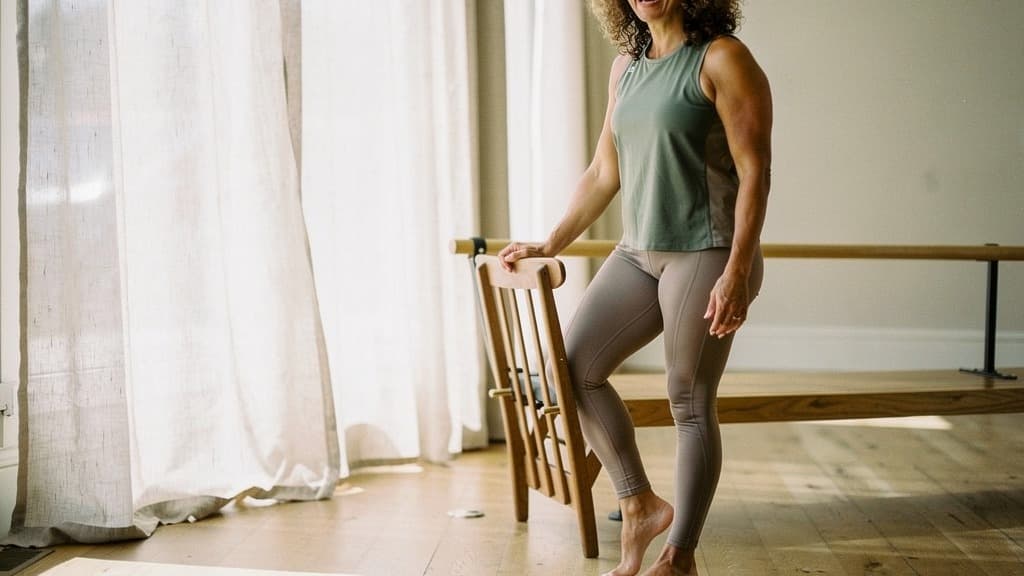
Barre and Pilates both build strength and control without high impact, but they work differently: Pilates centres on mat-based core sequencing, while barre adds standing, weight-bearing work using a chair or barre for balance. For perimenopause, barre's standing strength work complements what Pilates builds on the mat, and neither requires prior dance or Pilates experience.
What's actually different between barre and Pilates?
Pilates is mat-based. Most of the work happens lying, kneeling or seated, breath-led, building control through the deep core, spine and pelvis before you ever add load. Barre is standing and weight-bearing. You hold onto the back of a sturdy chair or a barre rail for balance, then work the legs, hips and glutes through small, controlled ranges: pulses, holds, slow lifts. Both are about precision, not about pushing hard or moving fast.
The difference matters more in midlife than it did at twenty. Pilates trains the deep core and spinal control that everything else sits on top of. Barre adds standing strength: the kind your legs and hips use every time you get up from a chair, climb stairs or carry shopping. You're not choosing a 'better' discipline, you're choosing which terrain you want to train, lying down or upright.
Where they overlap is more useful than where they differ. Neither is high-impact. Both are slow enough to feel every muscle working, both are breath-linked, and both reward consistency over intensity. If you've been told your only options are cardio that leaves you wrecked or nothing at all, barre and Pilates are proof there's a third way.
- Pilates: mostly floor-based, breath-led, deep core first
- Barre: standing, weight-bearing, legs and hips through small controlled ranges
- Both: slow, controlled, no high impact
Which one suits you better in perimenopause?
There's no single answer here, only what suits how your energy and body feel day to day. Both styles offer a way of moving that doesn't ask more of you than you have to give. Contained, controlled intensity, the kind barre and Pilates both use, gives you a proper burn without tipping into exhaustion.
If your energy fluctuates week to week, this matters practically. A style built on control rather than maximal effort is easier to show up for on a low day, and still worth doing on a good one. Pilates tends to suit days when you want to slow right down and feel the deep core working. Barre suits days when you want to feel standing strength, the kind that shows up in balance and how steady you feel on your feet.
This isn't about picking the discipline that will 'fix' anything. It's about picking the one whose demand matches where your body actually is right now, not where it was ten years ago. You're not using the wrong body, you may be using the wrong map for the terrain you're currently on.
Do you need dance experience or a Pilates background to start either one?
No, and this is one of the most common things holding women back from trying barre. Barre is inspired by ballet, not a ballet class. There's no choreography to learn, no turnout to master, no dance vocabulary. The barre itself, or the back of a sturdy chair at home, is simply something to hold onto for balance while you work through a move with control. If you've never taken a dance class in your life, you're not behind.
Pilates asks even less by way of prior experience. You need a mat and a bit of floor space. The moves are named for what they do, not for any dance heritage, and every instruction is about breath, alignment and control rather than performance.
What both do ask for is a willingness to move slowly and pay attention, which can actually feel harder than moving fast. Old habits push you to rush a set to get it over with. Barre and Pilates both work because you don't rush them, you listen to what the muscle is doing on the way up and the way down, and that's a skill, not a fitness level.
- A sturdy chair, or a barre if you have one
- Bare feet or grippy socks
- A bit of floor space for the mat work if you're pairing it with Pilates
What about deep core strength, does barre or Pilates work better?
Both disciplines train the core, but they reach it differently. Pilates is built around the deep core from the first minute: the transverse abdominis, the pelvic floor, the muscles that don't show in a mirror but that everything else depends on for stability. Barre reaches the same deep structures indirectly, through standing balance work that asks your core to stabilise your spine while your legs are doing something else entirely.
This is 360 degree activation rather than the version of 'core work' most of us grew up with, which was really just repeated crunches aimed at the surface. Deep core strength doesn't come from pushing harder on that surface layer. It comes from learning to activate the structures underneath it, and that takes listening more than effort.
To be clear, this is movement education, not medical treatment. Neither barre nor Pilates diagnoses, treats or prevents any pelvic health condition, and if you have specific concerns there, they belong with your GP or a pelvic health physiotherapist first. What movement can do is build strength and confidence in how your body feels day to day. If deep core work is what you're specifically after, that's the entire focus of Love Your Core, sitting alongside barre rather than replacing it.
Can you do both, and how do you choose where to start?
You don't have to choose forever, only choose where to start. Plenty of women do both across a week: Pilates for the days they want to slow down and work the deep core, barre for the days they want to feel standing strength and leave the session having worked their legs, hips and glutes too. There's no rule that says loyalty to one discipline matters more than what your body actually needs that day.
If you're deciding where to start rather than where to end up, think about what you're missing most right now. If it's standing strength, balance and the feeling of being steady on your feet, barre is the more direct route. If it's a slower, floor-based way to reconnect with the deep core, Pilates is worth starting there instead.
Either way, the session length matters more than people expect. Twenty minutes is intentional, not incidental. It's long enough to properly load a muscle group and short enough that you'll actually do it on the days you weren't planning to. Not less ambition, more intelligence: the same amount of change, built from precision rather than from how long you can grit your teeth through a class.
If standing strength and balance are the part you are missing, Awaken Barre is the barre side of this, twenty-minute sessions, no dance experience needed.
Common questions
Is barre or Pilates lower impact?
Both are low impact. Neither involves jumping, running or sudden force through the joints. The intensity comes from control and time under tension rather than from impact, which suits a body that's asking for something more considered than it used to need.
How many times a week should I do barre or Pilates in perimenopause?
There's no fixed number that works for everyone. Consistency matters more than frequency, and missed sessions don't erase progress, this isn't a streak to protect. Returning to it regularly, even a couple of times a week, will do more than an ambitious schedule you can't sustain.
Do I need any equipment to start barre at home?
Just something sturdy to hold onto, like the back of a solid chair, and bare feet or grippy socks. Pilates needs even less, usually just a mat and a bit of floor space.
Is twenty minutes really long enough to make a difference?
In midlife your body responds to precision rather than volume, so yes. A focused twenty minutes of controlled, well-targeted work asks more of the right muscles than a longer session done on autopilot.
Is barre secretly a ballet class in disguise?
No. Barre borrows some positions and vocabulary from ballet, but there's no choreography, no turnout requirement and no dance experience needed. The barre itself is just a balance aid, similar to holding the back of a chair.
I already do pilates. Why would I add barre?
Pilates builds deep core control largely through floor-based work. Barre adds standing, weight-bearing strength and balance training that pilates on its own doesn't cover, so the two tend to work well together instead of covering the same ground.