Cirqa vs Whoop vs Oura for Midlife Women: Which Wearable Actually Helps?
Chrissy Sundt · Rest & Illumination ·
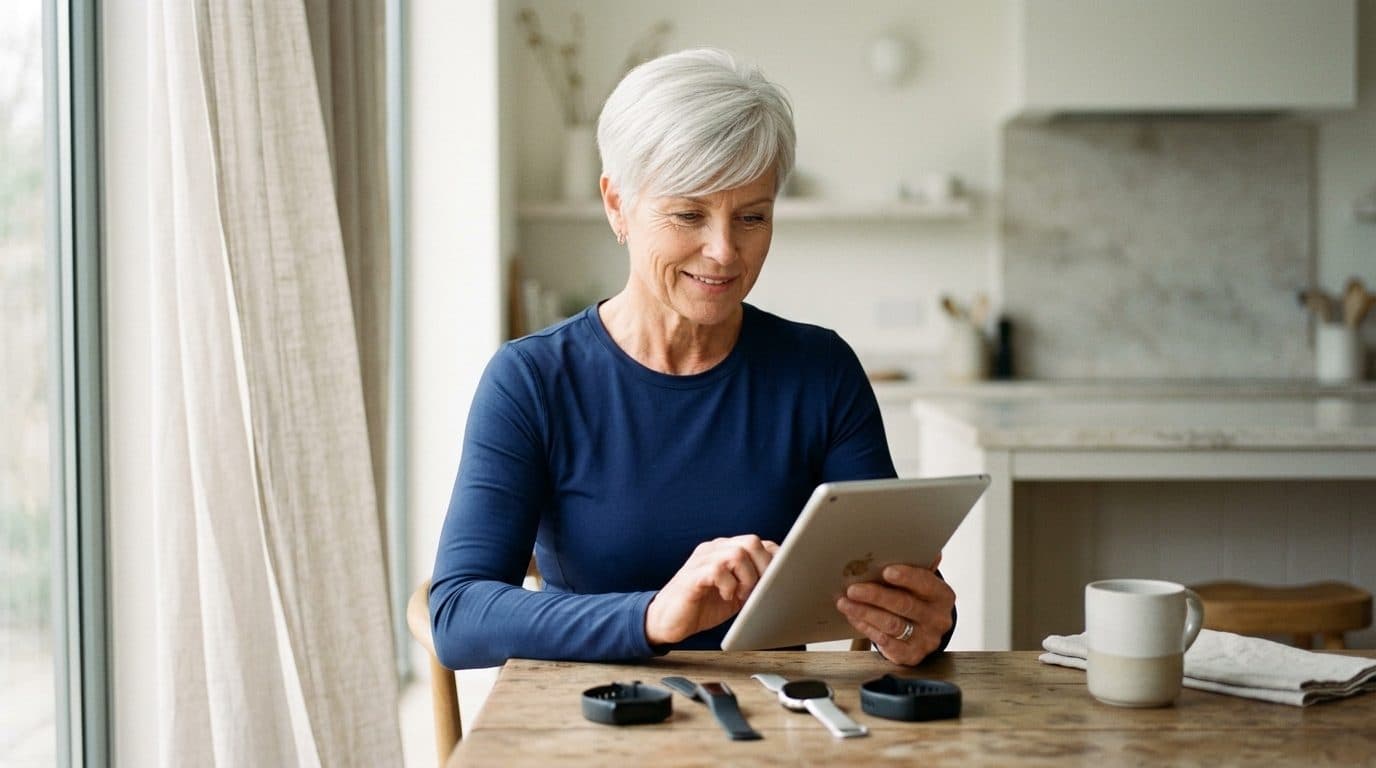
Cirqa, Whoop and Oura all track heart rate variability, resting heart rate and sleep, but they differ in focus: Cirqa and Oura lean towards women's hormonal and temperature data, Whoop leans towards training load and strain. None of them replaces a conversation with a GP about how you're actually feeling. The right one is whichever data you'll actually use to rest, not just measure.
What do Cirqa, Whoop and Oura actually track, and why does that matter in midlife?
All three devices are built on the same handful of underlying signals: heart rate variability, resting heart rate, breathing rate and sleep stages, rolled up into a daily score with a different name on each app - readiness, recovery, strain. Oura is a ring, screenless, checked through the app once or twice a day. Whoop is a screenless strap worn on the wrist or bicep, built around training load and a nightly recovery percentage. Cirqa is a ring too, but built explicitly around women's hormonal health, leaning harder on skin temperature and cycle-related pattern data than the other two.
The overlap matters because in midlife the raw numbers change even when nothing is wrong. Resting heart rate can drift, sleep gets lighter and more fragmented, and HRV, which tends to fall with age in everyone, can look markedly different to how it read at thirty. A tracker doesn't know that context. It just reports the number and, depending on the app, tells you whether that's good or bad against a baseline built from your own recent history, not against midlife women generally.
That's the first thing worth understanding before comparing them feature by feature: none of the three is measuring perimenopause itself. They're measuring the downstream effect of whatever happened in your body that night, whether that's hormones, wine, a late dinner or a stressful day. The difference between them is what they emphasise and how they present it back to you.
- Oura - ring, screenless, general readiness and sleep score
- Whoop - strap, screenless, recovery percentage and training strain
- Cirqa - ring, marketed specifically around women's hormonal health and temperature patterns
Does any of them actually understand perimenopause?
None of the three diagnoses anything, and none should be read as though it does. What differs is emphasis. Cirqa is marketed specifically at women's hormonal health, so its temperature tracking and pattern insight are pitched towards cycle and perimenopause changes from the outset. Oura has moved further into this territory over recent versions, layering cycle tracking and temperature trends onto its core readiness score. Whoop's history is sport and training load first, women's health second, so its language still leans towards performance and strain more than hormones.
The catch is that skin temperature and HRV shift for a long list of reasons that have nothing to do with hormones - a cold, a late glass of wine, a hot bedroom, a stressful email at eleven at night. Hormone-related symptoms are also well known to vary hugely from one woman to the next, even among those going through the transition at the same time. A device can flag that something has changed. It can't tell you what changed, and it isn't a substitute for talking to a GP or menopause specialist about symptoms that are affecting your life.
Read the hormone-insight features on any of these three as a prompt to notice a pattern, not a verdict. If your temperature or HRV trend shifts for a fortnight, that's worth paying attention to. It isn't a diagnosis, and no app should be treated as though it is.
Which one suits a midlife woman prioritising recovery over performance?
There isn't a single best answer, because the right one depends on what you'll actually do with the number it gives you. If you see a low recovery score and take it as permission to rest, Whoop's data can be genuinely useful. If you see a low score and feel compelled to prove the app wrong by training harder, the strain-chasing framing can work against you. In perimenopause, cortisol is often already elevated, so a device that nudges you towards pushing intensity to hit a number is working against, not with, what your nervous system needs that day.
Oura's ring format suits someone who wants the data without the daily engagement loop: check it, note it, move on. It sits quietly in the background rather than prompting you towards a strain target.
Cirqa suits someone specifically trying to link how they feel to a hormonal pattern - hot flushes, disrupted sleep, mood swings - because that's what it's built to surface. If that link is what you're after, it's the most purpose-built of the three. If you mainly want a general sleep and recovery picture, either of the others will give you that without the narrower focus.
Whichever you choose, the device is a mirror, not a coach. It tells you what happened. What you do with a low-recovery morning is still your call.
- Whoop - suits someone who won't be tempted to chase the strain score
- Oura - suits someone who wants low-effort, passive tracking
- Cirqa - suits someone trying to connect symptoms to a hormonal pattern
Can a wearable replace learning to read your own body?
A wearable can tell you your HRV dropped last night. It can't tell you why you feel wired but tired at three in the afternoon, or why an ordinary Tuesday suddenly feels like too much. There's a useful distinction worth holding onto here: short, recoverable stress that the body handles well, and grinding, accumulating stress that carries a real cost over time. A tracker can show you the accumulation in retrospect. It can't show you the stress itself, and it can't do the noticing for you in the moment.
That's the gap no device closes. Your deep core doesn't activate from pushing, it activates from listening, and the same is broadly true of your nervous system: it responds to being paid attention to, not to being monitored from a distance. A score that reads recovery 61 per cent is a data point. Whether you're actually depleted, or just had one bad night's sleep after a late flight, is something only you can tell by paying attention to how the day actually feels.
Adaptation happens in the rest, not the session itself. A wearable can remind you that rest matters. It can't rest for you, and it can't replace the slower skill of noticing, before the app tells you, that today wants to be a gentler day.
How should a recovery score actually change what you do that day?
The most useful way to use any of these three is as a weekly trend, not a daily verdict. A single low score after one bad night doesn't mean much. A trend sliding downward over two or three weeks is worth acting on - that reads as accumulating fatigue rather than one rough night's sleep.
In practice that might mean treating a low-recovery day as a cue for a gentler session rather than none at all. Twenty minutes of Awaken Barre, done with attention to how it actually feels that day, sits comfortably either side of a low readiness score. It was never built to spike strain in the first place, which is a deliberately different aim from a tracker built around performance and push.
Not less ambition. More intelligence: using the data to choose the right effort for the day you're actually having, rather than the one the app thinks you should be having. That's the real point of tracking recovery in midlife, not chasing a bigger number, but getting better at listening to what's going on underneath it.
If you want this as movement rather than another article, Awaken Barre is the twenty-minute programme I built for a body that has already changed.
Common questions
Can Oura or Whoop tell me if I'm in perimenopause?
No. Both track signals like resting heart rate, HRV and skin temperature that can shift as hormones change, but neither is a diagnostic tool. A change in your readiness or recovery trend is worth noticing, not a result to act on alone - talk to a GP or menopause specialist about symptoms.
Is Cirqa specifically designed for menopause?
Cirqa is marketed around women's hormonal health more directly than Whoop or Oura, with an emphasis on temperature and cycle-related pattern tracking. It still isn't a diagnostic device, and how useful that focus is depends on whether you're specifically trying to link symptoms to a pattern.
Do I need a wearable to follow the Midlife Movement Method?
No. Sessions are built around roughly 20 minutes and how the movement actually feels that day, not a recovery score. A tracker can add information if you already use one, but it was never a requirement.
Which is more accurate, Whoop or Oura?
Accuracy varies by metric and by person, and neither publishes data specific to midlife women's physiology. Rather than chasing the most accurate device, it's more useful to pick whichever one you'll actually check consistently enough to spot a real trend.
Can a fitness watch detect perimenopause?
No. A watch can flag pattern changes in resting heart rate or sleep, but those changes have plenty of other explanations too. Perimenopause is identified through your symptoms and history, ideally discussed with a GP, not through a wearable's algorithm.
Should I trust my watch's daily readiness or recovery score?
Treat it as one data point, not an instruction. Hormonal fluctuation in perimenopause can make these scores noisier than they were in your twenties, so weigh them against how you actually feel before deciding how to train.