How Much Water Should I Drink in Perimenopause?
Chrissy Sundt · Nourishment ·
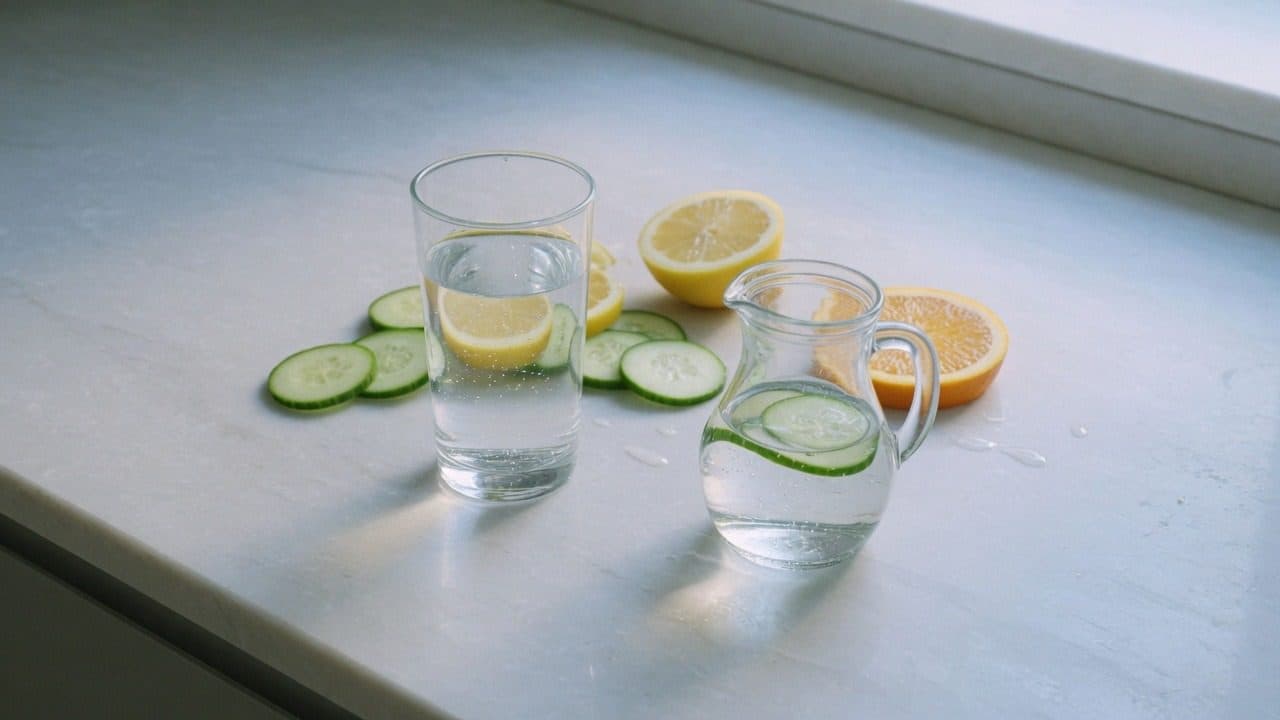
Most guidance for adult women, perimenopausal or not, points to roughly six to eight glasses of fluid a day, around 1.5 to 2 litres, though hot flushes, night sweats and training can raise what your body is asking for. Fluid from food counts too. Urine colour and thirst are a better daily guide than chasing an exact number.
How much water should I actually drink in perimenopause?
There isn't a special perimenopause number that overrides the general guidance. The starting point most nutrition sources settle on for adult women is somewhere around six to eight glasses of fluid a day, roughly 1.5 to 2 litres, and that includes water, herbal tea, and fluid from food. It's a range, not a target you fail to hit if you have a low day.
What changes in perimenopause is the context around that number, not the number itself. Hot flushes, night sweats, heavier or more erratic periods, and busier, more distracted days can all push your fluid needs up or make it easier to fall behind without noticing. If you train, even in short sessions, that adds to it too.
Rather than fixating on litres, a more useful daily check is simpler: pale straw-coloured urine, a mouth that doesn't feel dry, and energy that doesn't dip sharply mid-afternoon are all reasonable signs you're keeping pace. If you're consistently thirsty, headachy or foggy, that's worth paying attention to rather than pushing through.
This is simply nourishment. The goal is a habit you can sustain on an ordinary Tuesday, not a number you chase and then abandon.
Why hydration can feel different in perimenopause
Fluctuating oestrogen affects how your body regulates temperature, which is why hot flushes and night sweats show up for so many women in this stage. Sweating overnight or through a flush during the day means you're losing fluid at moments you're not necessarily reaching for a glass of water, which is part of why staying ahead of it matters more than it used to.
Thirst itself can also feel less reliable. Some women notice they don't feel thirsty until they're already quite dehydrated, or that a dry mouth creeps up during a stressful, distracted day and goes unnoticed until it's uncomfortable. It's simply a different set of signals to learn, the way you'd learn a new pair of shoes.
I've felt this myself, waking at 3am overheated and reaching for water I should have had hours earlier. It's one of the smaller, less-talked-about parts of this transition, but it's real, and it responds well to a bit of structure rather than willpower.
The map you used in your thirties needs updating for the terrain you're in now, and that applies to hydration just as much as it does to training or sleep.
Signs your body wants more water
Most of the useful signals are ones you already have access to without any tracking. Urine that's consistently dark rather than pale straw is one of the simplest. So is a headache that shows up mid-afternoon for no obvious reason, especially on a day you've been busy, caffeinated, or out in the heat and haven't had much plain water.
Dry skin, chapped lips, and a mouth that feels sticky rather than fresh are worth noticing too, particularly if they're new rather than a longstanding feature for you. Concentration that drops off earlier than usual, or a sense of flatness that a short walk or a cup of tea doesn't shift, can also be your body asking for fluid before it's asking for anything else.
They're ordinary feedback, the same way hunger or fatigue is feedback, and worth listening to rather than working around.
If you notice a pattern, a dry afternoon most days, a headache that shows up around the same time, that's more informative than any single day. Build your response around the pattern, not the one-off.
What counts towards your fluid intake
Water is the obvious source, but it isn't the only one, and treating it as the only one is part of why hydration can feel like one more thing to manage. Herbal tea, milk, and soup all count. So does a good portion of the fruit and vegetables on your plate: cucumber, melon, tomatoes, and citrus are all mostly water by weight.
This matters more than it sounds, because fibre and fluid work as a pair. If you're increasing the fibre in your meals, which most women in perimenopause benefit from thinking about, you need enough fluid alongside it for that fibre to do its job comfortably. It's worth reading alongside how much fibre you actually need at this stage, because the two aren't separate conversations.
If bloating is part of what you're navigating, the fluid and fibre balance is often where the practical fixes live, and these high-fibre foods and how to introduce them are a sensible place to start rather than cutting things out.
None of this needs to be complicated. A glass of water with each meal, a piece of fruit with water content built in, and a cup of tea mid-morning add up faster than a bottle you're meant to finish by 6pm and rarely do.
Building a hydration habit that actually sticks
The habits that hold up are the boring, structural ones rather than the ones that rely on remembering. A glass of water by the kettle before your morning tea, one on the bedside table you drink from before you check your phone, and a refill each time you sit down to eat are small enough to survive a chaotic week.
If you train, even in a 20-minute session, that's a natural prompt to build around. Having water before and after an Awaken Barre session, or thinking through what to eat and drink before a barre class in perimenopause, gives you a fixed point in the day to check in rather than trying to hydrate evenly across sixteen waking hours.
Meals are another natural anchor. If you're planning what's on your plate anyway, practical meal ideas for perimenopause is a useful place to see how fluid-rich food and a glass of water sit together without extra thought.
Consistency over intensity applies here too. A glass with every meal, most days, will do more for you than an ambitious two-litre bottle that sits half full on the counter by evening.
Common questions
Does perimenopause actually increase how much water I need?
There's no fixed extra amount to add, though hot flushes, night sweats and disrupted sleep can all increase how much fluid you lose without you noticing. Staying ahead of it with a steady daily habit tends to work better than trying to calculate an exact extra amount.
Can being under-hydrated make hot flushes feel worse?
Hydration and temperature regulation are connected, and many women notice flushes feel more manageable when they're keeping up with fluids through the day. Water doesn't prevent or treat flushes; staying hydrated is simply one comfort measure among several.
Is tea or coffee dehydrating in perimenopause?
Normal amounts of tea and coffee still contribute to your daily fluid intake for most people, despite the old advice to the contrary. If you're drinking several strong coffees and little else, adding plain water alongside them is still a sensible habit.
How do I know if I'm drinking enough without tracking every glass?
Urine that's pale rather than dark, a mouth that feels comfortable rather than dry, and steady energy through the afternoon are a reasonable daily check. If you're consistently thirsty or getting afternoon headaches, that's worth adjusting for rather than tracking to the millilitre.