Perimenopause Workout: What Your Body Needs Now
Chrissy Sundt · Mindful Movement ·
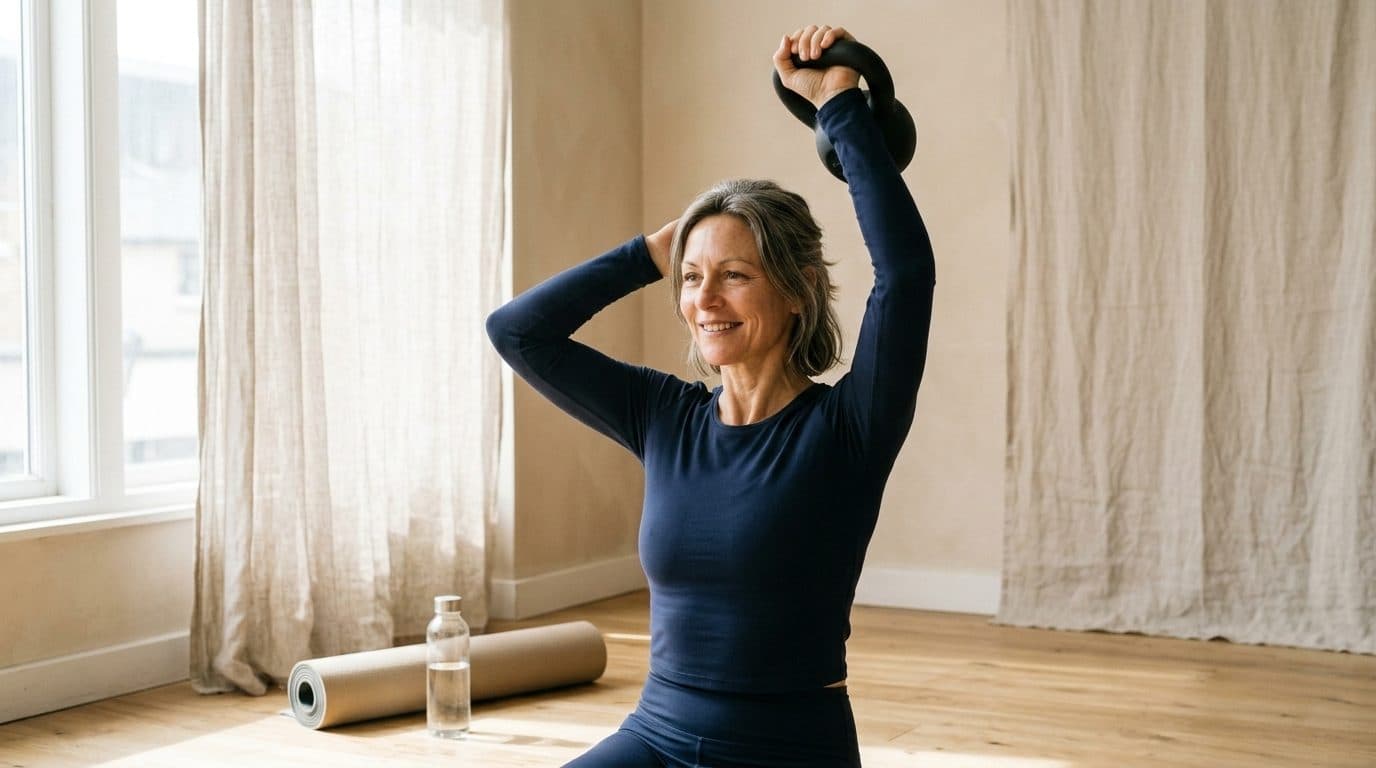
A perimenopause workout works best when it trades constant cardio and pushing harder for shorter, more precise sessions, around 20 minutes, that build strength, balance and deep core control without adding to an already elevated stress load. That means training with more intelligence for the body you have now.
Why a Perimenopause Workout Needs a Different Approach
In your thirties, more effort usually meant a better result. Push harder in a class, run further, add another circuit, and you felt it working. In perimenopause the same effort can leave you flat for days, disrupt your sleep, or simply stop producing the changes it used to. That's the terrain changing underneath the same effort, not a verdict on your fitness.
Cortisol in perimenopause is often already doing more work than it used to, so a session that piles on another layer of physical stress can work against you rather than for you. Your nervous system isn't looking for another challenge to survive, it's looking for a signal it can trust. That's a different job for a workout to do, and it changes what counts as effective.
Training built around a woman's own physiology in perimenopause looks different from a scaled-down version of a programme designed for men, or for the woman you were a decade ago. The underlying mechanisms have shifted, so the method has to shift with them.
The aim is choosing movement that matches what your body is actually responding to right now, which is a more precise task than simply doing less of everything. How your deep core stops firing the way it once did is worth understanding on its own, and it's covered in more depth in why the old approach to core work stops working.
What Changes in Your Body That Affects Training
Strength and power tend to matter more in perimenopause than they did before, simply because both can decline faster than people expect once hormones start shifting. That doesn't mean chasing heavier weights for their own sake. It means training the muscles that keep you stable and able to move well, deliberately and consistently.
Recovery also behaves differently. A session that would have left you ready to go again the next day at thirty might need a full day's rest to settle at forty-five or fifty. A body in perimenopause often just needs that extra day, and a good workout accounts for it.
Balance and joint control often need more direct attention too, because the small stabilising work your body used to do without thinking now benefits from being trained on purpose. Slow, controlled strength work through a full range of movement does more for this than another round of steady cardio.
A well-built perimenopause workout holds all of this together: enough load to build strength and protect stability, with enough rest built in that the body isn't left managing more stress than it can handle. If you want a sense of what that looks like session to session, a full-body strength session built for this stage of life is a useful place to start.
How Much Exercise You Really Need in Perimenopause
Twenty minutes sounds too short to a lot of women, especially ones used to measuring a workout by how depleted it leaves them. But in perimenopause your body responds to precision far more than it responds to volume. A focused session that trains the right things, at the right intensity, beats an hour that leaves you wrung out with little to show for it.
This is why session length is deliberate. Twenty minutes is long enough to build real strength and control, and short enough to fit into a life that's already full, without becoming one more thing you have to find energy for. That matters, because the workout you can actually do consistently is the one that changes anything.
Intensity needs the same rethink. Instead of maximum effort every time, a perimenopause workout keeps intensity contained and intelligent, so you get a genuine training effect without tipping an already-loaded system further. That can feel counterintuitive if you're used to judging a session by how hard it was.
The scoreboard here is different: consistency and control, plus how you feel the next day, matter more than how many calories a session claims to burn. If you're weighing up how a structured programme fits around a real UK working week, what a workable online programme for perimenopause actually involves is worth reading alongside this.
What a Perimenopause Workout Looks Like in Practice
In practice, this often looks like barre-based strength work: slow, controlled movements using a barre as a balance aid, much like the back of a sturdy chair. It has nothing to do with ballet or dance training. You don't need any dance background to do it well.
A typical session moves through standing strength work for the legs and glutes, then controlled core sequences that build stability from the inside, not just the visible muscles, before finishing with mobility work for hips, spine and shoulders. Nothing is rushed, and nothing relies on momentum to get through a movement.
The pace is part of the point. Slow, controlled reps ask more of the muscle than fast ones, and they give you time to actually feel what's working, which matters when you're rebuilding a connection to your body that midlife can quietly erode. Why slow, controlled strength work suits a changing body goes into the reasoning behind that pace in more detail.
It's strength and control work, dressed simply, aimed at a body that needs a different kind of challenge than it used to: no dance steps, no punishing circuit. If you're curious how this fits into a wider method rather than a single class, what the Midlife Movement Method actually covers lays out the fuller picture.
How to Choose a Perimenopause Workout You Can Keep Doing
The best perimenopause workout is the one built specifically for this stage of your life, not a version of what worked in your twenties or thirties with a few tweaks. That means checking what a programme is actually training: is it building strength and stability with recovery built in, or is it just a lower-impact version of the same push-harder model.
Consistency matters more than any single session. Missing a week doesn't erase what you've built, and returning matters far more than a perfect streak. A programme that makes that easy to believe, because it's designed around a realistic week, is worth more than one that demands perfection to work at all.
It also helps to know what you're training for: Strong Enough for 85™, training today as an investment in the body you want to be living in decades from now.
If short, focused, barre-based sessions sound like the shape of workout your body has been asking for, that's exactly what Awaken Barre is built around.
If you want this as movement rather than another article, Awaken Barre is the twenty-minute programme I built for a body that has already changed.
Common questions
Is cardio still useful in perimenopause?
Cardio still has a place, but it stops being the whole answer once you're in perimenopause. Strength and controlled mobility work tend to matter more for this stage, so many women get better results from rebalancing towards those than from adding more cardio.
How often should I do a perimenopause workout?
This depends on the person and the format, but shorter, more frequent, focused sessions generally suit perimenopause better than occasional long, hard ones. Recovery time between sessions matters as much as the sessions themselves.
Do I need any dance or ballet experience for barre-based workouts?
No. Barre is a fitness discipline inspired by ballet, not a ballet class, and the barre itself is simply used as a balance aid. No dance background is needed at any point.
Why do 20-minute sessions work if I used to train for an hour?
In perimenopause, precision tends to matter more than time on the clock. A focused twenty minutes aimed at the right things can do more than a longer session spent on the wrong ones, and it's far easier to keep doing consistently.