Is Barre Good for Menopause? Here's What It Actually Does for a Changing Body
Chrissy Sundt · Mindful Movement ·
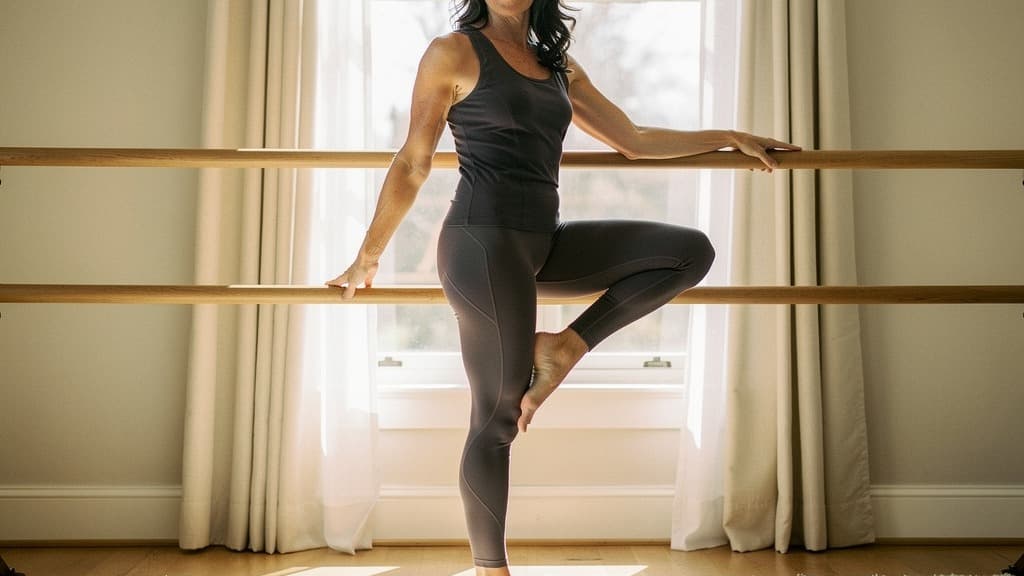
Yes, when it is designed for a changing body. Barre suits perimenopause and menopause because it combines gentle resistance, balance and postural control without high-impact strain, supporting strength and stability while you adapt. No dance background needed. For weekly rhythm, see [how often should I do barre](/blog/how-often-should-i-do-barre); for the earlier phase, [barre for perimenopause](/blog/barre-for-perimenopause).
Is barre actually good for menopause, or is that just marketing?
That's a fair question, and you deserve a straight answer rather than a hard sell. Barre suits perimenopause and menopause because of how it actually works on your body. It's built from small, controlled movements rather than big, jarring ones, which matters when your joints, your energy and your recovery don't behave the way they did a decade ago.
The mechanism is straightforward. Barre combines light resistance, isometric holds and balance work in a way that keeps your muscles and nervous system engaged without asking for the kind of intensity that used to feel like proof you'd done something. Your body in this stage doesn't need force. It needs consistency, and barre is one of the few formats built entirely around that idea.
This sits inside what we call mindful movement, one of the five pillars of the Midlife Movement Method alongside sleep, nourishment, rest and illumination, and connection. Movement is only useful in perimenopause if it works with your nervous system rather than against it, and barre, taught with intelligence rather than just enthusiasm, does exactly that.
I didn't come to this as theory. I've spent over twenty five years teaching barre and Pilates, and I'm navigating perimenopause myself right now, which means the adjustments in Awaken Barre aren't guesses. They're the ones I've actually needed.
Do you need any ballet experience to start?
No, and this is probably the biggest myth keeping women away from something that would actually help them. Barre is a fitness discipline inspired by ballet, not a ballet class. Nobody is checking your turnout, correcting your arms, or expecting you to have ever set foot in a dance studio. If you've never done a plie in your life, you can still do barre well from your very first session.
The barre itself works as a balance aid, exactly like the back of a sturdy chair, which is often literally what you'll use at home. You hold it lightly for stability while you work through small pulses, holds and postural positions. The skill being built is control and awareness, not choreography.
A typical session has no routine to memorise and nothing to get wrong in front of anyone. You move through positions at your own pace, guided cue by cue, with the barre there whenever you need it and ignored whenever you don't. There's no mirror to perform for and no version of the class where you're doing it incorrectly simply because you've never danced.
This is exactly why Awaken Barre is described as beginner friendly rather than beginner tolerant. The instruction assumes zero background, not a rusty one. You're told where to place your feet, how to hold the chair or barre, and what a small pulse should feel like, in plain language rather than dance terminology you'd need a class to already know.
- No dance background required, ever
- The barre is a balance aid, not a performance prop
- No choreography to memorise between sessions
- You set the pace, every single session
What does barre actually do for your body in perimenopause?
Barre works on strength, mobility and balance at the same time, which is a useful combination when your body is adapting to change rather than declining. The small range, high repetition movements build muscular endurance in the legs, glutes and back, while the isometric holds train the kind of postural strength that supports how you stand, sit and move through an ordinary day.
A significant part of the work happens through what we call deep core activation, meaning the deeper stabilising structures around your spine and midsection, not just the visible abdominal muscles. That kind of core strength isn't built by pushing harder. It responds to precise, controlled movement, done consistently, which is exactly the format barre is built around.
Balance work is woven through every session too, in the form of single leg holds, weight shifts and controlled transitions between positions. This builds the kind of steadiness and coordination that becomes more valuable, not less, as the years go on. None of this is about fixing something that's wrong with you. Your body isn't broken, it's recalibrating, and barre gives it a structured, low-impact way to build strength and confidence through that.
What you should expect from this is capability. Barre is movement education, and it doesn't diagnose, treat or resolve any specific condition. What it offers is a steady, achievable way to feel stronger, steadier and more at home in a body that's genuinely different to the one you had ten years ago.
How often do you actually need to do barre to feel a difference?
Less than you'd think, and that's intentional rather than a compromise. Awaken Barre sessions run around 20 minutes, because in this stage of life your body responds to precision, not volume. Twenty focused minutes of controlled, well cued movement does more for you now than an hour of something your nervous system has to fight to keep up with.
Consistency matters more than any single session's intensity. Three shorter sessions a week, done regularly, will do more for your strength, balance and energy than one long session you dread and then avoid. A long, hard session that leaves you wiped out for a couple of days isn't worth it if it means the next one gets skipped.
A simple way to start might look like this, adjusted to whatever your week actually allows.
This isn't about ticking a box every single day. It's about building something you'll still be doing in six months, which is worth far more than a routine that burns bright for three weeks and then quietly disappears. Missed sessions don't erase what you've built. Returning to it is what matters, not an unbroken streak.
- Two to three sessions a week, around 20 minutes each
- The same time of day where possible, so it becomes a habit rather than a decision
- A missed session is just one to pick back up next time
What if you've completely fallen out of exercise?
Then you're exactly who Awaken Barre was designed for, not someone arriving late or behind everyone else. It's a beginner friendly programme built specifically for women who've drifted away from exercise, often because their body changed and the workouts that used to work simply stopped making sense. There's no fitness level you need to arrive with, and no catching up required before you're allowed to start.
Not recognising your own body any more is one of the most common experiences women describe at this stage of life, and it has nothing to do with effort or discipline. Old routines stop working because your body is genuinely different now, not because you did something wrong. It simply means the approach needs to change.
Starting again doesn't mean rebuilding fitness you think you've lost. It means choosing a format gentle enough to begin safely and precise enough to actually build something real. Barre, at 20 minutes and paced for beginners, is designed to be the easiest way back into consistent movement, not the hardest test of whether you deserve to return to it.
You don't need to prove anything before you start, and you don't need to wait until you feel ready, because readiness tends to arrive after you begin, not before. Awaken Barre simply meets you where your body actually is right now.
You may also find online barre classes for women over 50 and restorative movement for midlife women useful alongside this.
Common questions
Do I need to be flexible or already fit to start barre?
No. Flexibility and fitness are things barre builds over time, not requirements to walk in with. Sessions start from wherever your body is today and adjust from there, so no prior training or particular level of mobility is needed before you begin.
Is barre safe if I have joint pain or stiffness?
Barre is low-impact and every position can be adjusted to what feels comfortable for your joints on any given day. You set your own range throughout, so there's never any pressure to push through a position that doesn't feel right, and the chair or barre is always there for extra support when you want it.
What equipment do I need at home?
Just a sturdy chair, a wall, or something similar to hold onto for balance. Awaken Barre is designed to work in an ordinary room, with nothing specialist required to begin.
Is barre only useful for weight loss?
No. Awaken Barre is built around strength, mobility, balance and how capable you feel in your body, not a number on a scale. It's about reclaiming your centre, not shrinking yourself.
Can I do barre if I haven't exercised in years?
Yes, that's exactly who the beginner-friendly design is for. You don't need to rebuild fitness first or catch up to a certain level before starting; the programme meets you where you are right now.
How often should I do barre in menopause?
Two to three short sessions a week is a sensible starting point, with recovery days between. Frequency matters more than marathon workouts; adjust if sleep or joints protest. Full detail is in the how-often guide linked above.