How Much Muscle Loss Is Normal After Menopause?
Chrissy Sundt · Mindful Movement ·
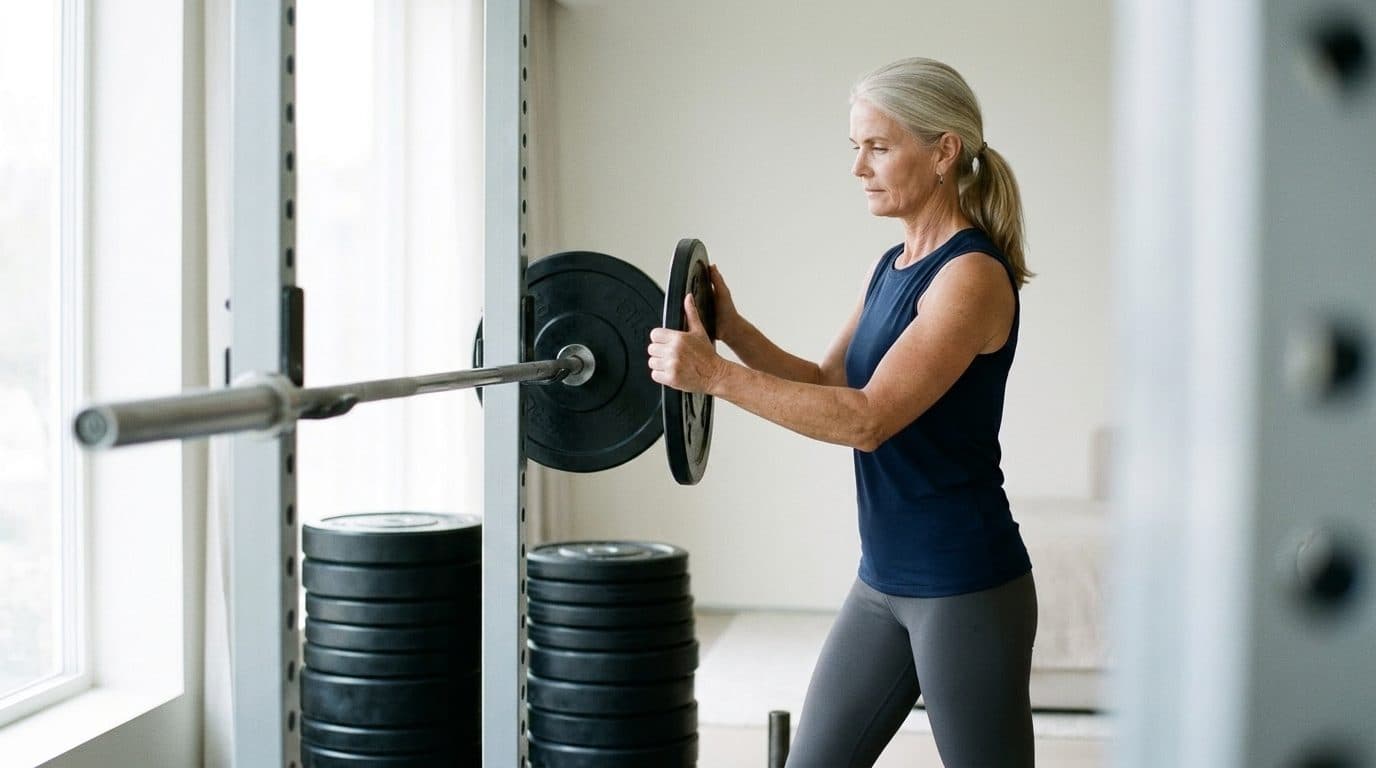
There's no single percentage that applies to every woman: muscle and strength decline at different rates depending on genetics, training history and daily activity. What research consistently shows is that the pace of change speeds up through perimenopause and menopause compared with earlier decades. It's the change in pace that training needs to respond to, more than any single number.
How much muscle loss is normal after menopause?
Ask five women how much muscle they have lost since menopause and you could get five different answers, and more than one of them might be right. The rate of change depends on genetics, how much strength work you did in your twenties and thirties, your general activity level, and factors like sleep and stress that never make it onto a chart.
What research does show, consistently, is a change in pace rather than one fixed figure. Training that worked at thirty can quietly stop working the same way through the menopause transition, because the underlying terrain shifts faster here than it did in the decade before it. That is a shift in pace. It does not mean something in your body has failed.
This is also why strength and muscle tone are not quite the same conversation, something we unpack properly in why strength drops before muscle tone does. You can feel weaker on a jar lid or a stair rail well before a tape measure or a mirror shows anything different, and that felt change is often the more useful signal.
I notice it in my own perimenopause as a shift in how my body responds week to week, not as a single number I could point to. Paying attention to that shift matters more than the arithmetic behind it.
Why does muscle loss speed up around menopause?
Oestrogen is not only a reproductive hormone: it also plays a part in how muscle tissue repairs and rebuilds itself after you train it. As oestrogen fluctuates and then falls through perimenopause and menopause, that repair process does not work quite the way it used to, and recovery can take longer even when the training itself has not changed.
A woman's physiology does not respond to training the way a man's does, and scaled-down versions of male training protocols are a poor fit here. A large part of what gets experienced as muscle loss is actually a mismatch: the training that built muscle in your thirties can quietly stop working, because the body underneath it has changed what it needs from a session.
This is part of why a gentler-looking session can still do serious work, something explored properly in whether barre genuinely builds muscle after forty. Load, control and recovery all matter more here than how hard a session looks from the outside.
None of this means you need to train harder. It means the approach that used to measure success by soreness and exhaustion needs replacing with one that measures it by what you can still do next week.
Is muscle loss after menopause inevitable, or can you influence it?
Muscle responds to signal at every age, including this one. What changes in perimenopause and menopause is how much signal it needs, and how well it recovers from that signal. That is a training problem worth solving, and it is a solvable one.
This is the whole argument behind training with more intelligence rather than simply training harder: matching dose and intensity to the body in front of us now, rather than the one you had a decade ago, something we teach as Intelligent Movement™. The question of heavier lifting versus lighter, more controlled work comes up constantly, and the honest comparison is laid out in heavy versus light weights for menopause.
What the research and what I see in a studio agree on is that consistency beats intensity here. A missed week does not undo months of work, and returning to it matters more than any single session.
So no, you are not powerless over this. You are working with a body that needs a different kind of attention to produce the same result.
What does losing muscle in menopause feel like day to day?
Long before any scan or number changes, most women notice it in ordinary tasks. Stairs that used to pass without thought start asking for a hand on the rail. A case into an overhead locker takes a run-up. Getting up off the floor involves more furniture than it once did.
Balance is often the first thing to shift, and it is easy to put down to clumsiness rather than strength. The small muscles that stabilise an ankle or a hip are easy to ignore until they are the reason you wobble stepping off a kerb, which is one reason balance work earns a proper place in training rather than being treated as an afterthought, covered in why the barre supports balance better than open floor work.
None of these signs are dramatic on their own. That is partly the point: muscle loss in midlife tends to arrive as a series of small, easy-to-dismiss moments rather than one obvious event, which is exactly why it gets left unaddressed for so long.
Paying attention to how a week feels, rather than waiting for proof on paper, is usually the earlier and more useful warning.
- Stairs or kerbs needing a handrail you did not use to need
- A heavier bag or case feeling harder to lift overhead
- Getting up from the floor taking more steps or more furniture
- A wobble stepping off an uneven surface
What is worth doing about it now?
Strength training is the intervention with the most consistent evidence behind it for maintaining muscle through this stage of life, and that does not have to mean hours in a gym. Short, well-loaded sessions done consistently outperform occasional long ones, which is part of why sessions in my own studio run to around twenty minutes rather than sixty.
Barre fits here because it loads muscle through a full range of controlled movement, using the barre itself as a balance aid rather than anything to do with dance experience, and builds the kind of strength that shows up in daily tasks rather than only on a machine. How twenty minutes of barre rebuilds strength through menopause goes into why that dose works the way it does.
The aim here is strength enough to do what you want to do at eighty, which is the entire premise behind training to be Strong Enough for 85™. That matters more than how your body looks this month.
If you want a structured way to start that does not depend on guesswork, Awaken Barre is built around exactly this kind of loaded, controlled movement, at a pace a changing body can keep up with.
If you want this as movement rather than another article, Awaken Barre is the twenty-minute programme I built for a body that has already changed.
Common questions
Does menopause cause muscle loss on its own?
Hormonal change plays a part, but it is one factor among several, alongside activity levels, sleep and how much strength work you have kept up over the years. It is rarely one single cause.
Can strength training rebuild muscle lost in menopause?
Strength training can build and maintain muscle at this stage of life, the same way it can at any age, when the load and recovery are matched to your current body. It is a forward-looking investment rather than a reset to an earlier version of you.
Is it too late to start strength training during or after menopause?
No. Muscle continues to respond to training signal regardless of when you start. Consistency from here matters far more than how early you began.
How is barre different from general strength training for this?
Barre loads muscle through slow, controlled range of movement and uses the barre as a balance aid, not as a prop for dance steps. It builds strength and stability together, which is useful for the everyday tasks muscle loss tends to affect first.